Michael Dell, the founder and CEO of Dell Technologies, made everyone’s GivingTuesday donations look like chump change after he and his wife committed $6.25 billion to seed so-called “Trump accounts” for American children. The remarkable contribution will put $250 into the accounts of 25 million older kids who don’t qualify for the $1,000 investment accounts created as part of the OBBB Act. And while good deeds are of course their own reward, Dell’s stock also benefited after the president praised the couple.
Stocks reversed yesterday’s slump, with all major US indexes rising. Megacap tech propelled stocks higher, with shares of every Magnificent 7 member rising, except for Tesla. A rebound in bitcoin rippled across other speculative assets as the market’s mood shifted back to a risk-on sentiment. |
|
|
Yesterday in Las Vegas, at its annual re:Invent developer conference, Amazon AWS made a bunch of product announcements that reveal its plan to continue capitalizing on the AI boom. Things right now are great for Amazon — AWS is enjoying a substantial lead in the cloud computing market, serving up AI infrastructure in the cloud to customers large and small using the models of their choice.
But lest the market settle into the narrative that it’s just the Nvidia-OpenAI alliance of companies versus Broadcom-Alphabet, the hyperscaler revealed a few new announcements designed to remind investors that it’s often the glue holding everything together regardless of who wins. |
-
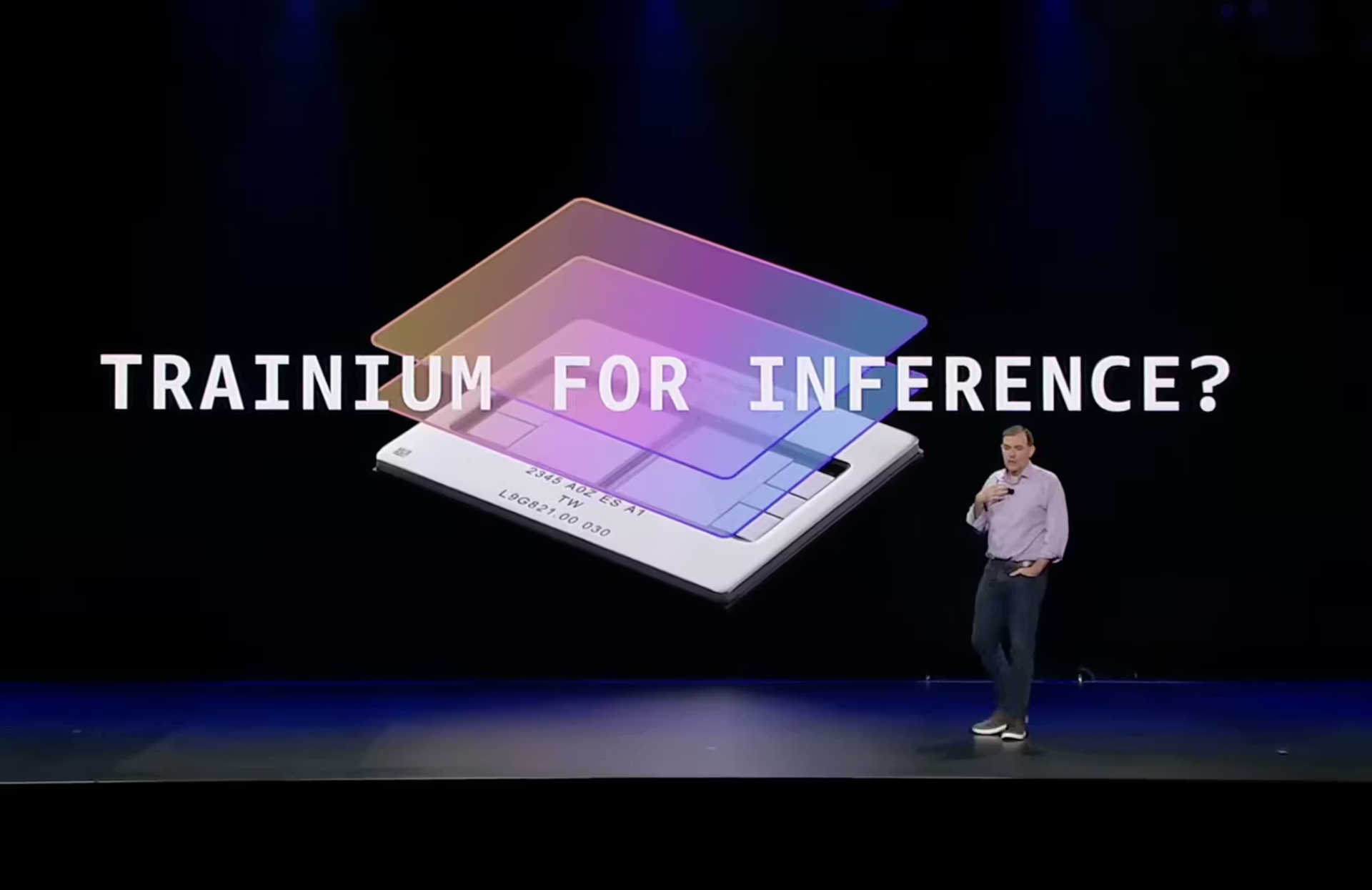
Probably the most consequential announcement was about the company’s new Trainium3 custom AI chip. Amazon said these chips can cut costs associated with training and using AI models by up to 50% compared to GPU-based systems.
- Three years out from ChatGPT’s disruptive debut, AI companies are diversifying their computing resources away from GPU juggernaut Nvidia and starting to sample the price and performance benefits of alternative custom chips, such as Trainium.
-
Amazon also announced updates to its own frontier AI model family called Nova, including Nova Lite (fast and cheap for everyday tasks), Nova Pro (for complex reasoning workloads), Nova Sonic (a new speech-to-speech model), and Nova Omni (an “all-in-one model for multimodal reasoning and image generation”).
|
The new models may help the company offer cheaper, more efficient AI computing for its customers versus running competing frontier models on popular Nvidia GPUs. Nvidia pared gains on the news but eventually powered through and finished up on the day. |
|
|
The potential for increased competition, particularly from Google (which is reportedly in talks to sell its custom TPUs — codesigned with Broadcom — to Meta), has been a drag on Nvidia shares as of late, as this has the potential to weigh on its market share and profitability. Even as traders fret over competition, however, it’s clear that leading tech companies are building for a future where Nvidia is still the dominant player. They’re customers, teammates, and competitors with the $4 trillion chip designer all at once.
Some examples from yesterday’s event: Amazon Web Services CEO Matt Garman asserted that “AWS is by far the best place to run Nvidia GPUs,” making the case for why potential customers should utilize its cloud offerings.
The company also said that the next edition of this custom chip (Trainium4) “will support Nvidia NVLink Fusion high-speed chip interconnect technology.” In other words, Amazon is preparing for a world in which its upcoming chips will be used in tandem with Nvidia’s offerings. |
|
|
An economy empowered by indexes |
Nasdaq’s newest campaign “Blueprint of Tomorrow” spotlights the transformative impact of Nasdaq indexes. It explores economic megatrends and showcases how Nasdaq Global Indexes and its global partners are turning bold ideas into investable products that fuel innovation and expand investor access to the engines of global growth.
|
|
|
With end-of-year outlooks largely in, we figured it was worth taking stock of the prognostications from some of Wall Street’s more high-profile equity strategy shops.
True to form, these professional market watchers are bullish, as seen in our chart mapping each firm’s predictions for how the S&P 500 will rise next year. More interesting are the rationales for their projections, which largely center on two key issues facing investors and traders: the paths forward for the AI investment boom and the Federal Reserve.
|
- Deutsche Bank equity strategists see the largest jump, thanks to a combination of robust earnings growth in 2026 and price-to-earnings multiples that they expect to stay near some of the most elevated levels we’ve seen since the dot-com boom of the late 1990s.
-
Morgan Stanley analysts are only slightly less optimistic, writing that another factor that may keep valuations elevated will come from easier monetary policy than is currently baked into the market prices. (For more on how the Fed and interest rates affect valuations, read this.)
-
RBC and JPMorgan’s predictions likewise hinge on the US central bank.
- Goldman Sachs’ analysts say high price-to-earnings multiples might actually now be the new normal, and have an explanation for that trend.
-
HSBC analysts think another year of high-flying gains could be in the cards, partly driven by continued big spending from hyperscalers, which Barclays’ analysts concur with, saying the “AI story keeps rolling.”
|
Last to drop their outlook and the least bullish of the bunch, Bank of America analysts still see the S&P rising but warn that “investors should get ready for an air pocket.” |
|
|
It’s not shocking that most of these professional market watchers are bullish, considering the institutional biases of those employed by the securities industry — and the fact that the stock market usually does rise each year. Even the most moderate of the bunch, BofA, still predicts a 4% gain next year, while almost everyone else is penciling in double-digit gains.
|
|
|
The man best known for predicting the collapse of Enron doesn’t see a similar fate for the world’s largest corporate bitcoin holder, but he has some fundamental issues with Strategy. And while one critic says we’re seeing “the beginning of the end” for the company, Chanos is “not that bearish.” |
|
|
|