|
Hello, fellow wayfarers … My annual list of my favorite books of the year … Why N. T. Wright thinks the Book of Ephesians is key to understanding your life and the world … A pastor’s Desert Island Playlist … This is this week’s Moore to the Point. |
My 10 Favorite Books of 2025 |
|
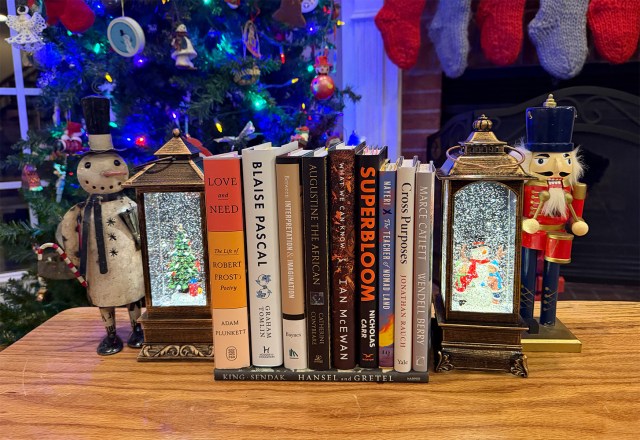
As soon as I hear the sound system play Mariah Carey’s "All I Want for Christmas Is You," I know it’s time to start compiling my list of my favorite books of the year. That happens, as you know, the day after Halloween. Below are books that resonated with me in some way or another in this crazy year. Here they are in alphabetical order by author. |
|
"Even as a child who knew almost nothing about the Bible, I recognized the major biblical references right away, and as I studied Scripture and reread the Chronicles [of Narnia], I delighted in finding richer meaning in the books every time I picked them up," the author of this book writes. "Like Edmund’s sister Lucy in Prince Caspian, I saw Aslan get bigger every time I returned to Narnia." |
|
Leslie Baynes, a former scholar in residence at The Kilns in Oxford, England, explores how C. S. Lewis interacted with current biblical scholarship and how he related his biblical depiction to his literary imagination. Even at points where I differed with the author, this was an invigorating read. That’s particularly true of the last half, where she explores how the Bible—especially the Gospel of John—shows up in the Chronicles of Narnia. She notes that biblical references become more explicit when Aslan is present. |
|
Since I’ve written a full-length review essay of this book for Christianity Today—and since regular readers know how much Berry has shaped my imagination and thought—I will not replow that field. This is a beautiful book, a fitting endpoint, if it is, for the Port William community. The book ends with these words: |
|
As he has come to know, Andy’s grief for the things that are lost affirms his love for them, as even the loss of them affirms the bounty by which they once existed, for in this world grief goes hand in hand with gratitude. |
|
"Better than any argument is to rise at dawn / and pick dew-wet red berries in a cup," Berry once wrote. This book is like that cup—sweet, with just the right amount of bitter mixed in, which makes the sweetness even better. This book is not an argument. It’s a standing ground—and a good one. |
|
Nicholas Carr warned us, years before it was an everyday topic of conversation, what digital life would do to our attention spans. This book looks at what social media technologies in particular have done to us, why, and what we can do about it. This is not abstract tech sociology. There are some clearly identified villains: The tech bros about whom Carr writes care more for statistics than people. |
|
Carr identifies why social media led us to this crisis of rage, resentment, and unseriousness. Social media technologies function based on the fact that human beings need to be seen and acknowledged. We can do that quietly in person, but on social media, we must be loud. Plus, he shows, our familiarity with one another leads not to more connection but to less. Envy and anger, he notes, are fueled by proximity. The "technologies of connection" give us these dark aspects of nearness without communion. |
|
The book explains why most people look at their own images repeatedly when on a Zoom call, and it’s not, as I would have thought, narcissism. It’s that human beings are constantly alert to how others view us. The person looking at that image is wondering how he or she appears before the judgment seat of everybody else. In an always-online world, that has implications. |
|
And once again, Carr warns about what’s coming next, or rather, what’s already here but mostly unnoticed: the attempt to replace reality itself with an algorithm-created world that lets a person think he or she created it. That much of the church is not even thinking about this is itself a crisis—and one for which we’ll pay for generations. |
|
Maybe salvation, if that’s not too strong a word, lies in personal, willful acts of excommunication—the taking up of positions, first as individuals and then, perhaps, together, not outside of society but at society’s margin, not beyond the reach of the informational flow but beyond the reach of its liquefying force. … If you don’t live by your own code, you’ll live by another’s. |
|
You can listen to Carr and me talk about these topics—and many more—here. |
|
Catherine Conybeare, Augustine the African (Norton) |
|
Augustine is kind of like John F. Kennedy in one way (and one way only): People love to write about his life, even as we might ask ourselves, "What else is there to say?" I’ve read almost all these books about Augustine and usually conclude that it’s impossible to improve on Peter Brown’s epic biography, Augustine of Hippo. But this book is different. |
|
Conybeare, a respected classicist, concentrates on one aspect of Augustine that is usually left out of any consideration of his life or work: He was African. She then shows why this matters. It’s not a matter of 21st-century identity politics but a matter of understanding the world that shaped one who would shape the centuries to come. She traces the uniquely African context of languages, of relationship to Rome, of the particular crises and fragmentations of the church. |
|
She does all this without turning Augustine into a mere receptacle of the political or cultural or theological forces around him. There is only one Augustine, and she reminds readers of this in the quotations she chooses from him. Here’s one, about his education: "People were more displeased if one pronounced ‘human’ without the ‘h’ than if one felt hatred for a human being." |
|
Stephen King and Maurice Sendak, Hansel and Gretel (HarperCollins) |
|
This is, I’m quite sure, the only Stephen King story you will ever read that ends with these words: "They lived happily ever after." King was asked to reimagine the Brothers Grimm story, using artwork done long ago by the now-deceased author and illustrator of Where the Wild Things Are. The result is a beautifully illustrated book that keeps intact the horror of a story about really horrible things: abandonment, lostness, poverty, predatory adults. |
|
But as Sendak knew, the way to overcome the "wild things" is not to pretend they’re not there; it’s to stare them straight in the eyes until they make you their king. |
|
In introducing the book, King writes, "Reader, I hope you will enjoy this poor effort at breathing a bit of life into an old story, and I know you will enjoy Maurice Sendak’s art, which is sunny on top and dark inside. Or vice versa." |
|
When I started reading this novel, I thought I knew what it was. McEwan writes a kind of science fiction—a couple of researchers working a hundred years from now, after nuclear wars and artificial intelligence and climate disaster have wiped away civilization almost to the nub, with the possible exception of the one remaining superpower, Nigeria. Two researchers in that future archipelago, which is what remains of the United Kingdom, are looking for a long-lost document rumored to be the pinnacle of 21st-century genius—"A Corona for Vivien," written by a poet for his wife on her 54th birthday. |
|
The story flashes back and forth between our recent past (2014) and 22nd-century Oxford. The narrative turns out to be a hand guiding the reader into a haunted house; all the while, the reader barely notices how the lights are dimming. At one point, the book seemed to have shifted from a sophisticated literary take on Blade Runner into the world of insufferably condescending and morally repulsive characters from a John Updike novel (Rabbit Runner?). And then I found that this too was misdirection. |
|
I hardly know how to describe the story line without spoiling it for those of you who will want to read it, except to say the book is ultimately about time, memory, guilt, shame, and the question of whether there is something more than the judgment of history. The characters seem to seek all kinds of things—pleasure, fame, stability, a missing poem—but they are really looking for atonement, to resurrect the title of a previous McEwan book. |
|
A couple years ago, something sad came untrue. I missed out on one of the most enjoyable books I’d read in a decade from this list. Beth Moore recommended that I read Daniel Nayeri’s Everything Sad Is Untrue, saying, "You’re just going to have to trust [me]; this book is amazing." She kept on me, asking, "Have you read it yet?" until I did. I realized very quickly that she was right. But I read it the year after its publishing date, so I didn’t get to include it here. I wasn’t going to make that mistake again. |
|
The Teacher of Nomad Land tells the story of an orphaned brother and sister in Iran during the Second World War. I suppose you could say it’s kind of Hansel and Gretel, except with Nazis instead of witches. The boy, Babak, aspires to teach nomadic children to read and to watch out for his little sister, Sana. They encounter a Jewish boy on the run from a German who seeks to kill him. I don’t think I’m spoiling this fast-paced story by telling you the last words of it: "Babak is a teacher, and a teacher is one who gives. Sana is a kid sister. Everybody has good work to do." |
|
This time I was the one texting Beth: "You have got to read this. It’s amazing." Think of this newsletter as a text from a friend saying the same thing: Read this. It’s amazing. |
|
Robert Frost might not be at the very top of a list of "Writers I Like but Would Not Want to Live Next Door To," but he’s definitely on the first page or two. I’ve always found Frost brilliant but thought of him as a "You kids get off my lawn on a snowy evening" kind of grouch. This book surprised me by making me see a more human, more complicated, and more likable Frost. While changing the reader’s perspective of the poet himself, this book takes the reader into a deeper look at the work that came out of his complex psychology. |
|
There’s a reason many people misremember the name of one of the most famous American poems as "The Road Less Traveled," and this book tells us why. But Frost did not write the "The Road Not Taken" as a "You can do it" sign in a human resources department or a "Be yourself" lyric for a Disney film. The actual elegiac force of the poem is wrapped up with the life and work this book describes and analyzes. |
|
Plunkett shows us the changes in Frost’s political views, his conflicted relationship with Christianity and the Bible, his insight into the meaning of metaphor, and his lifelong attempts to balance loyalty and ideals, justice and mercy (he preferred justice and called himself an "Old Testament Christian"). Plunkett quotes Frost in a letter: "Everyone is marked by his own craziness that he does not give way to." The rest of the book shows us how that worked itself out in one life—and the art that called out from it. |
|
I try not to include books by friends on this list, but as you can see from some past years’ lists, sometimes that’s asking too much. This is one of those exceptions. In 2003—long before I knew him—Jon wrote an essay in The Atlantic celebrating the decline of religion and the coming Scandinavian-ish secular paradise. As I mentioned in our podcast conversation on the book, I recently found a piece of mine blasting him for it. Now we seem to be in a whole new world from that innocent time—and Jon says he’s changed his mind. |
|
As you’ll see, he hasn’t changed his mind as much as I (and his many other Christian friends) would like. He’s still an atheist. But as this book lays out, he now recognizes that a healthy American democracy needs Christianity to be, well, Christian. |
|
Rauch diagnoses with precision what he calls "sharp Christianity"—the fear-based, siege-driven posture that defines identity by enemies and politics by apocalypse. "Be not afraid" became "be very afraid," he told me, and the pews started catechizing the pulpits. |
|
He makes the case for what he calls "thick Christianity," a faith that asks much, forms deeply, and binds people together in the slow ways of affection and belonging. That’s quite different from the post-Christian secularism some progressives wanted. It’s also quite different from those on the purportedly Christian right who think the New Jerusalem is replicating Hungary on I-65 in Tennessee. |
|
The book is a plea from a sympathetic outsider to those of us who are Christians, asking no more from us than that we be ourselves. |
|
You can listen to the conversation we had about the book here. |
| | |