|
|
|
|
Good morning. Canada is rebuilding its defence industrial base and, according to Prime Minister Mark Carney, it’s the kickstart our economy is looking for. Today, I’ll break down some of the ways we can be smart about spending on defence to continue to reap economic gains for decades to come. That’s in focus today, along with a new caffeine high. |
|
|
|
|
|
|
|
|
|
|
|
|
|
|
|
|
Trade: The United States should scrap all national-security-based tariffs on imports from Canada and Mexico – including on aluminum, steel, cars and lumber – and move quickly to renew the three-country trade agreement, the largest U.S. business group testified yesterday |
|
|
|
|
Mining: According to court filings, Barrick’s chair considered splitting the company in 2018 but doubled down on its Africa jurisdiction instead |
|
|
|
|
Telecom: A top Telus executive says the decision to pause its dividend growth was due to “extreme circumstances,” as the share price tumbled, sending its yield up in recent weeks |
|
|
|
|
|
|
|
|
|
|
|
|
|
|
|
A man films South Korean Air Force FA-50 fighter jets during Seoul International Aerospace and Defense Exhibition in Seongnam this fall. Kim Hong-Ji/Reuters
|
|
|
|
|
|
|
|
|
|
|
Strategize, spend, self-sustain |
|
|
|
|
I’m Pippa Norman, The Globe’s and Mail’s innovation reporter. Lately, however, my coverage has become dominated by the business of defence. And I’m far from the only one keeping an eye on the burgeoning industry. |
|
|
|
|
Our federal Finance Minister, François-Philippe Champagne, seems to have a new favourite catchphrase: “Every company should have a defence strategy.” |
|
|
|
|
|
|
|
|
Last month, on a day spent chasing him around downtown Toronto from a conference for Canada’s fastest growing companies to a lunch hosted by the Canadian Club, I heard him say the phrase at least three times to various groups of people. |
|
|
|
|
It seems to be part of a concerted effort by Carney’s government to sell its $84-billion defence-spending boost over the next five years as an opportunity for significant economic growth. As Eugene Lang and Brigid Waddingham write in a recent column for The Globe, this framing is necessary if Mr. Carney hopes to erode “conventional Canadian defence skepticism.” |
|
|
|
|
But while his messaging might leave a company scratching its head about how its skin-care line, for example, could possibly have a defence application, Champagne is not wrong about what’s at stake. Canada’s manufacturing sector is struggling under the weight of U.S. President Donald Trump’s tariffs. |
|
|
|
|
|
|
|
|
|
National Defence Minister David McGuinty, left to right, South Korea Prime Minister Kim Min-seok, Prime Minister Mark Carney and Hanwha Group vice-chariman Kim Dong Kwan after touring a submarine at the Hanwha Ocean Shipyard in Geoje Island, South Korea on. Oct. 30. Adrian Wyld/The Canadian Press
|
|
|
|
|
Depending on what the government decides it wants to prioritize in the remaking of its defence industrial base, this could have huge implications for lumber producers and steelmakers looking to sell more at home. |
|
|
|
|
So, after many hours spent poring over the defence budgets of some of our allies and dissecting them with experts, here are a few of the key takeaways I’ve gleaned about how Canada could kickstart its economy with defence: |
|
|
|
|
- Look forward: Prioritize research, development and innovation. The world of warfare is changing, quickly. Canada’s defence industrial base needs to be making something that the Canadian Armed Forces, and our allies, will actually want to buy.
- Know our strengths:
We’re good at some stuff already. We should lean into that. Shipbuilding and quantum technologies stand out as two sectors in which Canada has already shown clear strength. It doesn’t make sense for us to disregard that and build submarines instead.
- Think bigger:
Use defence spending to generate benefits for civilians,
too. The United States’ development of GPS and the internet through its Defense Advanced Research Projects Agency are famous examples of how this type of spending can push technological frontiers, creating a lasting impact.
- Spend wisely: Spending on capital assets, such as infrastructure and equipment, provides more long-term economic returns in the form of jobs and other benefits than dollars spent on operations or services. According to a Canadian Global Affairs Institute analysis, those jobs are likely to be STEM-focused and will help the government grow the middle class.
|
|
|
|
|
The time is ripe for Canada to rebuild its defence industrial base, with geopolitical tensions on the rise. But first, as David Perry, president of CGAI, told me, the federal government needs to make it clear to industry what it’s prioritizing building at home and what it expects from those building it. |
|
|
|
|
In my deep dive into what Canada’s modern defence economy could look like, which is the cover story for the business section this weekend, I take a closer look at Poland and South Korea as two compelling – yet very different – examples. |
|
|
|
|
Each country’s approach has its merits and downfalls. But they share at least one commonality: They’re both years ahead of Canada in building a defence industrial base, offering valuable lessons to their North American ally. I hope you’ll take the time to give it a read. |
|
|
|
|
|
|
|
|
|
|
|
|
|
|
|
|
|
|
|
|
|
|
|
|
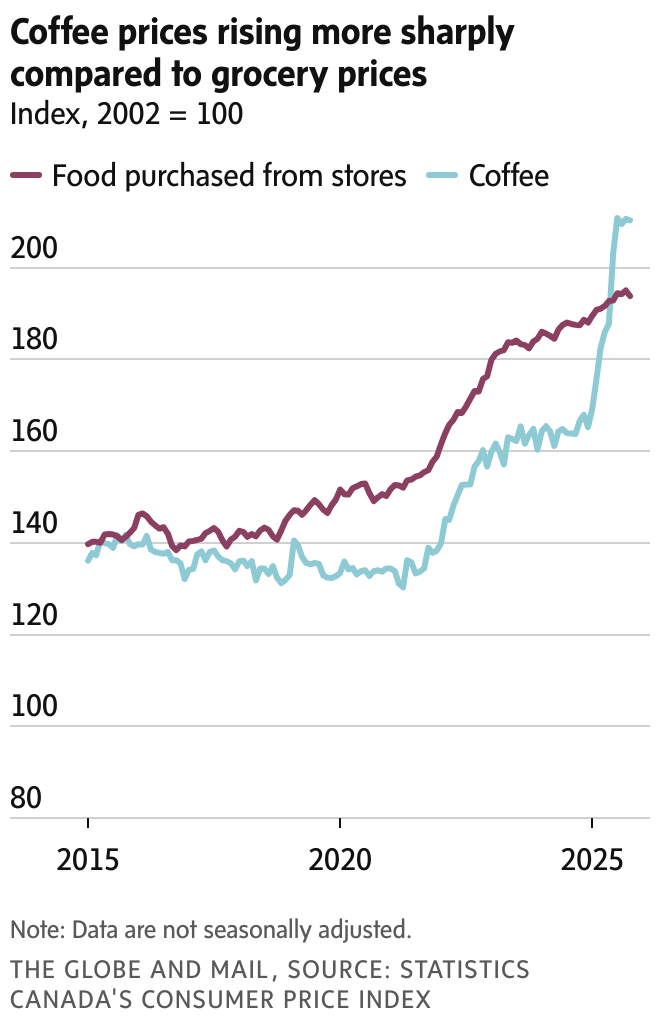
We’ve written about rising cost of coffee before, but dear reader, we have more bad news. As of October, coffee prices have jumped by 26.3 per cent
over the previous year, outpacing the 3.4-per-cent rise for overall groceries, according to Statistics Canada. Prices have soared by 59 per cent over the past six years, making coffee a major source of financial strain in the checkout aisle. The reason? Climate change and U.S. tariffs. |
|
|
|
|