|
Advent is the season for Christians where we await the birth of Christ. Christians believe that Christ is the Savior. We sense we are not at home in this world. There must be something else. We feel anxiety, depression, and death. We want things. After we get them we find they do not bring us happiness. Our earthly existence and journey through time is summed up in one medieval prayer as a “vale of tears.” St. Augustine recognized that restlessness will never find peace until we rest in God. Sadly, people today are so immersed in bourgeois creature comforts that condition us to a life of ease. Many never awake to the realization that there is something to be saved from. Advent is an expectation and a yearning. T.S. Eliot wrote a poem about the journey of learned men seeking the meaning of human life, dissatisfied with the world and longing for God — “The Journey of the Magi.” All through history, the myths and faiths of people of various cultures have recognized the need of a divine being to save us from ourselves and our seemingly pointless lives. All civilizations have sought this intersection of the timeless with time.
These wise men journeyed in the very dead of winter. “The way was deep, the weather sharp.” All along the way they were tempted by “a voice singing in their ears that this was all folly.”
But the wise men persisted and found an answer to their search. They found a baby not sitting in splendor on a throne amidst noise and power like Caesar but in a cold shelter on a still night they witnessed a child radiating the otherworldly peace and tranquility they sought.
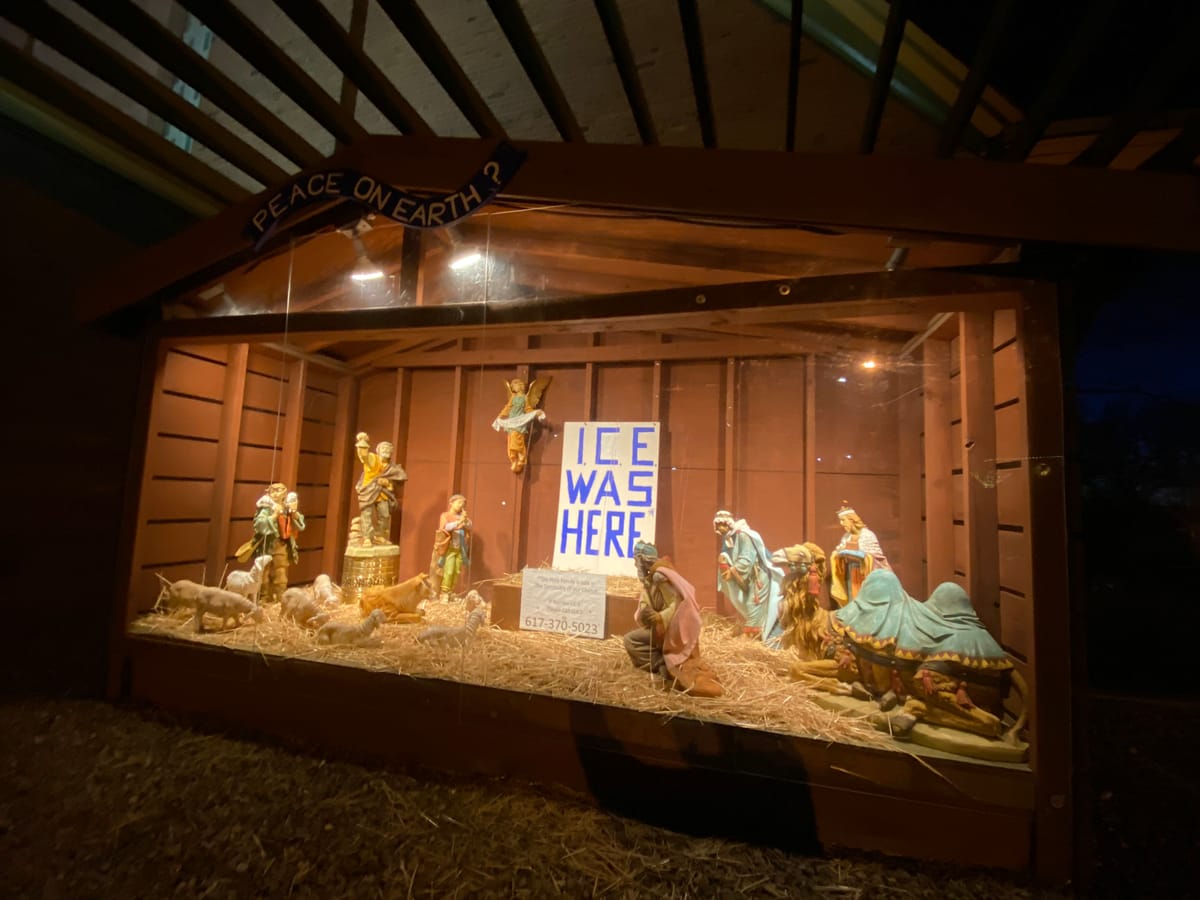
During Advent, Christians set up a creche and manger in commemoration of the Magi and Christmas journey. We remember Mary and St Joseph and their suffering. It's curious that a manger which was used to feed cows now becomes, with Christ's body, the new food for mankind. To celebrate Advent is to bring to life within ourselves the hidden presence of God as we turn our minds from the visible to the invisible, from the world to the eternal. How sad it is, then, that someone would try to use the birth of our Lord in a manger for purposes of political propaganda as the pastor of St. Susanna Church in Dedham did. He turned the manger into a political prop to protest against President Donald Trump, who is doing his job protecting American citizens from immigrants who enter our country illegally and are responsible for many crimes. One hesitates to call this priest “Father,” as Stephen Josoma seems more interested in climate change and gun control and in seeking the praise of the world rather than in the salvation of souls. The priest seems less interested in the Roman Catholic Church and more interested in the church of the New World Order.
Flannery O'Connor had a wonderful name for this church of man, tied up in the modern world's belief system. In her 1952 novel Wise Blood she called it “The Holy Church of Christ Without Christ,” where “the lame don't walk, the blind don't see and the dead stay that way.”
In thinking about this sacrilege against the Nativity of Our Lord, I sadly mused that in our so-called progressive age it is improbable that Jesus would have been permitted to be born at all. Mary's pregnancy, in poor circumstances, and with the father unknown, would have been an obvious case for an abortion. Her talk of having conceived as a result of the intervention of the Holy Ghost would have pointed to the need for psychiatric treatment, and would have made the case for terminating her pregnancy even stronger.
Thus our generation, needing a Savior more, perhaps, than any that has ever existed, would be too humane to allow one to be born.
But Christ was born, and our journey through time continues, with hope.
Patrick J. Walsh was a member of the 2016 Trump campaign’s National Catholic Advisory Group. He lives in Quincy.
|