|
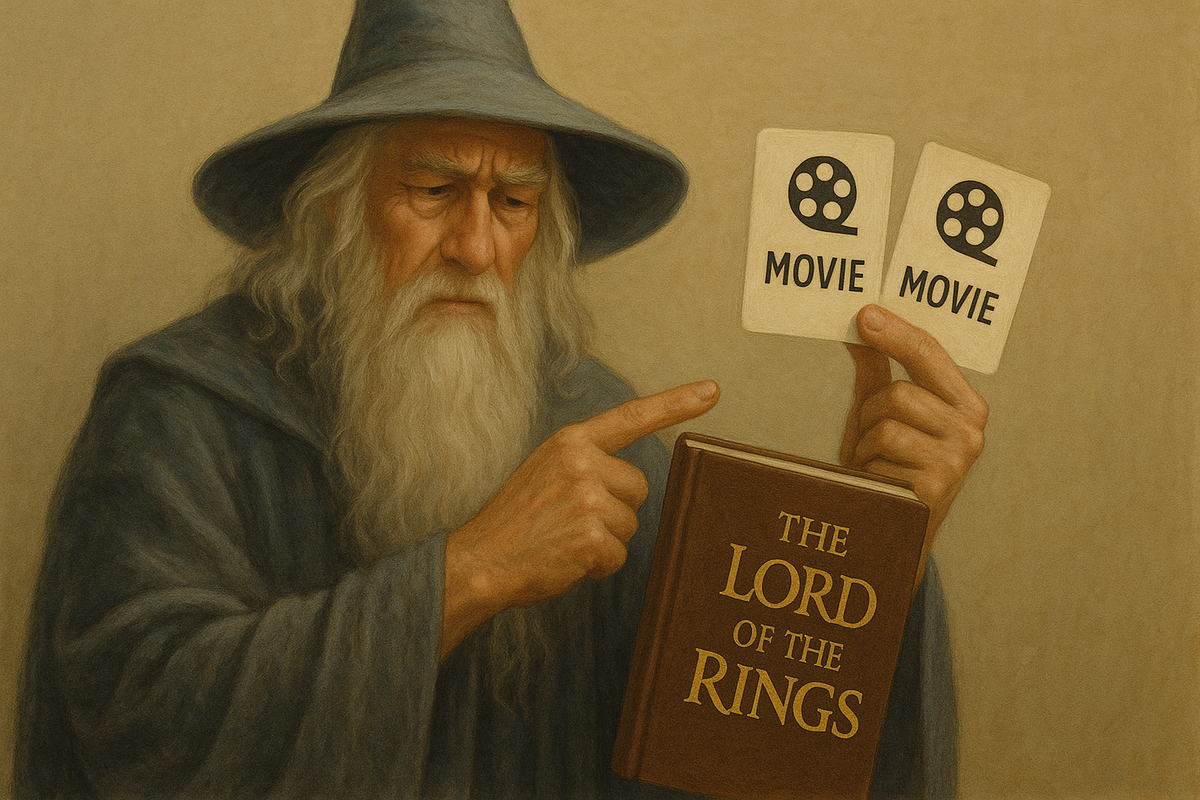
Last year I watched all three of the Lord of the Rings movies … and enjoyed them. I admit I needed a little orienting and plot-reminding assistance from my instigating teen-ager, a true LOTR fan who invited me into this alternate world. It’s 13 hours of viewing, after all; a person can get confused! But ultimately I got the scope of Tolkien’s work — his worlds, creatures, characters, scenes — and came away genuinely admiring the impressive rendering as it unfolded on film. Movies are great, because stories are great. After all, we humans are people of story, by definition. We’re story-making and story-loving creatures. Stories help us make sense of the world and our own place in it. Through them we see how events unfold, learn cause and effect, see beauty and goodness (and their opposites), and consider how virtue and vice play out in people’s lives. Think of the classic “hero’s journey,” when we follow a character who experiences the world, eventually assimilates good, and changes for the better. Or think of the opposite, a tragedy — which happens when people don’t choose the good and experience bad outcomes. Stories that accurately reflect the world help us interact with the basic goods of knowledge of truth, beauty, play, friendship — and they enlarge us. Engaging with them helps us flourish: we learn and delight. Our intellects and emotions are fed, both. Consider a toddler’s enthusiasm when you say, “Let me tell you a story,” or sit down to read him a picture book. Compare this with saying, “Let me explain something to you.” We relish story; we tolerate didactic instruction. Adults are the same as toddlers in this. Because stories are powerful, it’s fruitful to pursue and immerse ourselves in good and beautiful stories. So the Lord of the Rings story is wonderful, and the movies, a cinematographic representation, are also great … but how does the movie compare to the trilogy of books? The books, after all, are where the story was originally told. This question I cannot answer because – I admit it – I have not read the books (much to my teen-ager’s chagrin). Perhaps you can relate. In our time, after all, watching movies is vastly more common than reading books. Reading for pleasure is declining — it has dropped 40 percent in the past 20 years (and much more for men than women); on the other hand, consuming visual media of all kinds is increasing. Studies vary, but the numbers suggest that 80 percent of people watch movies or TV for fun, while less than 50 percent read regularly for fun (less than 25 percent for men). The question is: Does it matter? If you’re taking in a story in movie form or in book form, is it a matter of personal preference — six of one and half dozen of the other? It does matter, and it’s not just personal preference. Not at all. Reading great books does something that isn’t replaceable. It’s well described by Steven Rinella here: Books invite us to feel unfamiliar feelings and think alien thoughts. They train us in empathy and make us feel less lonely. They help us to discover what we believe, what we value, and what we never imagined. Great works of literature are entertaining, but they are not mere entertainment. A great book induces self-examination and spiritual expansion.
I can’t say it better. Central aspects of being human are amplified and augmented in reading books. In addition, reasons found in natural law provide us with more. Here are three points that help unpack why reading stories in book form is almost always better than watching stories in movie. - Book-reading is active, which yields more; and movie-watching is passive, which yields little.
The more active we are in pursuing the goods, the more we will thrive; passivity does not lead to flourishing. You have to engage and exert effort when reading a book, and that effort gains you the goods in ways you otherwise can’t. As I’ve written elsewhere, “The goods don’t rush up to us like an enthusiastic little dog and jump into our lap. That’s not how it works. They have to be sought after.” - Book-reading gives our imagination more of a workout than movie-watching does.
Using our imagination increases our wonder, creativity, initiative, and even memory. This is a concrete benefit that comes from the activity-versus-passivity point above. When you watch a movie, you consume content that was prepared by someone else; the makers rendered the concepts for you. It’s prepackaged, so you can’t create the landscape or characters or scenes in your own mind’s eye. Especially in characterizations do movies give us little in comparison to books; they leave us with a dearth of material with which to consider how and why a person thinks, reacts, makes decisions. It’s all conflated and simplified. - The time it takes to read a book allows the story, imagery, meaning, and beauty to sink into your person and psyche.
It necessarily elicits reflection and pondering, because without reflection and pondering you can’t receive anything from the book. The reflection and the pondering are the reading. When watching a movie, on the other hand, the story runs at a prescribed speed going by quickly, and the speed works against deep thinking and internal processing. We are becoming a people who, as professors are now attesting, struggle to hold plotlines and key details precisely because we aren’t habituated to reading long-form, and this works against our critical thinking skills and overall flourishing. Ah, you might say. But when you watch a movie with other people, you can talk about the story and imagery and rendering together; it is a corporate experience focused on meaning and allows connection and bonding over the shared experience. And that’s true. In such experiences, the goods of knowledge and beauty and friendship can all come together at once; it’s a fine example of experiencing a common good. It is indeed positive and valuable. This is why watching a movie with others is almost always better than watching it alone. But is it more valuable than reading a book together, through a family or friend read-aloud? After all, reading aloud together was a common way of experiencing story before television and movies emerged. Families also listened to stories narrated via audio during the golden age of radio, from the 1920s to 1940s. Listening to stores together drew out the amount of time people could experience the shared value of engaging stories, and it fostered healthy community at the same time. As people listened it enhanced their attention span and attention to detail; they could mull the elements longer and discuss the story with others in greater depth. This point may be moot for most; movies reign today and movie-watching is here to stay. Few people, whatever their convictions, will be replacing corporate movie-watching with community readalouds (although it would be great if we did). But whether we rekindle readlouds in our homes or not, may we be encouraged to return to reading great books. May we remind ourselves of the truth that its value cannot be replaced by watching a movie, even of the same story — and even a really well-done rendering of that story. Faced with a choice between reading the book or watching the film, don’t follow my example with The Lord of the Rings. Read the book! (P.S.: I spoke at length on the power of reading great books in a podcast, here, if you’re interested in hearing more.) Susan Arico is a New Hampshire-based consultant and writer with focus in digital wellness and the intersection of faith and culture. You can follow her on her Substack, For the Sake of the Good, and at her web site, www.susanbarico.com.
|