Enjoy this limited-time preview of our new subscriber-only newsletter. For full access, plus ad-free articles, podcasts and exclusive video briefings, become an NBC News subscriber. Learn more↗ |
|
|
|
It’s Monday and the countdown to the holidays is on. We’re feeling it here at 30 Rock with the big beautiful tree in the plaza, and the big beautiful crowds that come along with it. |
|
|
That aside, I spoke to senior legal correspondent Laura Jarrett for today’s podcast about today’s arguments in front of the Supreme Court over expanding presidential powers even further, allowing oversight of agencies like the Federal Trade Commission.
Plus Paramount/Skydance mounted a “hostile bid,” as it’s called, for Warner Bros. Discovery — it feels like we’re watching an episode of “Succession.” Plus I’m on NBC News Now tonight with a report on Iran’s worsening water crisis. I often explain my job as needing to know a little about a lot, because any day can be a multitude of topics. Today’s newsletter was produced with Senior Editor Michelle Garcia. Let's get into it. |
|
|
Less than a year ago, when President Donald Trump returned to the White House, he and his administration embarked on mass firings of federal workers.
Rebecca Slaughter was one of those workers. She’s a Democrat who was appointed to the bipartisan five-member Federal Trade Commission during Trump's first term, and became the head of the commission under President Joe Biden. She sued the Trump administration over her dismissal, citing a 111-year-old law that gives the FTC — and at least 26 other government agencies — independence from the executive branch.
Now the matter is before the Supreme Court. Slaughter’s case isn’t just about someone upset about losing their job, but a challenge to the way Trump exerts his authority and whether these agencies will continue to be independent at all.
A tiny history lesson: Congress passed a law creating the FTC in 1914. President Woodrow Wilson signed it into law to, as he said, "bust the trusts" that dominated the economy at the time, like J.P. Morgan’s railroad monopoly that Teddy Roosevelt broke up in 1902 or Andrew Carnegie's domination of the steel industry. (“Gilded Age” fans may want to take note on how that show may end for the Russell family.) In addition to breaking up monopolies, the FTC’s mission became to "protect the public from unfair or deceptive acts or practices.”
So this independent agency and others like it were not set up or regulated by the executive branch; they would fall somewhere under the legislative branch. In fact Congress passed more laws over the years expanding the FTC’s mandate to regulate businesses and prevent monopolies from taking shape.
Presidents do appoint the members of the FTC, called commissioners. But if the president isn’t a fan of a commissioner? Too bad. The rule has been that a president can only remove a commissioner “for inefficiency, neglect of duty, or malfeasance in office.” Trump said he was firing Slaughter because her service was “inconsistent with my Administration’s priorities.” |
|
|
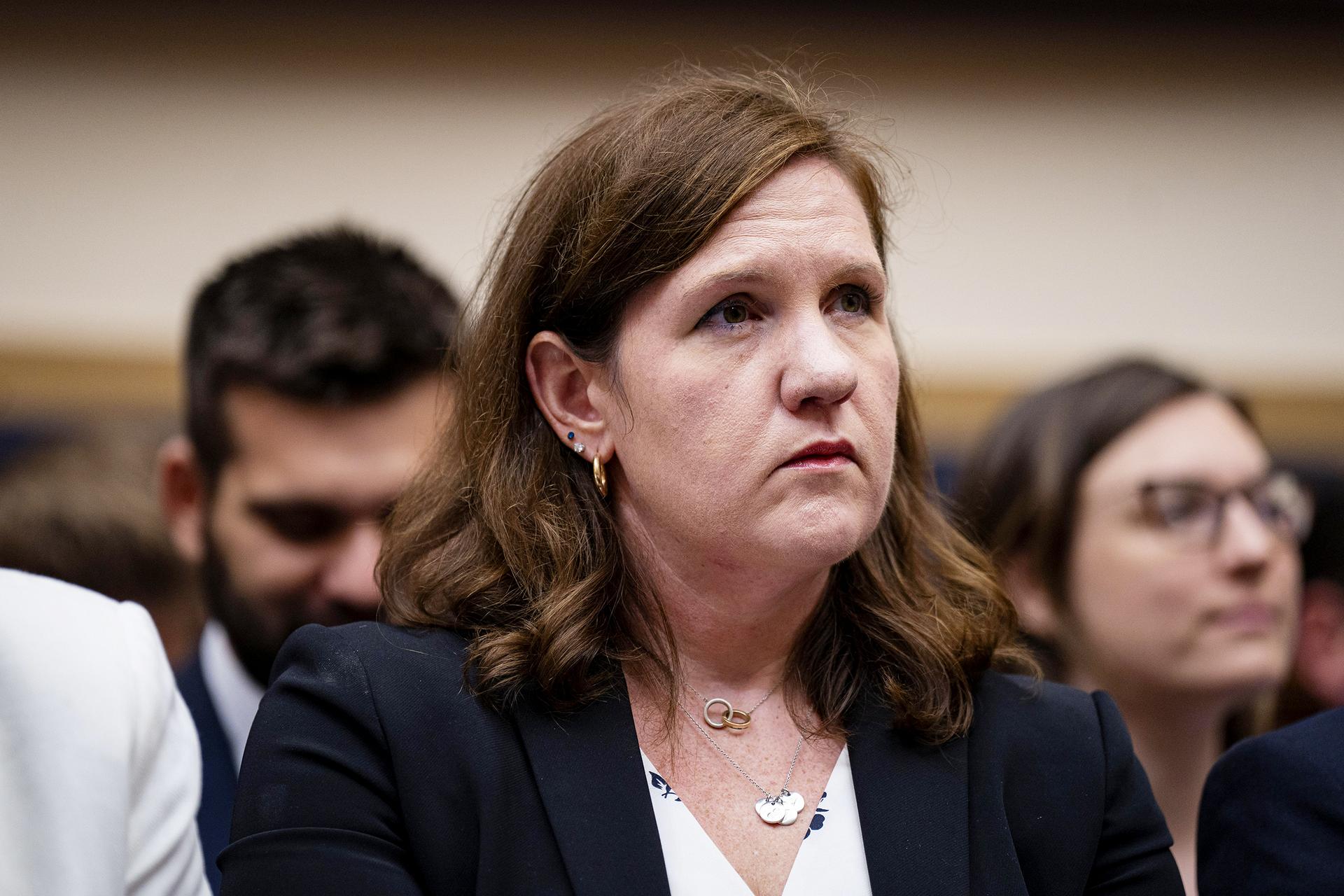
Rebecca Slaughter in Washington in 2023. (Al Drago / Bloomberg via Getty Images) |
|
|
The arguments: Slaughter’s case is that the president can't simply fire her because of her political affiliations, and that only Congress can fire her. Trump’s legal team made a "unitary executive theory" argument, or the idea that Article 2 of the Constitution gives him the authority to exert power over these agencies.
Earlier this year, the conservative majority of the Supreme Court allowed Trump to remove Slaughter as the case wound its way through the courts (as part of its shadow docket). So there’s a good chance that the panel will side with Trump when it delivers its final ruling, expected by June 2026.
Why it matters: Beyond Slaughter and two other FTC commissioners (all Democrats), Trump has fired regulators from several other independent agencies, including the Consumer Product Safety Commission and the Equal Employment Opportunity Commission, seemingly without cause.
The outcome of this case, like other cases the Supreme Court has heard during Trump’s second term, will determine the extent of his power for the rest of his time in office and for presidents that follow, regardless of party. The court’s ruling in this case could be as influential as its decision last year to shield Trump from prosecution related to the Jan. 6, 2021, attempt to interfere with the results of the 2020 presidential election. |
|
|
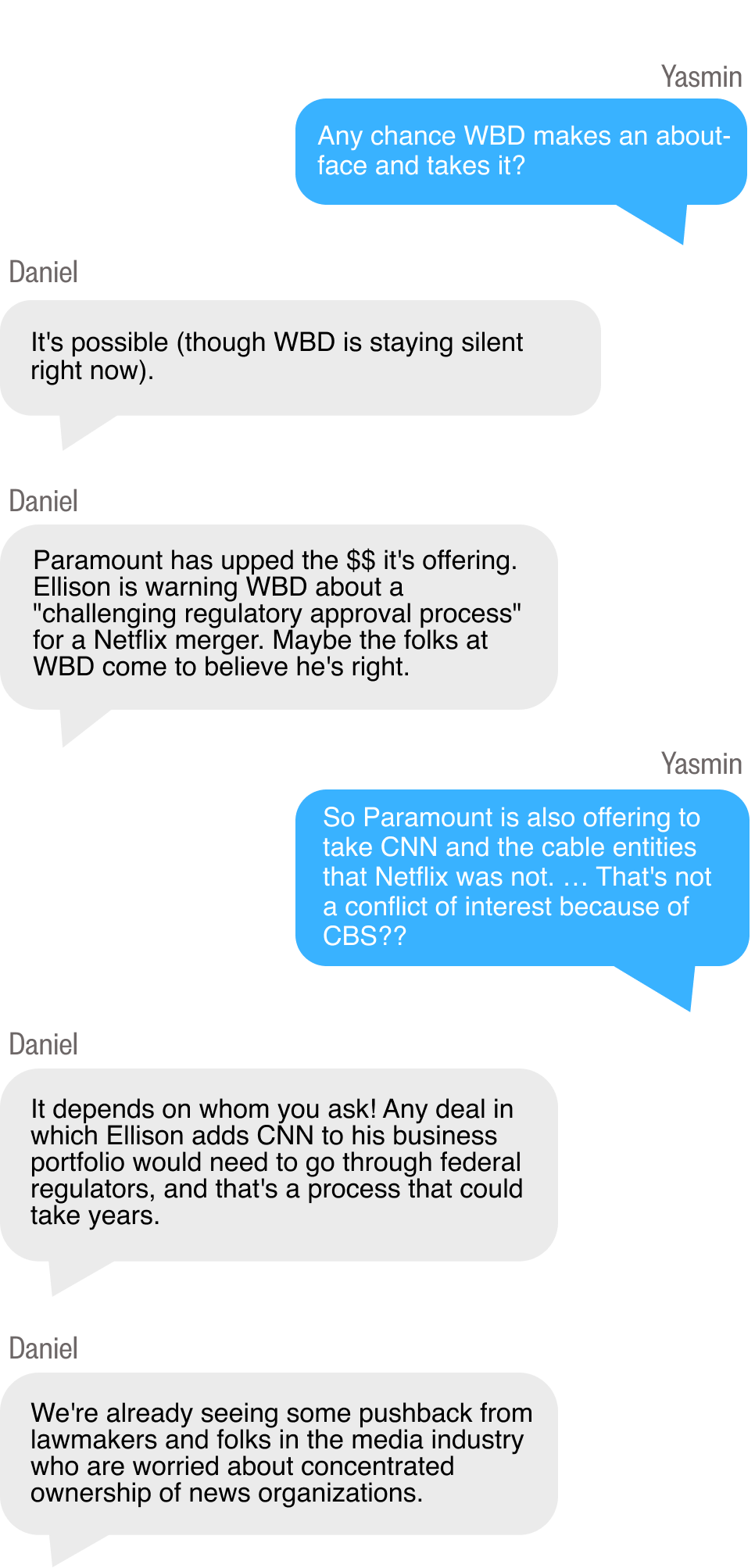
The next act of the Warner Bros. sale drama is upon us. After Netflix announced an $83 billion merger with the legacy Hollywood studio, another major contender has said, “Oh not so fast.” Paramount Skydance, the newly formed company headed by David Ellison, had been the expected front-runner to buy out Warner until Netflix came along.
Now Paramount announced that it would make a hostile bid for the studio, offering $108 billion for the entirety of Warner Bros. Discovery, which includes cable entities like TNT and CNN. Paramount’s offer comes with many investors, including Affinity Partners founded by the president's son-in-law Jared Kushner, Qatar and Saudi Arabia.
The Federal Communications Commission will have to approve any deal that goes through and the WBD board of directors said they will issue their recommendation in “accordance with the terms of their agreement with Netflix" within 10 business days. So we wait. I needed to know more so I reached out to Daniel Arkin, a senior reporter who covers a mix of everything, including the entertainment industry. |
|
|
|