|
Hello, fellow wayfarers … How the Antichrist hides in plain sight every Christmas … What Andrew Peterson and I have learned about tradition, sadness, joy, and Christmas … Why I want us to pretend that you and I are in the terminal ward of a hospital so I can say something I’ve wanted to say … What caused a time machine to be on my grownup Christmas list … A Desert Island Playlist from Georgia … This is this week’s Moore to the Point.
|
The Antichrist Hides in Plain Sight at Christmas
|
|
The manger scene on your living room table might be keeping you from understanding Christmas. Those Nativity sets are, after all, how most of us want this time of year to be—safe and warm and cheery, with lowing cattle and humming angels in the background. But the actual birth of Jesus shook up the snow globe of all our expectations. In the backdrop were not little drummer boys but Roman soldiers and a bloodthirsty dictator who could not afford to lose. The Antichrist is in the Nativity too.
|
|
"I am hoping that Christmas will be a distraction this year, that I can just escape back into Bethlehem for a while and forget all the, you know, news," a friend said to me. I get it, and you probably do too. Today’s Bethlehem is in a war zone—and it would be hard to find a place on the globe that’s not either a tinderbox or fuel for the flames. Authoritarianism is on the rise. Many, even professing Christians, now speak as if "winning" were itself a moral category. The problem for my friend—and for me—is that first-century Bethlehem is not an escape from all that. It’s the epicenter.
|
|
In the coming weeks, many of our churches will read the familiar words from Luke 2 and Matthew 2 on the birth of Christ. Many more will also read John’s words about the Word that became flesh and dwelt among us. Few, however, will remember that the Book of Revelation is a Christmas story too.
|
|
In Revelation 12, Jesus unveiled for John a picture of the entire sweep of history: a woman who cried out in labor pains and gave birth to a baby who would rule the nations, a dragon who sought to devour that child and chased both mother and baby into the wilderness. Immediately afterward, Jesus revealed the dark and mysterious vision of a "beast rising out of the sea" (13:1, ESV throughout), described in terms of a political power that seeks domination over all else. With it was "another beast rising out of the earth," which was the religious authority giving justification for that domination (v. 11).
|
|
This is not a case of the story line shifting genres from Hallmark Channel Christmas movies in the Nativity accounts to Stephen King’s It: Welcome to Derry horror at the end. This is the same story all the way through.
|
|
The Beast rising from the sea, the imperial Roman power, is everywhere in the backdrop of the birth of Jesus. The words we will sing about and hear recited—Bethlehem, no room for them in the inn—all of it is due to a decree from Caesar Augustus to count the bodies of his subjects (Luke 2:1). This was the power move of a surveillance state, counting those subject to the empire to tax them and maintain order by force.
|
|
The carved wise men in our Nativity sets ought to remind us that those same men stood before Herod, who was enraged that the stars they saw predicted the coming of a king of Israel. That’s not only because Herod wanted to maintain his own power base as a client king of Rome but also because he knew he was a fraud.
|
|
Jewish sources from the time told the story of Herod’s descendant reading aloud from Deuteronomy 17 each year about the duties and limits of kings, as that text required the king to do (v. 19). Some of these sources said the king would weep when he came to the line "You may indeed set a king over you … from among your brothers" (v. 15). Herod was not from the offspring of David. He knew the promises. He was not one of the brothers.
|
|
Herod’s descendant might have wept, but Herod did not step down. Instead, he did what tyrants do when repentance is too costly: He turned with rage against those vulnerable to his power. And he found religious scholars who knew the Scriptures well enough to collaborate with his criminality by pinpointing the geographic location of the threat but not well enough to resist the violence that every one of those prophecies would tell them is evil.
|
|
When the apostle John described the Antichrist in his letters to the first-century churches, he did not fix his attention on deciphering 666 or weird occult practices but wrote instead that the spirit of the Antichrist is at work whenever someone denies that "Jesus Christ has come in the flesh" (1 John 4:2).
|
|
That flesh is important. Flesh and blood in Scripture is depicted as the ability to die, to be killed, to be vulnerable (Isa. 40:6–8). Nothing is more hurtable than an infant, utterly dependent on others for safety and food.
|
|
Our world right now seems especially fragile. Silicon Valley tech oligarchs are giving lectures on the Antichrist even while creating systems that promise to make us gods while surveilling us like slaves, all with a gumption perhaps not seen since O. J. Simpson vowed to find "the real killer."
|
|
Many, knowing we are on the edge of unimaginable changes and perhaps inconceivable chaos, quote poet William Butler Yeats’s World War I poem "The Second Coming," which laments, "Things fall apart; the centre cannot hold" and concludes with those haunting words "And what rough beast, its hour come round at last, / Slouches towards Bethlehem to be born"
|
|
But every generation thinks it is the first to face the Beast. The unsettling truth is that the Beast has been slouching toward Bethlehem since, well, Bethlehem. And the Beast always looks unstoppable. Power and domination cause even people who claim the name of Christ to conclude that only by being beasts ourselves can we stop this.
|
|
Christmas carols should remind us otherwise. The beast of human power keeps getting humiliated by a baby—even when it seems to be winning. Caesar gets his census. Herod gets his massacre. But even so, the angel screams, "Fear not, for behold, I bring you good news of great joy that will be for all the people. For unto you is born this day in the city of David a Savior, who is Christ the Lord" (Luke 2:10–11).
|
|
Nothing could seem more ridiculous in a world where Caesar could crucify dissenters and Herod could chase them out of the country. The world still looks like that: Survival looks like victory, safety looks like salvation, and control looks like faith.
|
|
We should remind ourselves of this. The Christmas story reeks of blood. That’s because the Incarnation is not about crowning the warmth of humanity but about tearing down the house of the Devil (Heb. 2:14–15). The good tidings of great joy are not that darkness isn’t real but rather that "the light shines in the darkness, and the darkness has not overcome it" (John 1:5).
|
|
Evil is in the backdrop of your Nativity set. But set your attention elsewhere. Look instead at the feeding trough, at what seems utterly unimpressive and fragile. The hope and fears of all the years are met in that box in Bethlehem. It’s beast versus baby. Only one of them will conquer.
|
Andrew Peterson Beholds the Lamb of God for Over a Quarter Century
|
|
This past Sunday night, Maria and our youngest son Taylor and I carried out our annual Christmas tradition of going to the Ryman Auditorium to hear our friend Andrew Peterson and a team of amazing musicians put on the Behold the Lamb of God concert—this year for the 26th time. I always tear up, especially at the end when the entire audience at the "Mother Church of Country Music" here in our city sings together, "O Come, All Ye Faithful." There’s nothing like it.
|
|
To mark the time of year, Andrew and I sat down at his place just down the road from me to talk about what he’s learned in his many years beholding the Lamb of God on a tour that created a Christmas tradition for thousands around the world.
|
|
We talked about Advent and Christmas—and how the music itself conveys the strange power of both—and about the backstage chaos that most people never see. Clementines turned into softballs, nightly TED talks to keep minds occupied, and the fear of forgetting Andrew’s song about Matthew’s genealogy of Jesus, which contains more names than a college-prep ancient history exam.
|
|
We also talked about exhaustion, longing, the reason Christmas is hard for some people, and the way the Incarnation keeps surprising us after all these years.
|
|
Along the way, I tested out my theory of why people resonate with the Christmas story beyond just the cultural traditions and of why, especially when reading Luke 3, the gospel still sneaks up on those of us who think we’ve heard it all. We also discussed Randy Travis Christmas covers, the new Wingfeather Saga televised release, and the things that make us laugh.
|
|
You can listen to it here.
|
|
And stay tuned for the next couple weeks, when David Platt and I talk about how to have a more radical Christmas, and producer Leslie Thompson and I go through which moments of the show surprised us in 2025 and stayed with us through the year. Plus, she asks me to give her my five books of the Bible I would choose for a desert island, and I do.
|
Goodbye to 2025. Hang On for 2026!
|
|
I’m going to take the next couple weeks to work on a big new project that I’ll tell you about soon, as well as celebrate Christmas with my family. Knowing that the next time I’ll be here with you will be the first Wednesday of the New Year, I wanted to say something about 2025 and you.
|
|
Annie Dillard, in her book The Writing Life, gave this counsel: "Write as if you were dying. At the same time, assume you write for an audience consisting solely of terminal patients. That is, after all, the case. What would you begin writing if you knew you would die soon? What could you say to a dying person that would not enrage by its triviality?"
|
|
A lack of triviality does not necessarily mean somberness. But it does mean gravity toward what really matters—and the end of that is joy.
|
|
I write every week for a couple reasons. One is that this is my little way of expressing gratitude to people whose writing spoke to me when I needed it, some of them living and some of them dead by the time I ever read what they had to say. Even those who are still alive didn’t know who was on the other side of those pulses of life they were sending into the world. I’m thankful none of them gave up when they probably wondered whether anybody out there was listening. We were, and it mattered.
|
|
These writers provoked me to say, as C. S. Lewis put it, "You too? I thought I was the only one!"
|
|
Writers still do that for me, but now readers do too. You are not an "audience" in my mind. Hearing from you—and meeting you in person across the country—is more than just motivation. It’s a way the Lord stirs me up "toward love and good works" (Heb. 10:25).
|
|
Here’s how you can help me out.
|
|
This newsletter and podcast are completely free. I want it to stay that way. For those of you who have the means, would you consider partnering with CT to help people all around the world to hear and see a message that is different from social media clickbait and AI-generated propaganda? Can you help us show people that because Christ reigns, the church can flourish, that life doesn’t have to be a cycle of panic and boredom and cynicism and despair but really can be charged with life and hope and joy and peace?
|
|
If so, and if you can, please partner with us by giving a tax-deductible gift before December 31 to help CT strengthen the church for generations to come. You can do that quickly and easily right here.
|
|
The year 2025 was wild, yet grace was everywhere. As Merle Haggard channeling Julian of Norwich put it, "If we make it through December, everything’s gonna be all right." And it will. Happy New Year, and I can’t wait to be back with you at the dawn of 2026.
|
All I Want for Christmas Is a Time Machine
|
|
In my column for the current issue of Christianity Today, I talked about how a conversation with Beth Moore about the Transfiguration led me to think a lot this year about how time-trippy the Christmas story is. I wrote,
|
|
Perhaps it’s not just coincidence that so many of our Christmas stories of the past play around with the wonkiness of time. Ebenezer Scrooge of A Christmas Carol is shown both the past and the alternate timelines of his future. George Bailey experiences something similar in It’s a Wonderful Life. We sing "O Little Town of Bethlehem" in the present tense, as if we were observing right now the little village at the time of Christ’s birth, noting, "The hopes and fears of all the years are met in thee tonight."
|
|
Perhaps the rhythms of Advent and Christmas drive us all to a kind of time travel. We look around to see who’s not at the table this year. We see those who were once children playing in the wrapping paper as now the grownups we tried to imagine they would become.
|
|
If you’d like to read the full piece—along with my regular columns, essays, and reporting from the wider Christianity Today team—you can access it here as a gift. And if you’re not already a subscriber, this is a good season to join us. You can do so here.
|
|
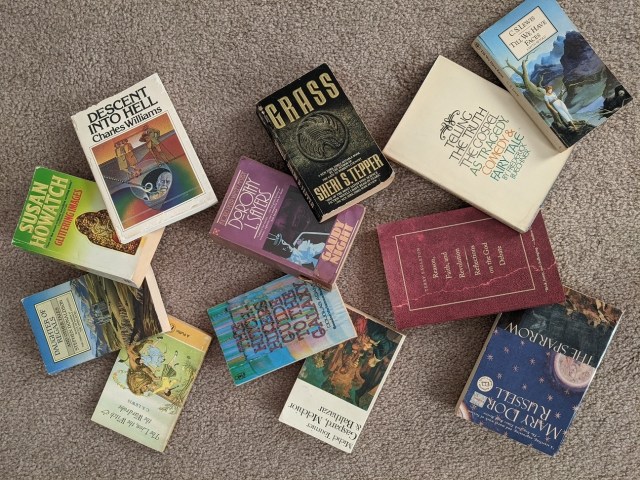
Every other week, I share a list of books that one of you says you’d want to have on hand if you were stranded on a deserted island. This week’s submission comes from reader Phil Davison from Cordele, Georgia:
|
| | |