Oil eases on signs of surplus

Global news you can trust.

Download the Reuters App.


Power Up

Power Up


A Reuters Open Interest newsletter

By Ron Bousso, ROI Energy Columnist


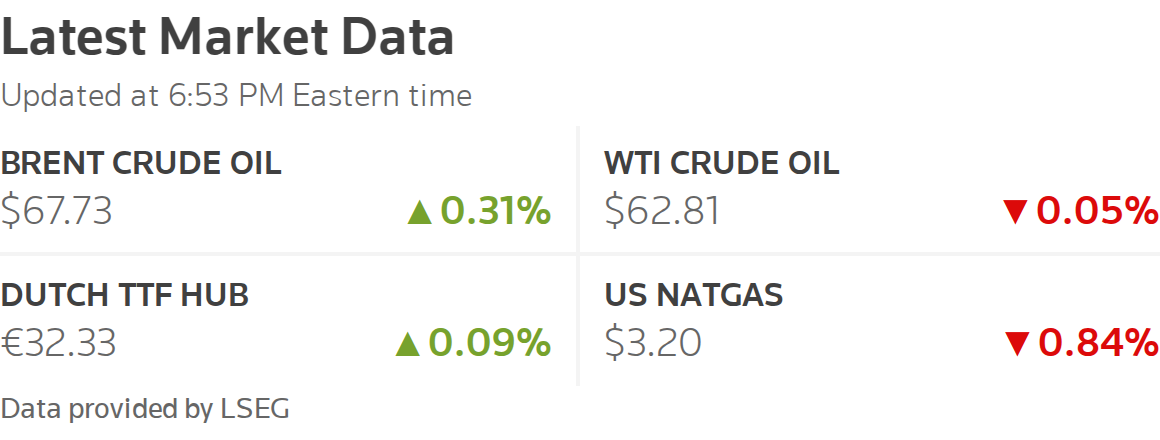
Data refreshes every time you open this email. For more energy news, click here. Please send any feedback to powerup@thomsonreuters.com.

Hello Power Up readers,

Oil prices are hovering near their 2025 lows early on Monday at $61 a barrel. Signs of rising global supplies are unnerving investors who are also weighing the likelihood that U.S. President Donald Trump could secure a ceasefire deal in the Russia-Ukraine war and spark regime change in oil-rich Venezuela.

Markets have been spooked by the increasingly belligerent U.S. stance towards Caracas after the U.S. Coast Guard last week seized in mid-ocean a supertanker carrying Venezuelan crude to Cuba. The U.S. is preparing to intercept more ships transporting Venezuelan oil, Reuters reported last Thursday. Washington has also imposed new sanctions on Venezuela President Nicolas Maduro's family as well as six crude tankers and shipping companies linked to them.

The tightening restrictions have already led to a drop in Venezuelan crude production, which declined by roughly 150,000 bpd in November from a month earlier to 860,000 bpd, according to the International Energy Agency.

But will the drop in Venezuelan oil exports lead to a global supply crunch? More on this below.


 Here are a few more headlines:

  • Russian state oil and gas revenue in December is likely to almost halve from a year earlier to 410 billion roubles ($5.17 billion) as a result of lower crude prices and a stronger rouble, Reuters calculations showed.
  • Nigeria’s richest man Aliko Dangote escalated his fight with regulators on Sunday, accusing them of enabling cheap fuel imports that threaten local refineries in Africa’s biggest oil producing country.
  • This fascinating Reuters investigation explains how the U.S. freight rail industry has become dirtier than coal power plants. BNSF Railway, one of the crown jewels of Warren Buffett’s sprawling Berkshire Hathaway conglomerate, calls itself an environmental leader in the U.S. rail industry with the cleanest locomotive fleet in North America. But it’s also a major source of pollution.

I love to get your thoughts and comments, so don’t hesitate to contact me at ron.bousso@thomsonreuters.com or follow me on LinkedIn.


Top energy headlines

  • Oil prices stable as Venezuelan supply disruptions balance surplus concerns
  • India proposes landmark nuclear law to end state monopoly and allow private sector operators
  • Poland's JSW needs over $830 million to stay afloat, says minister
  • Intercontinental Exchange reports Dutch gas trading record, eyes longer trading hours
  • Ukraine strikes Russian oil infrastructure in Caspian Sea for third time, source says


The Venezuela squeeze

The U.S. pressure on Venezuela – the military continues to build up its biggest presence in the Caribbean since the Cuban missile crisis - is already having an impact on the country’s oil industry.

The country’s crude exports had spiked in September to over 1 million barrels per day, the highest since February 2019, likely because state-run oil company PDVSA was depleting inventories in anticipation of tightening restrictions.

Venezuelan crude exports are now set to drop in December to 702,000 bpd, the lowest since May, according to data from analytics firm Kpler.

The tightening restrictions have also led to a drop in Venezuelan crude production, which declined by roughly 150,000 bpd in November from a month earlier to 860,000 bpd, following several months of production hovering above 1 million bpd, according to the International Energy Agency.

The drop is partly due to declining exports, meaning output could decline further if exports are constrained as Venezuela's storage fills up.

On top of this, production could be severely curtailed if U.S. restrictions impede imports of naphtha and diluents that are critical for the extraction and processing of Venezuelan oil.

Over two-thirds of Venezuela's oil production is of so-called heavy grade that is tar-like when extracted. Naphtha is used to reduce the oil’s viscosity, enabling it to flow through pipelines for export via terminals and tankers.

Venezuela's heavy crude production is unlikely to stop completely, though, regardless of the rising tensions, because President Donald Trump’s administration has issued Chevron , the second-largest U.S. oil producer, with a special licence to continue operating its joint ventures in Venezuela’s Orinoco belt, which produce around 250,000 bpd.

Chevron exports around 150,000 bpd of crude from Venezuela to the U.S. Gulf Coast, where refineries were built decades ago to process heavy grades from Mexico, Canada and Venezuela.

Putting all of this together, Venezuela's oil production could decline sharply. But the impact on the market will be limited.

Read the full column
 

Find ROI on the Reuters website, and join the debate on LinkedIn and X.


Get full access to Reuters.com for just $1/week. Subscribe now.


Sponsors are not involved in the creation of newsletters or other Reuters news content. Advertise in this newsletter or on Reuters' website

LiveIntent Logo
AdChoices Logo
 

Power Up is sent twice weekly. Think your friend or colleague should know about us? Forward this new