|
 |
No billionaire overlords. No false equivalencies. No BS.
Upgrade to paid to support independent accountability journalism.


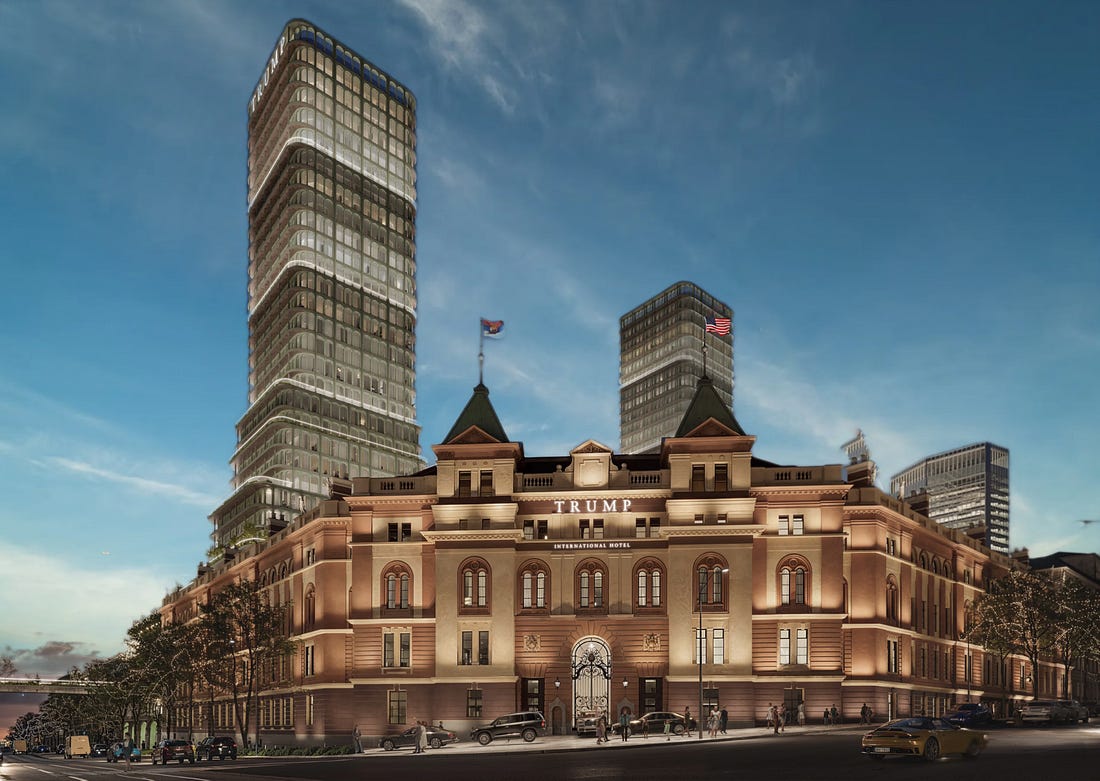 |
This week, Jared Kushner abruptly canceled his plans to build Trump Tower Belgrade after the project became enmeshed in a criminal corruption scandal involving Serbian government officials.
Kushner, President Trump’s son-in-law, has resumed his role as one of Trump’s top foreign policy advisers — representing the Trump administration in high-stakes negotiations over Gaza and Ukraine. But Kushner has also continued to run his private equity firm, Affinity Partners.
In 2024, armed with billions of dollars from Saudi Arabia and other foreign governments, Kushner inked a deal with the Serbian government to redevelop the former headquarters of the Yugoslav Army in Belgrade into a luxury hotel and residences. The building was damaged by NATO in 1999 during an aerial bombing campaign.
The deal included extremely favorable terms for Kushner. The Serbian government agreed to grant Affinity Partners a 99-year lease to the property, which is a prime location in central Belgrade, for free. Kushner also had the option to convert the lease to full ownership at no cost. Affinity Partners would then keep 78% of the profits from the $500 million development, with the Serbian government entitled to 22%.
In January 2025, shortly before Trump’s second inauguration, Kushner reached a deal with the Trump Organization to brand the development as a Trump Tower. That agreement meant Trump would directly profit from the successful development of the site.
There was one big problem: the property was designated a culturally protected site by Serbian law. It could not be developed unless the Serbian government changed its status.
The deal struck between the administration of Serbian President Aleksandar Vucic and Kushner required the Serbian government “to remove the cultural designation of the complex and to complete demolition work of the existing buildings” by May 2026. Failure to do so would entitle Affinity Partners to millions in penalty payments from the Serbian government.
Beyond the economic penalties, the Serbian government was eager to keep the project moving as it sought improved relations with the Trump administration. American sanctions have effectively shuttered NIS, Serbia’s “only oil importer and refiner of oil,” which is majority-owned by Russia. The New York Times reported that Vucic has “been seeking [Trump’s] help all year on economic issues.”
According to Serbian organized crime prosecutors, however, the Serbian agencies empowered to lift the designation on the property refused to do so. Serbian officials, prosecutors allege, then forged documents claiming that the property was no longer culturally protected.
The allegation was first made public in May 2025, when prosecutors announced “the arrest of Goran Vasic, the acting director of the Republic Institute for the Protection of Cultural Monuments, and said he had admitted fabricating an expert’s opinion.” Vucic was undaunted. He said there were no forgeries and vowed that the Kushner development would continue.
In November, in an effort to circumvent the forgery issue, the Serbian parliament passed emergency legislation to remove the cultural designation and allow the Trump Tower project to proceed. The passage of that legislation prompted a wave of youth protests. Thousands “symbolically formed a human shield… around a bombed-out military complex, vowing to protect it from redevelopment.”
Nevertheless, the Trump Tower project continued until Monday when prosecutors criminally charged Nikola Selakovic, one of Vucic’s closest political allies, and three other officials. Selakovic and the others were accused of “falsification of an official document” and other crimes.
Hours after the charges were announced, Affinity Partners released a statement saying it was pulling out of the project. “Because meaningful projects should unite rather than divide, and out of respect for the people of Serbia and the City of Belgrade, we are withdrawing our application and stepping aside at this time,” the company said.
The collapse of the deal is a case study in how Kushner’s dual role as an international investor and top Trump foreign policy advisor puts immense pressure on foreign governments. In Serbia, according to prosecutors, the pressure to deliver Kushner what he wanted was so great that top government officials were willing to violate the law.
Kushner’s luxury development in Albania required new law
In Albania, Kushner’s Affinity Partners is building an ultra-luxury resort on Sazan Island, which is owned by the Albanian government. Sazan Island, however, is part of Karaburun-Sazan National Marine Park. It is home to an endangered seal species, serves as a key feeding ground for turtles, and contains marshlands that are important to the health of the Mediterranean Sea.
A 2010 Albanian law made Sazan Island off-limits to development because of the park’s role in preserving marine life and promoting biodiversity. The island is currently completely uninhabited and has no access to fresh water. A luxury resort would likely require constructing a desalination plant and a sewage system.
In 2024, shortly after Kushner’s interest in developing the island became public, the Albanian legislature passed a law creating an exception to Sazan Island’s protected status for “strategic investments.” Subsequently, the Albanian government granted Affinity Partners “Strategic Investor” status, allowing Kushner to take advantage of the new law.
An Albanian NGO, the Protection and Preservation of Natural Environment, argues that the new law violates the Albanian Constitution by ignoring international law. The European Union (EU) has criticized the law, calling it a “negative development.” The EU believes that the revised law may violate the Bern Convention, an international treaty on wildlife. The issue could complicate Albania’s effort to join the EU.
What happens when you send billions of dollars to Kushner
In addition to an international scandal, the collapse of Trump Tower Belgrade also highlights Kushner’s inexperience as a private equity manager and businessman. His prior business experience involved nearly bankrupting his family’s real estate company. Kushner’s pitch to investors was that his government experience enabled him to navigate geopolitical risk effectively.
In Serbia, however, Kushner tied up $500 million for several years in a project that will never earn a pr