|
The Medium identifies essential signals on how technology is shaping creativity, and how creatives are evolving in response.
Reader Feedback: Netflix Retreats From Gaming Exactly When Gaming Becomes the Future
Netflix's platform was built for content recommendations, not the community and creation tools gaming offers. The WBD acquisition confirms they're doubling down on libraries over architecture.
| |||||||||||||||


In May, I argued that AI-era culture will be shaped by engagement models that look like gaming—daily habits, community, and creation rather than passive viewing.
Netflix co-CEO Greg Peters pushed for this future. Mobile games—without ads or in-app purchases—would drive engagement and reduce churn. But now Netflix is cutting back on mobile games and selling gaming studios.
The gap between vision and execution comes down to what makes gaming unique. As author and consultant Paul Greenberg observed, “The gaming industry, for more than a dozen years, has focused on providing products, services, tools, and consumable experiences to create highly personalized relationships.” Netflix built one of the world’s most sophisticated streaming platforms. It can deliver games like “GTA: San Andreas” but cannot offer community features or creation tools that build personalized relationships.
Locked In An Old Media Approach
Gaming architecture works differently. EA Sports FC (over 265 million users in the EA Sports Player Network) gives players tools to build custom teams, create competitions, and progress through personalized journeys. Roblox (112 million DAUs) provides creation tools that let users build worlds, not just choose between pre-made options. Epic’s Fortnite (37.2 million DAUs in the Epic Games Store) enables players to design maps, host events, and generate content that becomes part of the platform ecosystem.
Joost Van Droonen—a video games professor at the NYU Stern School of Business—outlined the economics in a recent essay:
Games that support user-generated content generate 23 percent more revenue over five years than those without. Player retention is 64 percent higher at two years and 90 percent higher at five. Active modders are 2.4 times more likely to purchase premium downloadable content—meaning free user creativity complements rather than cannibalizes paid offerings. Roblox’s creator payouts have grown from $329 million in 2020 to $868 million in 2024, evidence of an economic model where players become stakeholders.
By comparison, Netflix “remains locked in an old media approach.” Netflix’s gaming strategy treated games as titles in a library to reduce churn and drive deeper fan engagement with Netflix titles like “Selling Sunset”. It was risk-averse in evolving its platform architecture towards Greenberg’s framework.
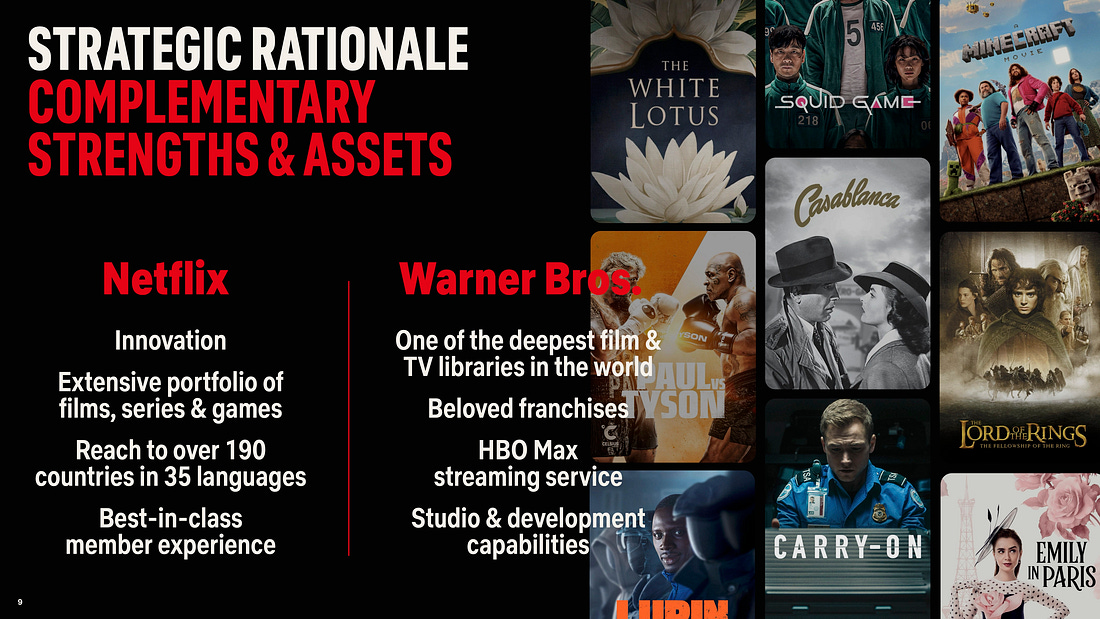
Its proposed acquisition of Warner Bros. Discovery decisively doubles down on that “old media approach”—buying more content libraries rather than rebuilding platform architecture for creation and community. Warner Bros. Games—home to major studios like TT Games, Rocksteady, and NetherRealm—merits only two mentions in the acquisition pitch deck to investors.
Two years ago, I spoke with a senior executive at one of the European gaming studio partners for Netflix. He noted that community was a key offering missing from Netflix games and predicted that would hinder its efforts. He was bullish on Netflix’s gaming roadmap and believes we will see community and other common features in gaming. Those did not pan out.
 |
“Games are the future”
Van Droonen commented on my last essay that “Games are the future.” Netflix is retreating from gaming exactly when gaming architecture becomes the model for AI-era media.
Roblox now offers AI-powered creation tools that let users generate 3D objects and environments through natural language. Players describe what they want and its Cube 3D AI model builds it.
Epic is building similar infrastructure for Fortnite, including The Persona Device—an upcoming AI tool for the Unreal Editor for Fortnite that allows creators to build characters with dynamic, conversational AI-driven personalities.
Electronic Arts CEO Andrew Wilson told investors on its Q4 2025 earnings call that the company is “investing in new workflows and capabilities to integrate AI to enhance how we build, scale and personalize experiences, from dynamic in-game worlds to delivering authentic athlete and team likenesses at incredible scale.”
Netflix has long identified these platforms as competition for attention. Now Roblox, Epic, and EA are investing in AI-driven creation tools while Netflix retreats.
Two Paths To Interactivity
The question is whether Netflix can rebuild platform architecture around creation tools and personalized relationships while remaining public and profitable. Both Disney and Warner Bros Discovery have taken a more basic approach of in-house studios and failed. Netflix has built the platform architecture and is pivoting. EA required going private to do so.
Netflix’s platform was built for a different, not-so-long-ago era: Algorithmic recommendations for content libraries to disrupt both cable bundles and DVD box sets. Now they are doubling down on that at the same time gaming’s architecture is merging with generative AI.
It would be easier to call this mistaken. It is not. Rather, it is the betrayal of a weakness much like Disney’s. It is now profitable and has a $435 billion market capitalization that is double Disney’s (~$200 billion). Neither gaming architecture (community features, creation tools) nor generative AI integration (user-generated content at scale) fit Netflix’s existing platform, which was built for algorithmic content recommendations
Netflix’s inability to adapt towards what Greenberg labeled “The most advanced business model in the universe” is someone else’s opportunity. Its risk aversion to generative AI content on its platform is also someone else’s opportunity.
Netflix’s pivot to acquiring Warner Bros. Discovery confirms it has successfully usurped the cable bundle and DVD box set. But in choosing content libraries over gaming architecture—exactly when AI makes gaming the model for media—Netflix reveals it is subject to the same constraints that traps other profitable, public legacy media companies like Disney: They can see the future but cannot rebuild their platforms to reach it.
Essays related to today’s analysis:
 |