Oil prices drift below $60

Global news you can trust.

Download the Reuters App.


Power Up

Power Up


A Reuters Open Interest newsletter

By Ron Bousso, ROI Energy Columnist


Data refreshes every time you open this email. For more energy news, click here. Please send any feedback to powerup@thomsonreuters.com.

Hello Power Up readers,

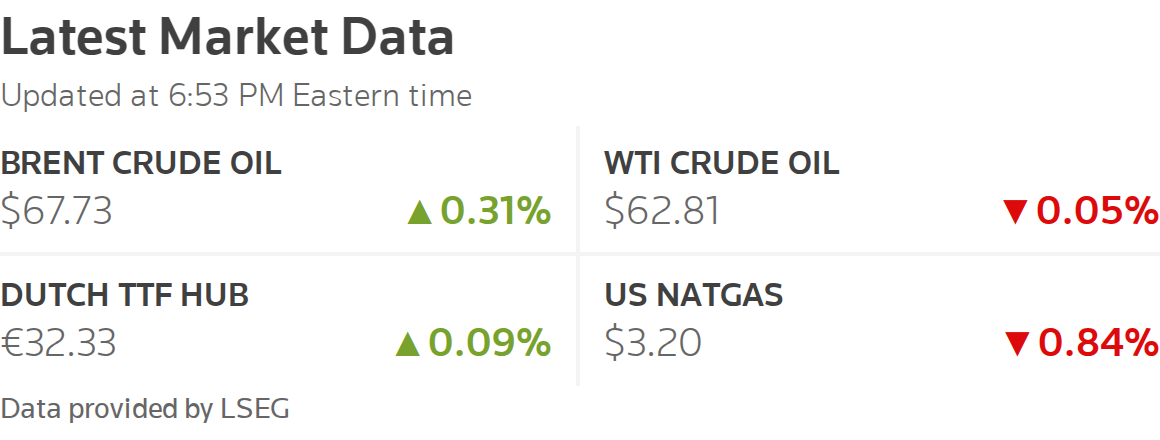
Oil prices dipped below $60 a barrel on Tuesday to their lowest point since February 2021 amid rising optimism over a possible peace deal to end Russia’s nearly four-year invasion of Ukraine. Prices bounced back early on Wednesday after U.S. President Donald Trump said he would impose a blockade on Venezuela’s exports of sanctioned oil, though prices were back below $60 by the end of the day.

The tightening U.S. pressure on Caracas could lead to a drop of around 500,000 barrels per day in the Latin American country’s oil exports. That would deprive Nicolas Maduro of vital revenue, but would have limited impact on a more than 100-million-bpd global oil market facing increasing signs of oversupply.

In other news, energy-watchers got a shock late on Wednesday when British oil giant BP announced that CEO Murray Auchincloss would step down on Thursday and that Meg O'Neill, current CEO of Australian-listed Woodside Energy, would succeed him in April.

Chairman Albert Manifold’s surprise appointment of an outsider, a first for BP, and a woman, also a first, to head the iconic British company follows three years of upheaval that included leadership changes, the overhaul of a failed renewables strategy, activist investor pressure and swirling rumours that the company would soon be acquired.

But O’Neill faces a tough task ahead. More on this below

Here are a few more headlines from recent days:

  • ROI Energy Transition Columnist Gavin Maguire had a look at one of the world's largest oil, gas and coal importers - Japan – which has cut fossil fuel electricity generation to the lowest levels in more than a decade in 2025, thanks largely to an ongoing recovery in nuclear power output.
  • Staying in Asia, the region's imports of U.S. crude oil, coal and liquefied natural gas are on track to decline this year despite President Donald Trump's efforts to boost shipments as part of his trade and tariff policies, wrote ROI Asia Commodities Columnist Clyde Russell.
  • Finally, I really enjoyed this fascinating Reuters article on how Qatar is banking on its abundant, low-cost energy to make up for lost time in the Gulf's artificial intelligence race, hoping that cheap power and deep pockets will help it catch up with regional rivals that have already secured a head start.

This is the last Power Up edition for the year. Thank you for your support and interest this year. We’ll be back in your inbox in early January. As always, don’t hesitate to contact me at ron.bousso@thomsonreuters.com or follow me on LinkedIn with any questions or thoughts. Happy holidays!


Top energy headlines

  • Oil prices steady as market assesses mounting risks to supply
  • Why Canada's hottest shale play is catching the eye of US producers
  • BP taps Woodside's Meg O'Neill as CEO after abrupt Auchincloss exit
  • Woodside's next CEO must steer costly LNG projects through glut risk
  • What is fusion energy, the quest coveted by Trump Media?


BP’s endless shakeup

The surprise appointment of Meg O'Neill as BP's first outsider CEO offers the bruised $90 billion British oil company three clear strategic choices for moving forward: build, buy or be bought.

The leadership overhaul is the clearest signal yet that BP Chair Albert Manifold, who himself took office on October 1, intends to fundamentally overhaul the long-struggling oil company.

"Progress has been made in recent years, but increased rigor and diligence are required to make the necessary transformative changes to maximise value for our shareholders,” Manifold said in a statement on Wednesday.

O'Neill, a U.S. citizen, will not only become BP's first outsider CEO but also the first woman to lead a Western oil major. She oversaw Woodside's expansion in recent years into a larger player in the liquefied natural gas space.

Taking the helm of BP is a job on an entirely different scale, however.

Auchincloss radically reversed his predecessor's ambitious energy transition strategy, scrapping plans to reduce BP's oil and gas production and expand its renewables business.

Following heavy pressure from activist investor Elliott Management, Auchincloss in February vowed to further focus BP's operations on its legacy business as returns from renewables languished.

BP has revived its oil and gas division with several new upstream projects in the Gulf of Mexico, Iraq, and Libya as well as a major oil discovery in Brazil.

These changes appear to have gone down well with investors.

BP's shares are up 10% so far this year, outperforming Shell, Chevron and TotalEnergies.

O'Neill thus inherits a company moving in the right direction.

But she will now be tasked with further improving BP's operational and financial performance under the supervision of Manifold, who seems to be far more involved in the daily running of the company than his recent predecessors.

Read the full column
 

Find ROI on the Reuters website, and join the debate on LinkedIn and X.


Get full access to Reuters.com for just $1/week. Subscribe now.


Sponsors are not involved in the creation of newsletters or other Reuters news content. Advertise in this newsletter or on Reuters' website

LiveIntent Logo