|
 |



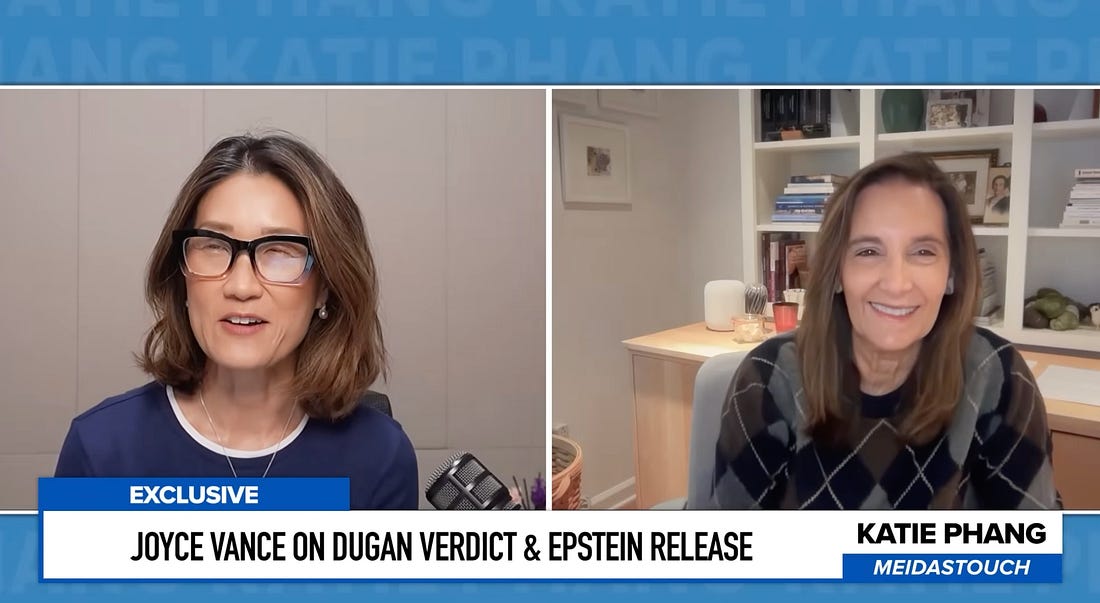
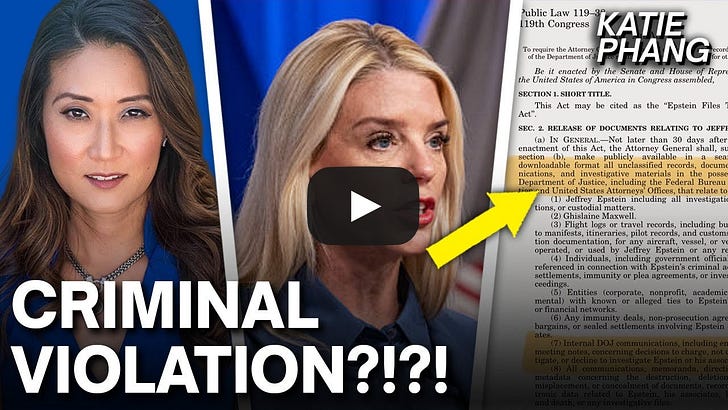
This morning, I joined the amazing Katie Phang for a live chat on her YouTube channel. We focused on the conviction of Wisconsin Judge Hannah Dugan, touching on the importance of accepting the legitimacy of jury verdicts, while simultaneously understanding that a convicted defendant can appeal based on legal issues. We discussed what some of the key issues on appeal here are likely to be. We also discussed DOJ’s failure to comply with the Epstein Transparency Act and fully release the files. It’s always helpful to work through complicated legal issues with another experienced trial attorney, and Katie is one of my favorite people to do that with. I hope you’ll enjoy our conversation.
 |
You can watch here or just click on the picture below:
The rest of the day was action-packed too.
In Washington, D.C., Judge Jeb Boasberg certified a class action lawsuit to make it possible for Venezuelan men who were deported from the U.S. to the CECOT terrorist prison in El Salvador to “facilitate their return to the United States to pursue their individual habeas claims.” The writ of Habeas Corpus safeguards people from unlawful imprisonment and permits them to petition a court to review their detention to ensure it doesn’t violate their constitutional rights.
Judge Boasberg found that the men’s due process rights were violated: “By granting the Motion, this Court is declaring that Plaintiffs should not have been removed in the manner that they were, with virtually no notice and no opportunity to contest the bases of their removal, in clear contravention of their due-process rights.”
Ironically, during her confirmation hearing, DHS Secretary Kristi Noem described habeas incorrectly—and about as far from being correct as humanly possible. When Senator Maggie Hassan (D-N.H.) asked Noem to define habeas corpus, Noem replied that “Habeas corpus is a constitutional right that the president has to be able to remove people from this country.” Of course, it is not. Hassan, a former governor and practicing attorney, confronted Noem. “Habeas corpus,” she told her, “is the foundational right that separates free societies like America from police states like North Korea.”
Most of the men who were sent from the U.S. to CECOT have since been released into Venezuela. But Judge Boasberg explains in his opinion that being released from unlawful custody isn’t the only remedy a court can order in response to a habeas petition: “A federal court possesses power to grant any form of relief necessary to satisfy the requirement of justice.” Precedent from earlier cases establishes that flexibility is necessary because it is “essential to insure that miscarriages of justice within its reach are surfaced and corrected.”
“Had Plaintiffs not been removed to El Salvador, granting their Motion would have led this Court to enjoin the Government from removing them pursuant to the [Trump] Proclamation until they had received the opportunity to challenge their designations under the AEA and the validity of the Proclamation,” the Judge writes. “It obviously cannot do so here as removal has already taken place.” So, he concludes, the remedy here has to be appropriate for the kind of injury the plaintiffs have suffered. The only sufficient remedy, he concludes, is ordering the government to give the men a “meaningful opportunity to contest” their designation for deportation and the legality of the proclamation Donald Trump issued, which was used for that purpose. “Otherwise,” Judge Boasberg writes, “a finding of unlawful removal would be meaningless for Plaintiffs, who have already been sent back to Venezuela against their wishes and without due process. Expedited removal cannot be allowed to render this relief toothless. If secretly spiriting individuals to another country were enough to neuter the Great Writ, then ‘the Government could snatch anyone off the street, turn him over to a foreign country, and then effectively foreclose any corrective course of action.’”
Judge Boasberg pointed out that in the course of an earlier appeal in this case, “The Supreme Court has already unanimously agreed that facilitating an individual’s return to the United States is a proper remedy, one that does not upset the Executive Branch’s exclusive authority over foreign affairs.” But he puts the burden on the government of clarifying how it will proceed: “Even so, the Court remains mindful of the deference due to the Executive Branch on issues of foreign affairs … For that reason, the Court will allow the Government to articulate what steps it proposes to facilitate the return of Plaintiffs.” The government will undoubtedly fight this decision tooth and nail. Expect an appeal to both the court of appeals and ultimately the Supreme Court.
You can read Judge Boasberg’s full opinion here.
We now know more about just how bad conditions in CECOT prison are, despite an effort by the new head of CBS News, Bari Weiss, to spike a planned 60 Minutes segment Sunday night. But the segment became available today, because Canada’s Global TV app received it before the broadcast was pulled. You can watch it here, compliments of our good friend Allison Gill, of Mueller She Wrote.
Judge Cannon continues to impose delay to benefit Donald Trump. Judge Aileen Cannon, who delayed the Mar-a-Lago prosecution to death, is doing everything she can to prevent the release of Volume II of Jack Smith’s report for as long as possible. On Inauguration Day, after Trump was sworn in, Cannon issued an order blocking the Justice Department from sharing the report with leaders of the House and Senate Judiciary committees, who were set to receive it in accordance with the typical practice after a special counsel concludes their work.
That order remained in place. But earlier this year, American Oversight and the Knight First Amendment Institute sought permission to intervene in the case and argue against the block so Volume II could be released. Cannon refused to rule on their request to participate in the case, even though it had been fully briefed for months. On November 3, an Eleventh Circuit panel gave Cannon 60 days to rule, finding that the parties had “established undue delay in resolution of their motions to intervene.”
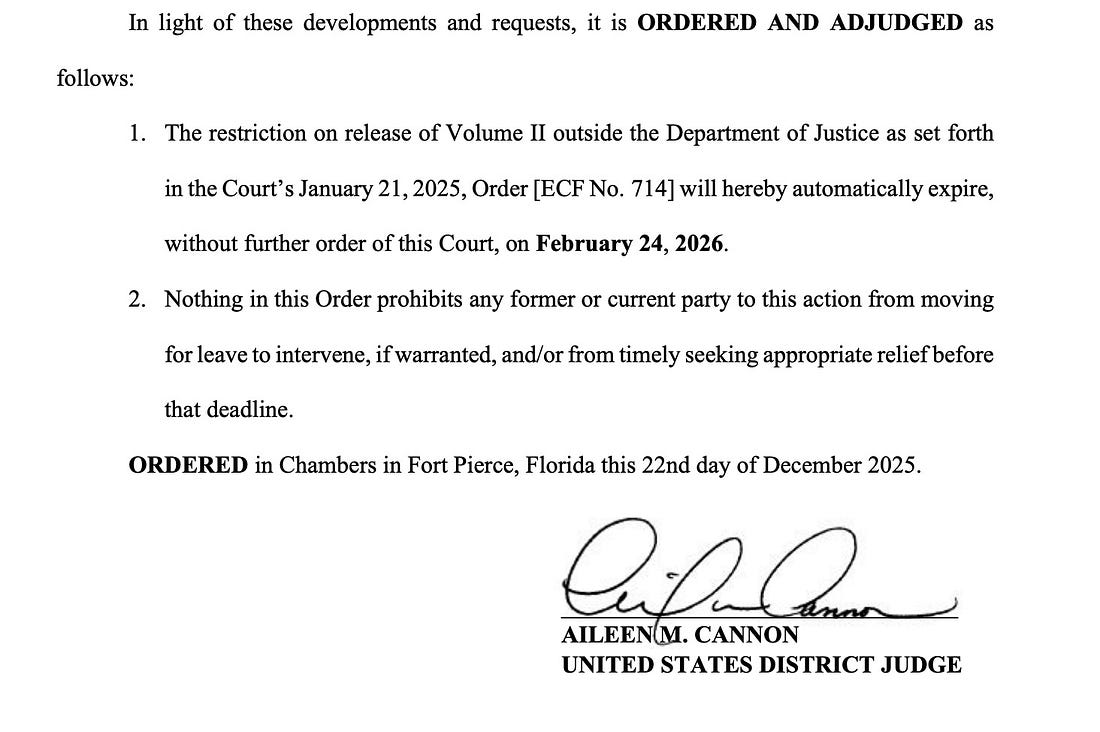
With that deadline looming, today, Judge Cannon entered an order giving the government until February 24, 2026, to release the report. But it’s still possible for the government to appeal and drag out the delay even further.
 |
Republicans in Congress won’t let Jack Smith testify in public. The Justice Department and Judge Cannon are trying to keep the public from seeing his report. That tells us all we need to know.
Also tonight, there is news of a lawsuit seeking to restore the name of the Kennedy Center and remove Donald Trump’s name from it.
Norm Eisen, the founder of Democracy Defenders Action, who is at the center of the whirlwind of pro-democracy litigation, will be with us in the morning for a Substack Live to discuss his newest lawsuit. We’ve all been waiting for someone to challenge Trump̵