|


 |
This March I published a book in Japanese, called Weeb Economy. Half of the book was republished (translated) posts from my blog, and half was a new section. I’ve been publishing that new section as a series of posts (Part I, Part II, Part III). But instead of publishing the final part as a fourth post, I figured I’d just publish the entire new section as a single post. So here you go! This is the entire new section of my book. It’s about a big idea for how to partially reverse the economic stagnation that has gripped Japan since the late 2000s.
Part I: I want the Japanese future back!
Japan lost the future in 2008, not in 1990
When I lived in Japan in the mid-2000s, it still felt very much like “the future”. 3g flip-phones with grainy cameras were far more advanced than anything I had encountered in the U.S. Japanese people had LCD or plasma TVs, while most Americans were still using old cathode-ray machines. Their kitchens had automatic rice-cookers and other appliances I had never seen, and their laptops were higher-performance and far more durable than the ones I had used in the U.S. Their toilets were like something from a spaceship, and their showers could dry clothing. Some people even had digital SLR cameras that could shoot movie-quality video — a miraculous technology I had never even dreamed was possible.
And the cities! Giant screens adorned the sides of buildings, like something out of science fiction. There was always a train station within walking distance that would take me anywhere I wanted to go. The trains were clean and fast and they ran on time, and they even had electronic screens that told you when the train would arrive at the next station. Japanese cars and even motorcycles glided along quietly, where in America they roared and grumbled. Even in the U.S., of course, the most revolutionary, futuristic car — the Toyota Prius — was a Japanese model.
In the 21st century’s opening decade, Japan felt like it had embraced that new century while America was still lingering in the 20th. William Gibson, the celebrated creator of the cyberpunk science fiction genre, wrote this in 2001:
The world's second-richest economy, after nearly a decade of stagflation…still looks like the world's richest place, but energies have shifted…yet it feels to me as though all that crazy momentum has finally arrived…[T]onight, watching the Japanese do what they do here, amid all this electric kitsch, all this randomly overlapped media, this chaotically stable neon storm of marketing hoopla, I've got my answer: Japan is still the future, and if the vertigo is gone, it really only means that they've made it out the far end of that tunnel of prematurely accelerated change. Here, in the first city to have this firmly and this comfortably arrived in this new century - the most truly contemporary city on earth - the center is holding…Home at last, in the 21st century.
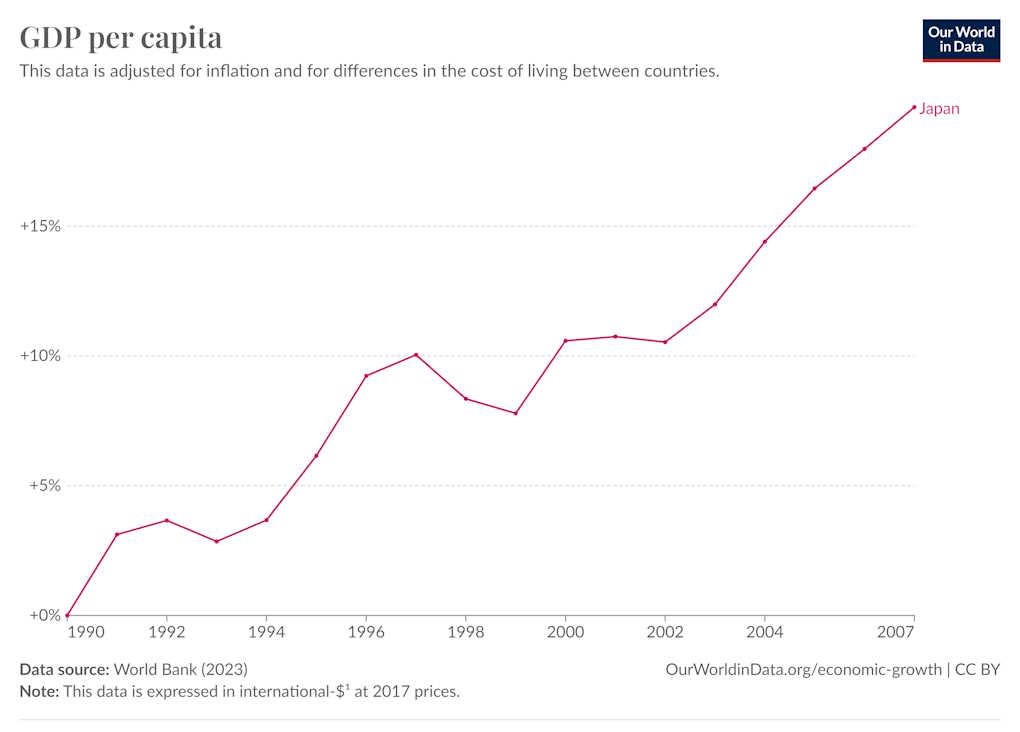
Now realize that the Japan of my earliest memories — the early and mid-2000s — was a full decade and a half after the famous bursting of Japan’s economic bubble. I am not hearkening back to the go-go days of the 1980s. By the time Koizumi Junichiro was in office, Japan’s “lost decade” had come and passed, full employment had been restored, and the country had returned to slow but steady economic growth. Despite the overhang of the bubble era, Japanese per capita incomes, measured at international price levels, grew by a respectable 20% between 1990 and 2007:
 |
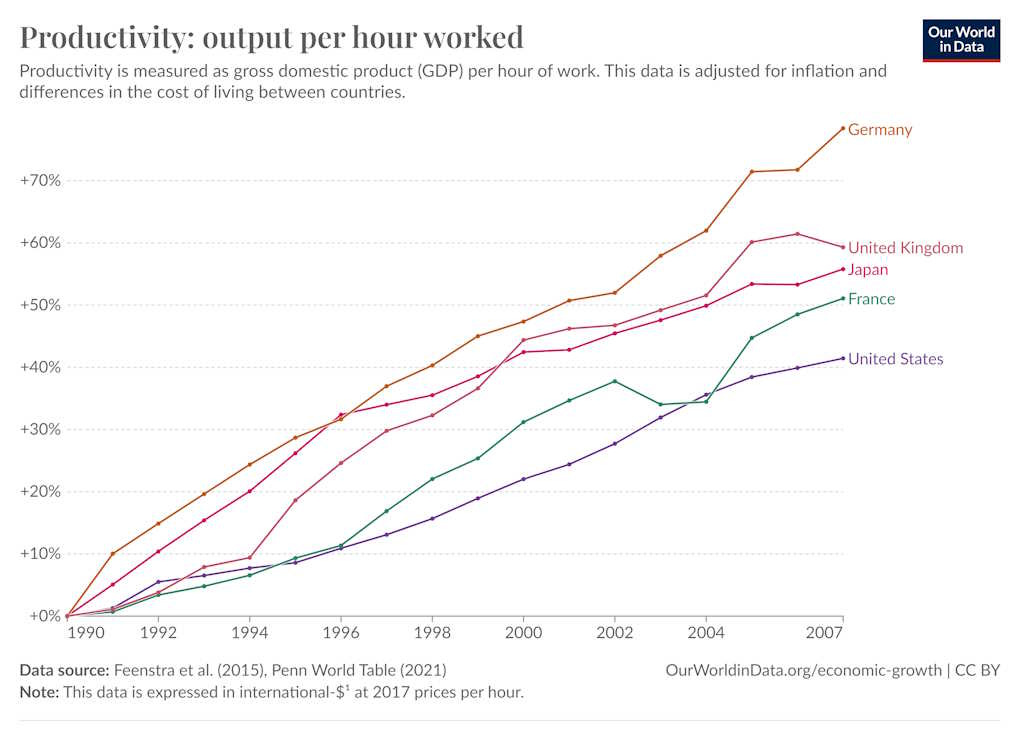
This was slower than the U.S. or West Europe, but that was mainly due to Japan’s more rapid population aging, which was increasing the percentage of retirees. In terms of GDP per worker, Japan kept pace with other rich countries over this time period, and even outgrew the United States:
 |
And this growth was being felt by regular Japanese people. It wasn’t just fancy gadgetry and big screens. Japanese houses were getting steadily bigger, growing from the tiny “rabbit hutches” of the postwar period into something similar to what Europeans enjoyed: