| | Looking back at what we got right and wrong in 2025, and what’s ahead for next year. ͏ ͏ ͏ ͏ ͏ ͏ |
| |  | Business |  |
| |
|
 In our last briefing of 2025, we’re looking both back and ahead — at what we got right and wrong this year, and what we’ll be watching in 2026. I’m usually wary of predictions, but feel I have a clearer sense of what 2026 will be about than I did in past years. The defining business stories of 2020 (global pandemic), 2021 (meme finance), 2022 (runaway inflation), 2023 (a policy response to that inflation that threatened a collapse of the banking system), 2024 (peak corporate culture wars), or 2025 (a wholesale rewriting of the global economic order) were harder to see coming. But the big story of 2026 is obviously — at least to me, on New Year’s Eve Eve — AI and how it reshapes business models, markets, culture, and politics. It’s nice knowing, if not what the stories will be, at least what they’ll be about. Wishing you all a restful end to the year, and we’ll see you in 2026. |
|
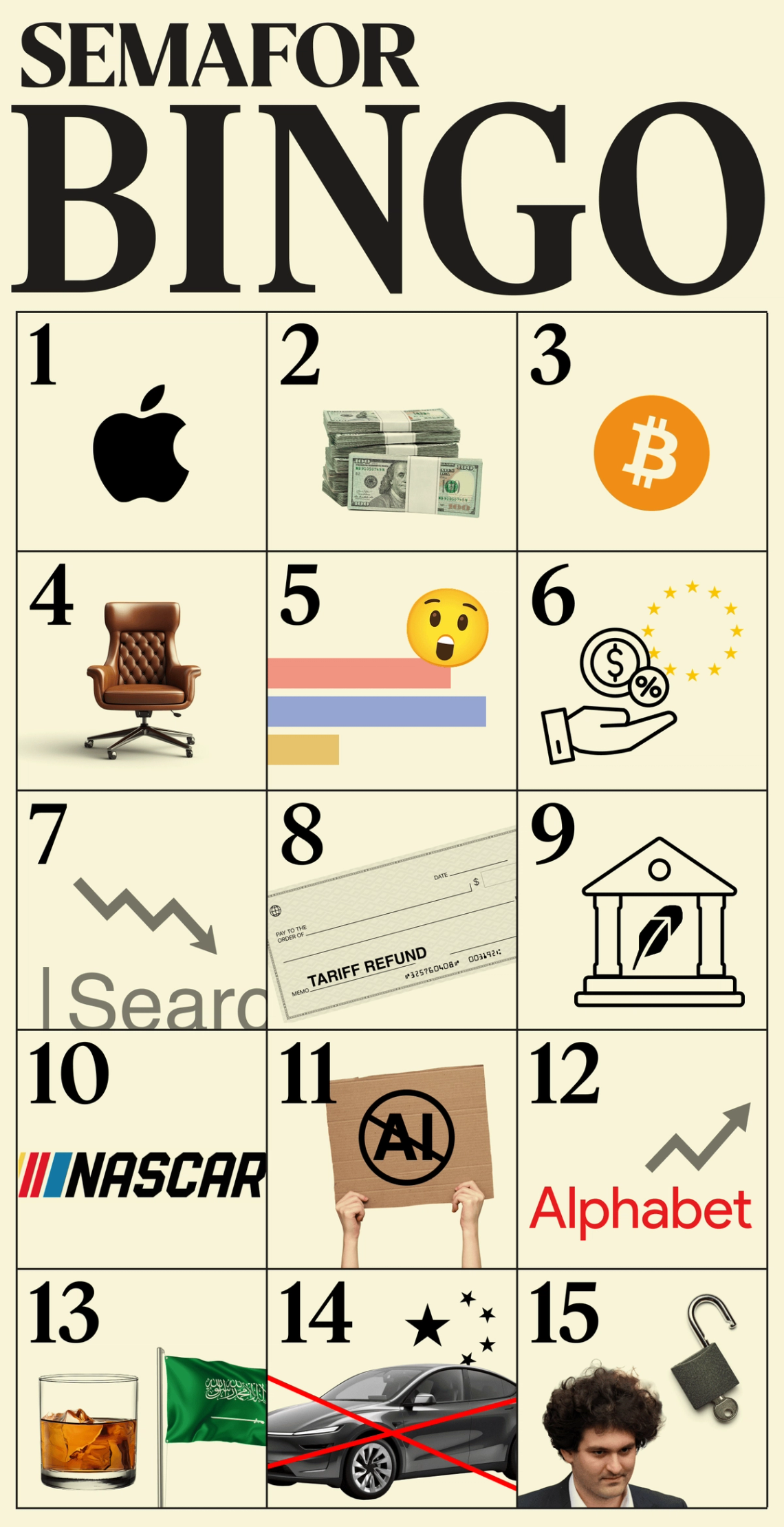 Here’s Semafor Business’ 2026 bingo card. Your free space is a new Fed chair, and other predictions run the gamut from likely to long-shot. We’ll check back a year from now to see how we did. — Liz and Rohan - Apple ponies up. Breaking its aversion to big M&A, Apple buys an AI search engine or model lab — think Mistral or Perplexity — to catch up in the tech and talent war it can’t afford to be losing.
- A new $1 trillion asset manager. Blackstone has held the mantle for too long. KKR is still a few years away, so this newcomer will be formed by acquisition. Here’s one combination you can cross off, and one to watch.
- Bitcoin at $120,000: Trump makes crypto the base of a US sovereign wealth fund. Nothing sends asset prices higher than a forced buyer.
- FREE SPACE: New Fed chair
- A predictions-market scandal will make Nobelgate look small and bring new regulation down on online betting.
- A European digital tax. France, Italy, and Spain already have one, and splitting €38 billion in revenue could help deficit-strapped and debt-shy governments pay for defense buildouts.
- SEO death spiral. Human-directed web traffic falls by 25% as agents come of age, sparking a sharp drop in e-commerce stocks.
- Tariff refunds. Either checks sent directly to Americans as a popularity play before the midterms, or payments to retailers after the Supreme Court finds some of the levees unconstitutional.
- Robinhood buys a bank. It becomes the latest fintech to embrace the “if you can’t beat ‘em, join ’em” ethos.
- NASCAR takes outside money. With the antitrust lawsuit settled, sports eating finance, and red-state culture ascendant, the lane is wide open.
- A major labor action over AI. Thousands of workers in telecom, healthcare, and manufacturing walk off the job, demanding ‘human-in-the-loop’ contracts that block AI from doing mission-critical tasks.
- Alphabet becomes the world’s most valuable company. Custom TPU chips, the Gemini 3 rollout, and a big Waymo expansion drive its market cap past a cooling Nvidia and Apple.
- Saudi Arabia starts serving. Allowing booze will lure Westerners who prefer the libertinism of Dubai, boosting the kingdom’s ambitions to win the “regional headquarters” race.
- China bans Teslas. Beijing enacts a total ban on Tesla sales, citing the recently passed cybersecurity law and “national security risks” posed by the cars’ cameras.
- Sam Bankman-Fried gets pardoned after a media campaign reframing his 25-year sentence as a partisan hit job.
|
|
➚ BUY: Resolution(s). Tech companies are already previewing buzzy new products ahead of January’s CES conference, with Samsung promising the “world’s first 6K glasses-free 3D gaming monitor.” ➘ SELL: Bubble(y). AI bubble worries be damned, every Wall Street analyst is predicting a fourth straight market rally year in 2026. “The pessimists have just been wrong for so long,” one told Bloomberg. |
|
 Carlos Barria/Reuters Carlos Barria/Reuters“Meta is early and theatrical in its rightward turn as Republicans take over Washington, but it won’t be alone,” we wrote in our first scoop of 2025, on Meta’s replacing its progressive policy chief, Nick Clegg, with a conservative. The “major attitude adjustment” we predicted back in January became one of the biggest stories of the year, as did our prediction that some of that obsequiousness would age badly as Trump started to look less invincible. “If the president-elect is talking about buying the Panama Canal, the reins on corporate America feel loose,” we wrote in January. What followed was a near-record year of M&A — though as Liz noted last week, it’s one with a decidedly more defensive and uneasy feel. Delaware keeps its grip on corporate America. “Reincorporating in Texas is like going to Bluesky — intriguing, maybe, but it seems like a lot of work, and none of my friends are there,” we wrote in March, as Elon Musk was galvanizing a huffy, tech-led exodus from the First State. It never caught on outside a few controlled companies. |
|
 Dado Ruvic/Illustration/Reuters Dado Ruvic/Illustration/ReutersHollywood’s hot potato. We assumed Paramount would win the bidding for Warner Bros. Discovery and remain a bit perplexed that Netflix even wants it. The streaming giant has gotten this far in Hollywood without a legacy studio — why start now? Big Law’s big whoop. Trump’s attacks on law firms felt existential last spring. Nine months later, they’ve created no big fractures in the industry. The legal M&A rankings look much like they did last year, principled defections by partners or clients were rare, and Skadden’s newest class of public-service-minded fellows is every bit as progressive as last year’s. Not exactly wrong, but we certainly top-ticked the argument that AI spending was nothing to worry about. “Most of the AI investment is coming from tech giants spending the profits produced by their cash cows,” we wrote in September, almost exactly as the industry went on a borrowing binge. |
|
| |



