|
At least five interesting things: Buy Local edition (#74)
Abundance and small business; Luxury housing and rent; Tariffs and the economy; Fraud; Math anxiety; Chinese robots
|

| |||||||||||||||


 |
2025 is drawing to a close, so here’s one last roundup of interesting econ-related items from around the web. I don’t have any podcasts for you this week, but an episode of “Doom Debates” with Liron Shapira will be coming out soon.
1. Why Abundance is good for small business
It always seemed a bit silly that some of the antitrust people decided to start a rhetorical fight with the Abundance people. After all, market power decreases abundance (since there’s a deadweight loss from monopoly). So theoretically these folks should be on the same side.
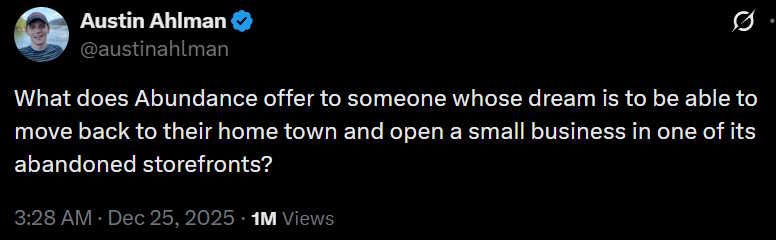
But for whatever reason, some folks still insist on seeing a contradiction here. For example, Austin Ahlman asks how the Abundance movement will help a small businessperson trying to revitalize his hometown:
 |
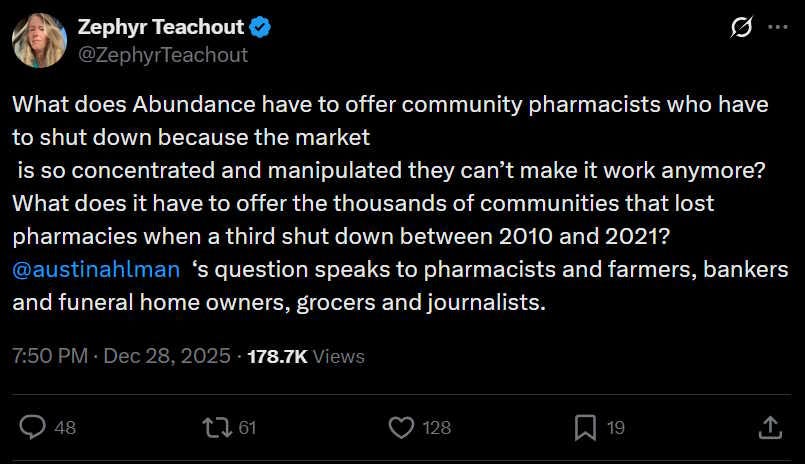
And Zephyr Teachout asks what Abundance can offer to small pharmacists struggling in the face of competition from big chains:
 |
I don’t sneer at questions like these; they are good and important questions. I’m a big supporter of small business, which I view as a pillar of the middle class, a provider of variety, and a positive force in urban politics. So I definitely want policies that support it.
In fact, the Abundance idea has a huge amount to offer small businesses. For example, let’s answer Teachout’s question first. Pharmacies face a huge number of regulatory barriers. It’s expensive, difficult, and time-consuming to get a permit to open a pharmacy. Renovating a space costs a lot of money and requires more onerous approvals and permits. There’s plenty of laborious labor regulation that raises the cost of hiring workers. And so on.
These costs function as barriers to entry for businesses. Big chain pharmacies like CVS and Walgreens can easily pay those costs and take the required time; in fact, they’ve already budgeted the costs in. But for small independent pharmacies, these regulatory costs and delays are a huge burden. This puts a thumb on the scale for the big chains, making it a lot easier for them to drive the mom-and-pops out of business.
Abundance isn’t purely a deregulatory project — there’s a lot of other stuff involved — but it definitely wants to reduce these sorts of regulatory overhead costs. That will make it much easier for small businesses to compete.
This also helps answer Austin Ahlman’s question about the businessman trying to revitalize his hometown; reducing regulation will help speed him on his quest. But for a small business in a declining town, demand is more important than regulation. Where will the small businessman get customers?
Abundance can help here too. Building infrastructure — roads, sewers, and electrical grids — will help people move to the declining town and revitalize it. Easy permitting for solar power and transmission will not only give the businessman cheap electricity, but will also lure industry to the area, bringing in workers who will then become the businessman’s customers. And so on.
Abundance is, at its core, an idea that will make it much easier to run a small business. Fortunately, local politicians from Zohran Mamadani to Daniel Lurie are embracing that idea, promising to reduce regulatory costs in their cities in order to help their small businesspeople. “Antimonopoly” intellectuals should pay attention.
2. “Luxury” houses reduce rents for people who live in “affordable” houses
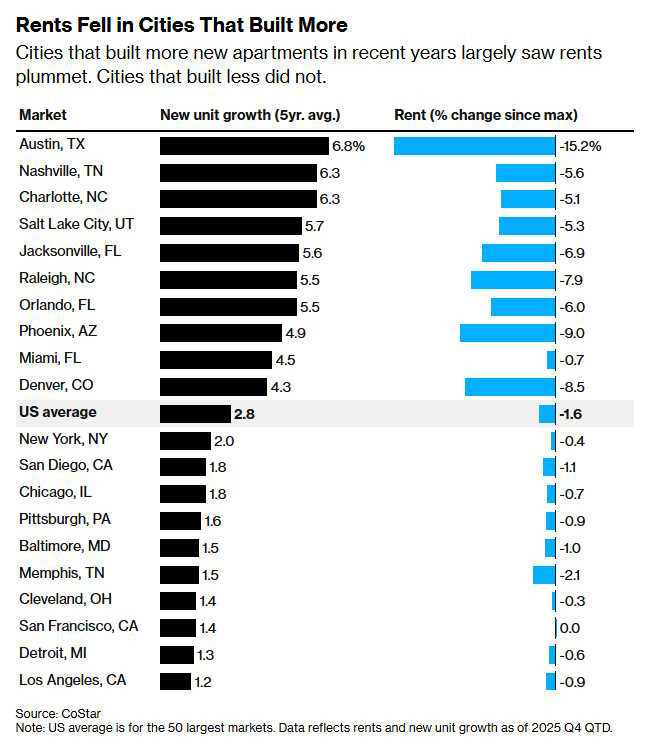
Speaking of abundance, the quest to lower rents by building more housing is starting to bear a little fruit. Emily Flitter and Nadja Popovich report that a few big American cities have built a bunch of housing, and that almost all of these cities have seen big drops in rent. Meanwhile, the cities that build less housing have seen much less of a drop:
 |
Now, correlation isn’t causation, as we all know. B