|
 |



Behavioral interviews have become the cornerstone of tech hiring, with 73% of HR professionals using them as their primary assessment method. For tech job candidates, mastering the behavioral interview is often more critical than many realize, particularly because candidates selected through modern behavioral assessment methods are 14% more likely to succeed in their roles. The path to landing a tech job involves navigating complex hiring funnels where understanding what recruiters and leaders actually evaluate—beyond the STAR method and technical prowess—can be the decisive factor between an offer and rejection.
 |
Understanding the Tech Hiring Funnel and Realistic Probabilities
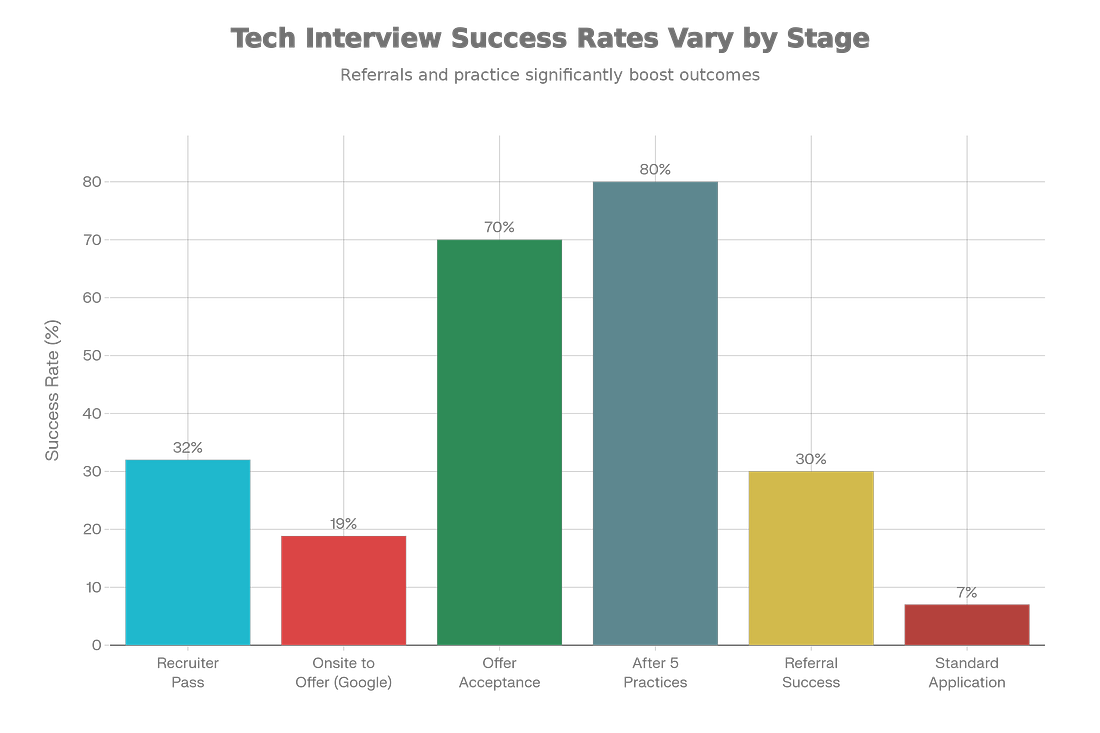
The statistics surrounding tech hiring reveal a brutally competitive landscape. On average, engineers pass only 32% of recruiter screens, but this masks a dramatic divide: the top 25% of candidates pass recruiter screens at a rate of 64.48%, while the bottom 25% pass only 5.54% of the time. This distribution illustrates that your preparation and presentation matter enormously.
For those who advance to the onsite interview stage, the acceptance rates vary significantly by company prestige. At companies like Google, approximately 18.83% of onsite candidates receive offers, though Glassdoor data shows this may be slightly higher than reality due to reporting biases. More conservative estimates suggest the true onsite-to-offer ratio at top-tier tech companies ranges between 10-20%. For perspective, it takes an average of 20 interviews to secure one offer, though if you’re highly selective about companies, you may need 35 interviews—nearly double—to receive your first offer.
However, the most critical number for your success is this: after participating in five practice or mock interviews, candidates’ pass rates jump to approximately 80%. This single data point provides actionable hope—your preparation directly correlates with your outcomes. Additionally, referrals dramatically change the playing field: referred candidates are hired at a 30% rate compared to 7% for all other application methods combined. This 4x advantage underscores why networking and internal connections matter far more than application volume.
For offer acceptance rates, once you receive an offer at a prestigious tech company, you have approximately a 70% chance of accepting it, but this figure is highly correlated with the interview experience—if your experience was positive, acceptance rates climb to 87.5%, while negative experiences drop acceptance to just 33.8%.
The STAR Method
The STAR (Situation, Task, Action, Result) method remains the gold standard framework for behavioral interview responses. However, recruiters note that many candidates use it mechanically, producing rehearsed, disconnected narratives. The key is that your time allocation matters: dedicate approximately 20% to situation, 10% to task, 60% to action, and 10% to result. The action segment is where you prove your value—this is where you should emphasize what you personally did, with specific details and quantifiable metrics.
Beyond STAR, forward-thinking interviewers are adopting the SOAR method (Situation, Obstacle, Action, Result), which adds explicit acknowledgment of challenges, reflecting the reality that candidates who merely highlight successes without addressing obstacles seem unrealistic. The transition to SOAR recognizes that 82% of employers now use virtual interviews, many incorporating AI analysis, and responses must be optimized for both human and machine evaluation.
What Tech Leaders and Recruiters Actually Evaluate
According to a recruiting leader at Zapier, candidates make a critical mistake by providing generic, non-specific responses. She emphasizes that “having those examples ready to go and rehearsed can help a ton,” but crucially, interviewers can detect when answers aren’t authentic.
Meanwhile, a Careem talent acquisition manager states that “behavioral interviews carry a lot of weightage in our hiring process. They help us gain insight into how candidates approach challenges and work collaboratively with others”.
The soft skills imperative has reached new prominence: 92% of recruiters prioritize soft skills over technical skills, citing communication, emotional intelligence, and collaboration as most crucial. This represents a fundamental shift in hiring priorities. Tech companies increasingly recognize that 88% of hiring managers prioritize cultural fit over specific skill sets when choosing between top candidates. While technical capability remains table-stakes, your ability to communicate, learn, and integrate with team dynamics often determines the final hiring decision.
The most revealing insight from business leaders: attitude is non-negotiable and often non-teachable, making it one of the most important hiring factors. Recruiters universally note that you can teach technical skills, but you cannot teach integrity, work ethic, passion, and adaptability.
Critical Success Factors
1. Concrete, Specific Examples with Quantifiable Results
One of the most common rejection triggers is providing vague, generalized responses. Instead of saying “I managed a crisis,” say: “When our API experienced a 99.2% failure during peak hours affecting 47,000 concurrent users, I led a cross-functional response that identified a memory leak in the request handler, deployed a patch within 23 minutes, and restored service to 99.99% uptime while preventing an estimated $340,000 revenue impact”.
Recruiters specifically look for the “power of three”—three concrete action steps you took to achieve results—rather than vague principles. Studies show that patterns of behavior across multiple examples are far more revealing than single isolated successes.
2. Demonstrating Ownership Over Blame-Shifting
Tech company interviewer feedback consistently highlights a critical red flag: candidates who avoid personal responsibility in team failures. When discussing challenges, use “I” language strategically—not to monopolize credit, but to show what you specifically did. Avoid phrases like “the team failed” or “management didn’t understand”; instead, frame it as “here’s what I contributed to the outcome” and “here’s what I learned about my own approach”.
Amazon’s leadership principle of “Ownership” explicitly demands this mindset—employees must think long-term and act on behalf of the entire company, never deferring responsibility with “that’s not my job”.