| Welcome, Weekenders! In this newsletter: |
| |
| • The Big Read: Dubious biological age tests sweep Silicon Valley |
| • Plus, Recommendations—our weekly pop culture picks: “Forged,” “While Israel Slept” and “Fallout” |
| |
| If your holidays were anything like mine, you probably spent more than you expected to on presents. You may have had a couple glitches with your online shopping—for example, shoes you had to return because they didn’t fit. Overall, though, in my personal experience, e-commerce has turned into a pretty well-oiled machine. |
| If I know what I want to buy, I can do so within seconds on the internet. If I don’t, a few minutes on Reddit or Wirecutter or a post on social media will help me figure it out. Unless weather messes things up, the deliveries usually get to me when they’re supposed to. |
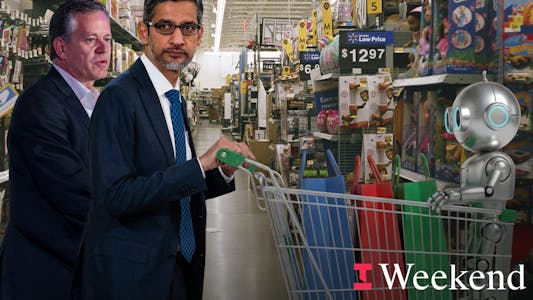
| All of which is to say, I am unconvinced I need AI to help me make purchases. But that’s not stopping the tech industry, in these first couple of weeks of 2026, from gearing up to persuade all of us their AI agents are going to help us do retail better in the future. |
| On Sunday, for example, Google CEO Sundar Pichai is set to speak at a big confab in New York put on by the National Retail Federation, where he’s scheduled to deliver a keynote about the “opportunity for retail in the age of agentic AI.” He’ll also have a fireside chat at the event with John Furner, the incoming CEO of Walmart, about how the two companies are using the technology. |
| The vision of these companies is that their AI agents are going to help people comparison-shop, monitor retailers for price fluctuations and actually conduct transactions. For now, though, these shopping agents are struggling to get off the ground. Earlier in the week we reported on Amazon’s and OpenAI’s bumpy attempts to launch their AI shopping efforts, which are still a work in progress. |
| It’s not clear consumers actually want these features. On Friday, I spent an hour trying to get Google’s mobile app to call physical stores on my behalf to check whether the retailers had items in stock, a feature Google announced in November. Eventually, I gave up. |
| Many of us are so finicky about our purchases that the idea of outsourcing the process of making them to AI is going to require a complete rewiring of our brains. I don’t even like members of my family buying things for me, other than groceries. |
| Still, I’ll admit ChatGPT often does a nice job of synthesizing product reviews from other sites like Reddit. But if AI companies want their agents to get a piece of my shopping budget this year, they’re going to have to find me some ridiculous bargains first.—Nick Wingfield |
| |
|
|
 |
|
| Silicon Valley has long had a fixation on business metrics like key performance indicators. When it comes to personal health, one of the favorite indicators of techies is biological age, a measure of their bodies’ condition relative to their chronological years. The curiosity about biological age has fueled a boomlet among more than a dozen companies that produce test kits for measuring it. |
| The only problem is that these tests often produce wildly different biological age results for the same person, as Jemima McEvoy reports in this Weekend’s Big Read. There’s no consensus on what the definition of biological age is, and some critics say the tests aren’t a good use of money. Still, some skeptics have softened their stance on them, saying they can encourage people to take better care of their health. As for me, I think the tests are terrific—but only if they say my biological age is 10 years younger than I actually am. Everything else is junk. |
| Nick Wingfield is The Information's features editor. You can reach him at nick@theinformation.com or find him on X. |
| |
 |
| Listening: “Forged” |
| After accumulating some wealth and fame, Kevin Hearn, the Canadian keyboardist of the Barenaked Ladies, decided to start collecting art a few years ago. And in a burst of national pride, he picked up a piece by Norval Morrisseau, an Indigenous artist who’s been labeled “a Picasso of the North.” |
| Or at least Hearn thought he had bought a Morrisseau. In reality, he’d purchased a fake, and over the past decade, his efforts to unravel the counterfeit item’s provenance eventually took down a massive international syndicate of art crooks, whose $100 million fraud ranks as one of the largest art swindles ever. “Forged” recounts the tale, with Hearn as a guest and another Indigenous artist, Adrian Stimson, as able host. Let me further pique your interest in the caper they recount: Much of it takes place in Thunder Bay, Ontario, murder capital of Canada.—Abram Brown |
| Reading: “While Israel Slept” by Yaakov Katz and Amir Bohbot |
| In seeking blame, human nature would like an easy, straightforward answer to this question: Who let the bloody October 7 attacks happen? |
| But as Yaakov Katz, The Jerusalem Post’s former editor in chief, and Amir Bohbot, a military correspondent at Walla, a top Israeli news outlet, would tell anyone, such an answer is impossible to find. The catastrophe, which they liken to Pearl Harbor, stems from a systemic, nationwide failure: Many, many people share some degree of culpability. They document it in searing, grim detail—and unwind the day’s events with the same somber but insightful depth. |
| As a coda, they include a rallying cry for their native land. “What we learned after October 7 is that Israel can overcome any external threat,” they write. “What it cannot overcome is the danger that lies within it—a threat born of division and self-inflicted harm.”—A.B. |
| Watching: “Fallout” |
| Well, don’t I feel like a man who’s wandered in from the Wasteland and found a steamin’ hot pot of flea soup on the stove: Amazon’s “Fallout” has returned, and the second season is just as mordantly wonderful as its 2024 debut. |
| The show draws inspiration from the very long-running videogame series of the same name about a post-apocalyptic future that follows a nuclear armageddon. Thankfully, the series is no dully faithful adaptation of any particular game. The plot is wholly original, and the latest season commences just where the last ended: Lucy (Ella Purnell) is wandering off with the Ghoul (Walton Goggins), a zombie-like bounty hunter, to track down her father (Kyle MacLachlan), who hopes to continue his former employer’s efforts to conquer the world. There’s another timeline set in the past, slowly revealing exactly how the planet ended up as a place with car-size mutant cockroaches. |
| “Fallout” maintains a glad-handish relationship with grossness and gore, and several heads explode even before the season 2 premiere finishes. That sense of humor is what makes the series such a delight, and the show finds great joy in taking poisonous stabs at concepts like groupthink and capitalism. One memorable line gets handed out early to a character with a highly descriptive name, Brain-on-a-Roomba (Michael Esper), who describes his corporate overlords’ desire to manage doomsday’s outcome as “the greatest achievement in the history of vertical integration.”—A.B. |