|



How Sentry Built Production-Informed AI Code Reviews (Sponsored)
 |
In order to have your code review reflect real system behavior, you can integrate production signals into developer workflows.
Sentry built Seer to connect production failure signals to incoming code changes before merge.
Under the hood is a multi-stage bug prediction pipeline ⚙️
Filtering: large change sets are scoped down to files with the strongest historical failure signals
Prediction: models generate and cross-check bug hypotheses using code context and production telemetry
Prioritization: findings are ranked by estimated risk so only high-confidence issues surface during review
See how this works in practice on the Sentry blog.
This week’s system design refresher:
12 Architectural Concepts Developers Should Know
Top Developer Tools You Can Use in 2026
5 Rate Limiting Strategies To Protect the System
How Live Streaming Works?
5 Leader Election Algorithms Powering Modern Databases
🚀 Learn AI in the New Year: Become an AI Engineer Cohort 3 Now Open
12 Architectural Concepts Developers Should Know
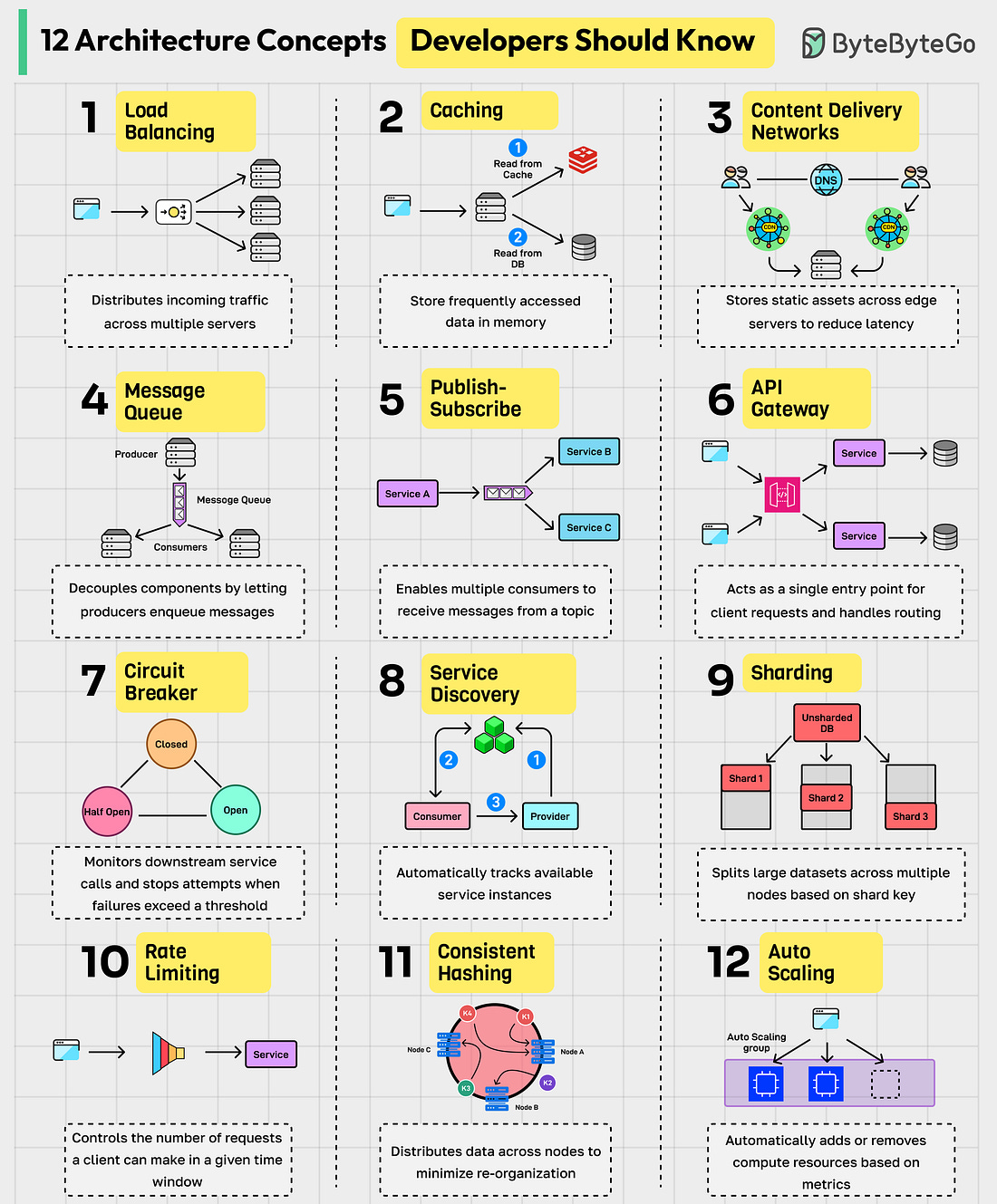 |
Load Balancing: Distributed incoming traffic across multiple servers to ensure no single node is overwhelmed.
Caching: Stores frequently accessed data in memory to reduce latency.
Content Delivery Network (CDN): Stores static assets across geographically distributed edge servers so users download content from the nearest location.
Message Queue: Decouples components by letting producers enqueue messages that consumers process asynchronously.
Publish-Subscribe: Enables multiple consumers to receive messages from a topic.
API Gateway: Acts as a single entry point for client requests, handling routing, authentication, rate limiting, and protocol translation.
Circuit Breaker: Monitors downstream service calls and stops attempts when failures exceed a threshold.
Service Discovery: Automatically tracks available service instances so components can locate and communicate with each other dynamically.
Sharding: Splits large datasets across multiple nodes based on a specific shard key.
Rate Limiting: Controls the number of requests a client can make in a given time window to protect services from overload.
Consistent Hashing: Distributes data across nodes in a way that minimizes reorganization when nodes join or leave.
Auto Scaling: Automatically adds or removes compute resources based on defined metrics.
Over to you: Which architectural concept will you add to the list?
Top Developer Tools You Can Use in 2026
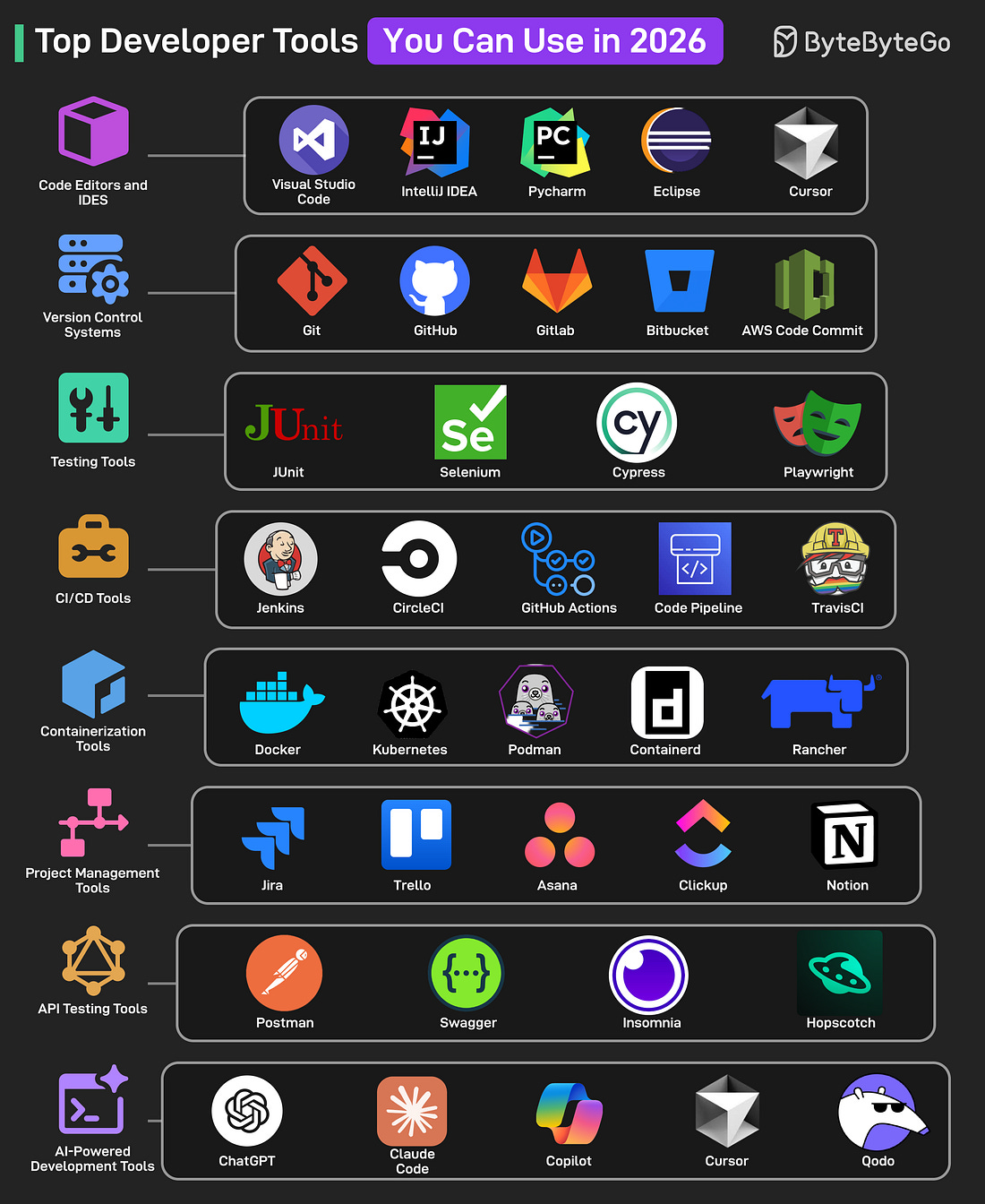 |
Code Editors & IDEs: These tools help developers write, edit, and debug code with greater efficiency. Examples are Visual Code, IntelliJ IDEA, PyCharm, Cursor, Eclipse, etc.
Version Control Systems: Track code changes over time and enable collaboration between team members. Examples are Git, GitHub, Gitlab, Bitbucket, AWS Code Commit, etc.
Testing Tools: Help ensure tha