|
 |



Saturday night, a federal judge prevented the Trump administration from revoking “parole” as many as 15,000 people who don’t have legal immigration status but have been permitted to remain in the U.S. for family reunification. “Parole” means that an individual has received temporary permission from DHS to enter and stay for urgent humanitarian reasons or significant public benefit, even if normally inadmissible. Parole is granted on a case-by-case basis. It is not a permanent status. People who receive it are able to remain in the U.S. and work, for the period of time they are granted parole.
Just before the holidays, the administration announced that it would revoke parole for these folks, all of whom are here legally and have sponsors in the U.S., by January 14th. These are people who have played by the rules and are waiting to get their green cards. The administration’s decision would have had no public safety benefit; it was simply a cruel holiday boot to these families, requiring applicants to return to the country they came from. The lawyers in Svitlana Doe v. Noem, a previously filed case in the District of Massachusetts, rushed into court on December 29, 2025, to amend their complaint and seek injunctive relief for the people about to be impacted, and an emergency hearing was scheduled for last Friday after DHS threatened to “promptly remove aliens” who entered the United States under the family reunification programs if they remained in the U.S. after the January 14 parole termination date.
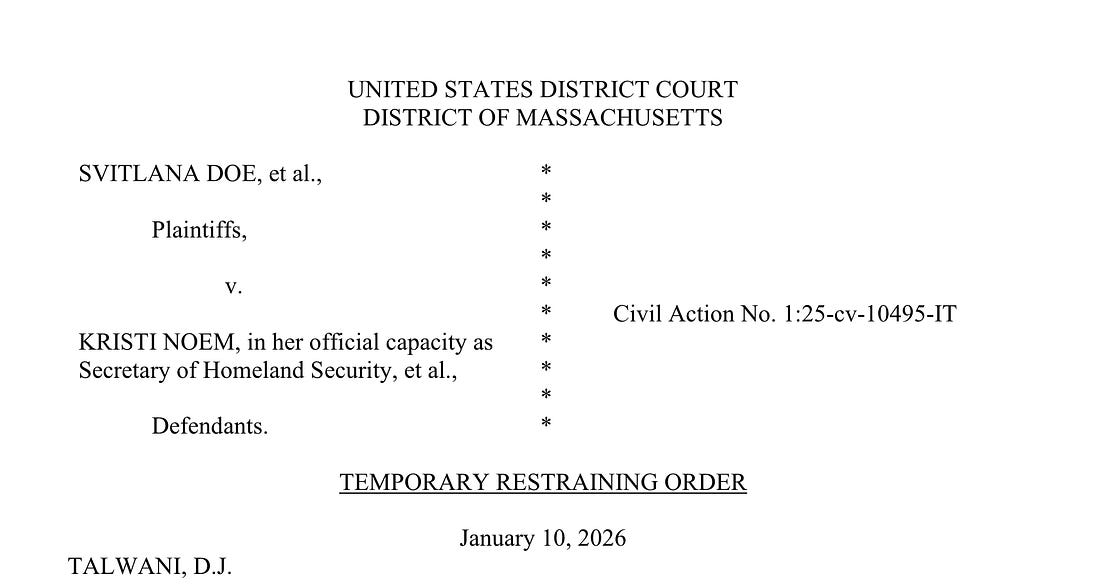
The lawyers asked the court to enjoin the government from early termination of previously granted parole status. They also asked Judge Indira Talwani to certify a class action so that, in addition to the plaintiffs named in the lawsuit, everyone impacted by the administration’s decision would receive protection. Judge Talwani’s order prohibits the government from revoking parole granted to Colombians, Cubans, Ecuadorians, Guatemalans, Haitians, Hondurans, and Salvadorans with family reunification status for the next 14 days. She also set an expedited briefing schedule to consider the plaintiffs’ claims.
 |
A key point here is that instead of going after violent criminals or people engaged in fraud—Trump’s main rationale for mass deportations—this is about going after people who have legal permission to be in this country. The fact that the administration is doing this suggests the administration can’t meet its stiff deportation targets and is now propping itself up to claim success by deporting people who are here legally.
Here is an example of just one of the families that would be forced to leave the country if the administration implements this new policy: David Doe is an Ecuadorian national who lives in Arkansas with his wife and two sons, ages 14 and 11. In 2012, his Dad, who is a U.S. citizen, filed to sponsor him. The family qualified for an F-3 immigrant visa, but it wasn’t until 2023 that they received the official invitation to come to the United States. The vaccinations and medical paperwork alone that they had to complete before coming here cost $1800 per person. Doe went to college for business in Ecuador, has a master’s degree in business from a Canadian university, and holds an additional degree in theology. The family received authorization to travel here in May of 2024, and their status permits them to remain and work here until July 2027. Doe originally took a job on the assembly line in a poultry plant cutting up chickens but was quickly promoted into management.
David Doe is not this individual’s name, obviously. But he says that he is afraid to use his real name because he fears retaliation from the government. Our government.
Doe v. Noem addresses the concerns of a number of groups of people, in addition to those involved in the injunction. The people whose lawful status the administration is trying to revoke, and whose status remains in jeopardy, include:
Ukrainians displaced by the war with Russia;
Nationals of Cuba, Haiti, Nicaragua, and Venezuela, who were granted status because their countries were ravaged by natural disasters and/or political strife;
Afghans fleeing the newly resurgent Taliban;
Military Parole in Place so that U.S. military servicemembers may seek parole for their parents, children, and spouses, and need not worry about the immigration status of these close family members while serving their country; and
A process for Central American minors, which permits them to reunite with parents who are already in the United States.
Tonight, lawyers for the plaintiffs explained to me that the families on whose behalf they sought the injunction are all statutorily eligible for green cards and on the cusp of getting them. The families were hand-selected by an invitation from the federal government to come here. The Judge was concerned about potential due process violations because the families received notice of the administration’s en masse early termination of their legal status via publication in the Federal Register—not exactly readily accessible, and far from the kind of individual, written notice due process requires. They told me the Judge characterized the administration’s action as callous and the notice as woefully insufficient. It does not sound like this case will go well for the government once it’s fully briefed. The appellate courts have remained receptive to claims the Trump administration is violating immigrants due process rights.
One of the lawyers in the case, Karen Tumlin, director of the Justice Action Center, explained the impact of the Judge’s injunction: “While we aren’t in the clear, this immediate pause on de-legalizing individuals who came here with Family Reunification Parole means that people will not be forced to separate from their loved ones next week. It’s cruel and completely unnecessary for the Trump administration to try to yank the rug out from under them, and we will continue to fight to ensure they can retain their lawful status and remain safe and secure with their loved ones.”
This administration is playing a shell game, trying to remove people like David Doe, who are making valuable contributions and are legally entitled to be here, from the country. They will use the rhetoric of violent, dangerous immigrants and “America first” to justify it. So make sure you tell the people around you the story of David Doe, who has just found out that after giving up his job and selling his belongings in Ecuador to move his family to this country, the administration wants to send them back to a place that is politically volatile and where they experienced the threat of violence. They will learn the next step in their fate in the next 14 days.
Thank you for your support for Civil Discourse. Your paid subscriptions make it possible for me to devote the time and resources to the newsletter, which allow me to bring you late-breaking news like this report.
We’re in this together,
Joyce
You're currently a free subscriber to Civil Discourse with Joyce Vance . For the full experience,