The “Donroe Doctrine” in action

Global news you can trust.

Download the Reuters App.


Power Up

Power Up


A Reuters Open Interest newsletter

By Ron Bousso, ROI Energy Columnist


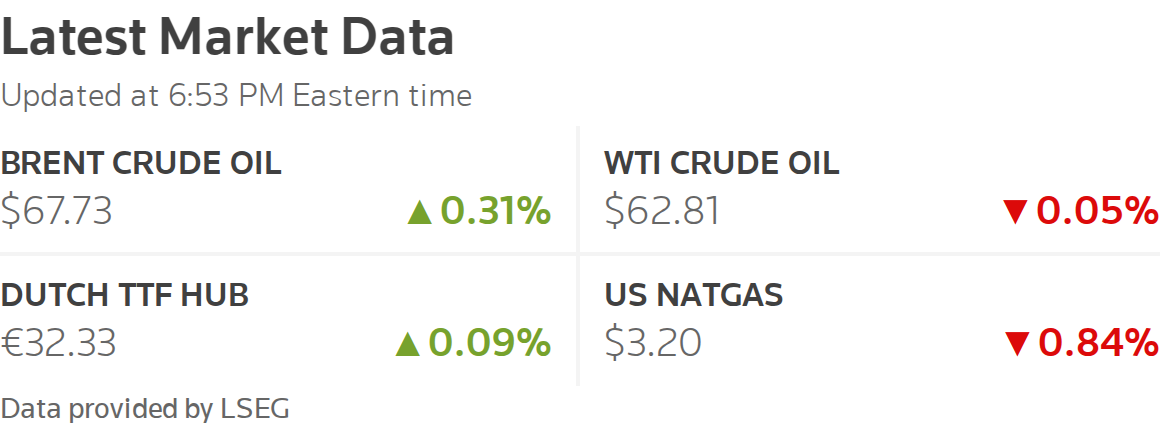
Data refreshes every time you open this email. For more energy news, click here. Please send any feedback to powerup@thomsonreuters.com.

Hello again Power Up readers,

Another week, another country? While the dust slowly settles on the U.S.-led raid to oust Venezuelan President Nicolas Maduro, attention in the energy markets has already turned to another important oil producing nation: Iran. U.S. President Donald Trump has threatened to intervene in the country after escalating anti-regime protests were met by a deadly crackdown over the past week.

It is still unclear if the U.S. will take military action against Iran in response to the unrest. What’s certain is that Iran is a big fish in the oil world, certainly bigger than Venezuela in terms of production. The Islamic republic produces around 3.3 million barrels per day, around 3% of global output, and exports around 1.4 million bpd, mostly to China. Venezuela, by contrast, produces less than 900,000 bpd.

Crucially, Iran controls one side of the Straits of Hormuz, a maritime chokepoint through which nearly a fifth of the world’s oil and gas flows. Any escalation in Iran would therefore raise concerns about disruptions in Hormuz, even though such activity has rarely occurred in the past, as I wrote during last year’s 12-day Israel-Iran war.

But let’s go back to Venezuela. Since our last newsletter, President Trump held a big televised gathering with the leaders of the largest U.S. and European energy producers and traders to discuss the future of Venezuela’s crumbling oil industry.

On the face of it, the meeting was a win for the U.S. president. It projected a sense of urgency, and Trump received lavish praise from many executives around the table.

But the meeting was far from a ringing endorsement of Trump’s ambitions to see energy giants pour $100 billion into Venezuela's oil industry, with the executives injecting a heavy dose of realism into the plan. More on this below.

Here are a few more energy-related headlines:

  • Global oil trading houses have emerged as early winners in the race to control Venezuelan crude flows, getting ahead of U.S. energy majors wary of credit and legal risks and securing a potentially lucrative business opportunity in the country.
  • A U.S. judge on Monday will consider a request from Danish energy company Orsted for an injunction against the Trump administration's decision to halt its $5 billion Revolution Wind project off the coast of Rhode Island.
  • I highly recommend this blog from energy guru Gerard Reid on the lessons drawn from recent major power outages that are essential for avoiding more, and potentially far bigger, disruptions as power grids evolve.

As always, don’t hesitate to contact me at ron.bousso@thomsonreuters.com or follow me on LinkedIn with any questions or thoughts.


Top energy headlines

  • Chile's Codelco expects to lift copper output by 10,000 tons this year
  • BHP to wait out Rio-Glencore talks, no plan to bid, sources say 
  • Trading houses beat US majors to first deals for Venezuelan oil
  • Oil prices hold near five-week high as investors assess impact of events in Iran and Venezuelan
  • Vitol, Trafigura offer Venezuelan oil to Indian, Chinese refiners for March delivery, sources say


Reality check 

Friday’s White House meeting was far from a ringing endorsement of Trump’s ambitions to see energy giants pour $100 billion into Venezuela's oil industry, dramatically increasing its current production of around 900,000 barrels per day.

Indeed, Exxon Mobil CEO Darren Woods asserted that the Latin American country was currently "un-investible" from a commercial and legal standpoint. President Trump has since said that he might keep Exxon out of Venezuela because of that “cute” remark.

But Woods may seem like stating the obvious. Venezuela has been subject to tough U.S. sanctions for nearly a decade, and its economy has suffered from decades of corruption and mismanagement.

Changing this reality would require several significant steps, beginning with the establishment of a government that can guarantee security on the ground and provide economic stability and fiscal confidence. All that could take months, if not years.

Read the full column
 

Get full access to Reuters.com for just $1/week. Subscribe now.


Sponsors are not involved in the creation of newsletters or other Reuters news content. Advertise in this newsletter or on Reuters' website

LiveIntent Logo
AdChoices Logo
 

Power Up is sent twice weekly. Think your friend or colleague should know about us? Forward this newsletter to them. They can also sign up here.

Want to stop receiving this email? Unsubscribe here. To manage which newsletters you're signed up for, click here.

This email includes limited tracking for Reuters to understand whether you’ve engaged with its contents. For more information on how we process your personal information and your rights, please see our Privacy Statement.

Terms & Conditions