| | In this edition, the case for Big Google, the Pentagon welcomes Grok, and what patent filings tell u͏ ͏ ͏ ͏ ͏ ͏ |
| |  | Technology |  |
| |
|
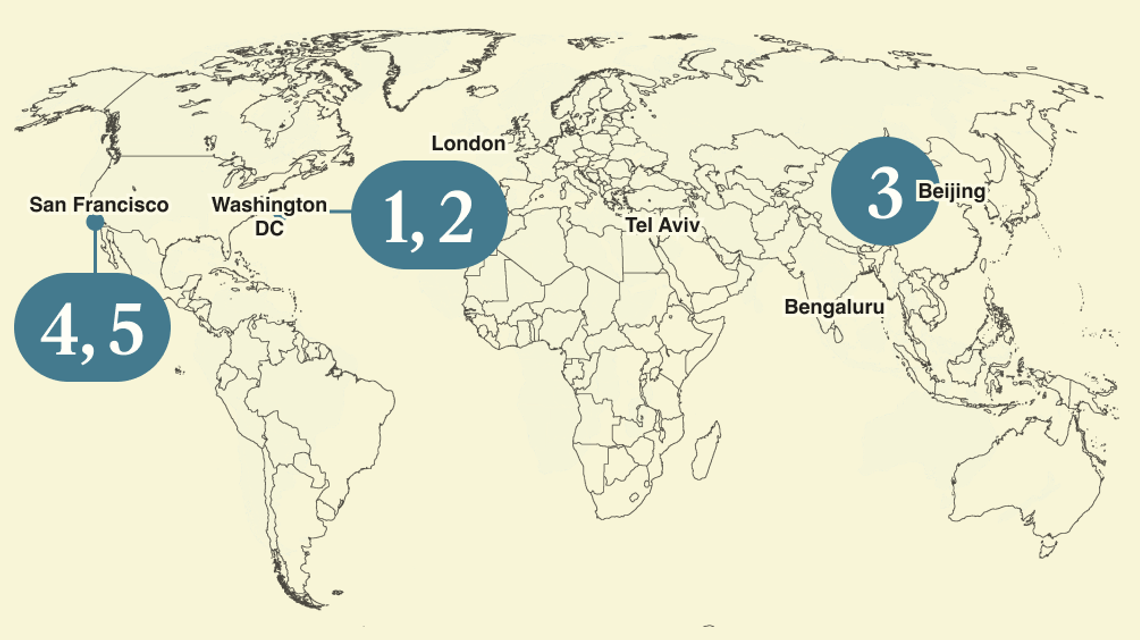 - In Grok we trust
- Patent power
- China’s chip defense
- AI coworker woes
- Tech ponies up
 The case for why Google’s immense power isn’t so bad, and a New York judge flips the script on using AI in court documents. |
|
 I was talking with a reporter this week about Apple’s decision to tap Google’s AI for Siri, and the reporter was lamenting the failure of the court system to rein in the all-powerful search engine giant, which was now running away with the AI race. What was the harm? I asked. The answer: If Google’s dominance forces every business to advertise on Google, it’ll ultimately drive consumer prices up. It’s almost as if there’s a religious aversion to the concept of a tech company being big and powerful, and the attempts to justify criticism are all over the map. It’s an even more difficult point to make when a company gives most of its products away for free. We need a new way to define “too powerful” in the tech industry, and it should be a simple test: Is the company spending serious capital on real innovation that could impact the economy or national security? In Google’s case, the answer is certainly yes. Using its massive compute resources, troves of data, and custom-designed processors helped turn theories languishing in resource-starved academia into reality. It’s also pushed forward quantum computing, which is critical to national security, and self-driving cars. A bunch of small companies simply couldn’t have made as big of an impact on such a massive scale. (Once upon a time, the federal government could have, but those days are behind us.) I’m not sure if search advertising is really driving up consumer prices, but if I have to pay an extra few pennies for my coffee, it’s probably worth the tradeoff. A programming note: I’ll be in Davos next week. I hope to see some of you there, and if you want to catch up with the latest from the World Economic Forum, sign up for our pop-up newsletter. |
|
 Evelyn Hockstein/Reuters Evelyn Hockstein/ReutersWhen Defense Secretary Pete Hegseth announced the Pentagon would integrate Elon Musk’s Grok models into military systems, he framed the decision around ideological constraints. The “Department of War AI will not be woke,” he said, echoing Musk’s vision for the chatbot as a rival to what he viewed as liberal-biased alternatives. In reality, Hegseth is following in the footsteps of many organizational leaders who are investing across all the AI models in order to keep up with ever-changing technology. The Pentagon previously built an internal platform with Google’s Gemini and has contracts with several other tech companies to develop AI tools for internal use. That’s the value of companies like Perplexity, which offer multiple models to choose between depending on the task since every few months it seems like a different AI model pulls ahead of the pack. It’s still early days for Grok’s enterprise business — it only launched last month — and Grok has already run into its fair share of problems. But a plug from the Defense Department will help it as it looks to expand its footprint and keep up as all the models try to one-up each other. |
|
Patent data shows where tech growth lies |
Talk to anyone in the industry and they’ll tell you the biggest points of technological growth: quantum computing, autonomous driving, robotics, and machine learning. But US patent data filed over the last five years tells a different story about the fastest growing sectors, according to a report by patent analytics firm IFI. They were technologies related to batteries, the production of sustainable materials, and electrolytic processes, which use electricity to spur chemical reactions and support clean fuel creation. The data suggests that the components of today’s biggest technology — AI — have largely been invented, and the next frontier for innovation is in power systems and sustainability. 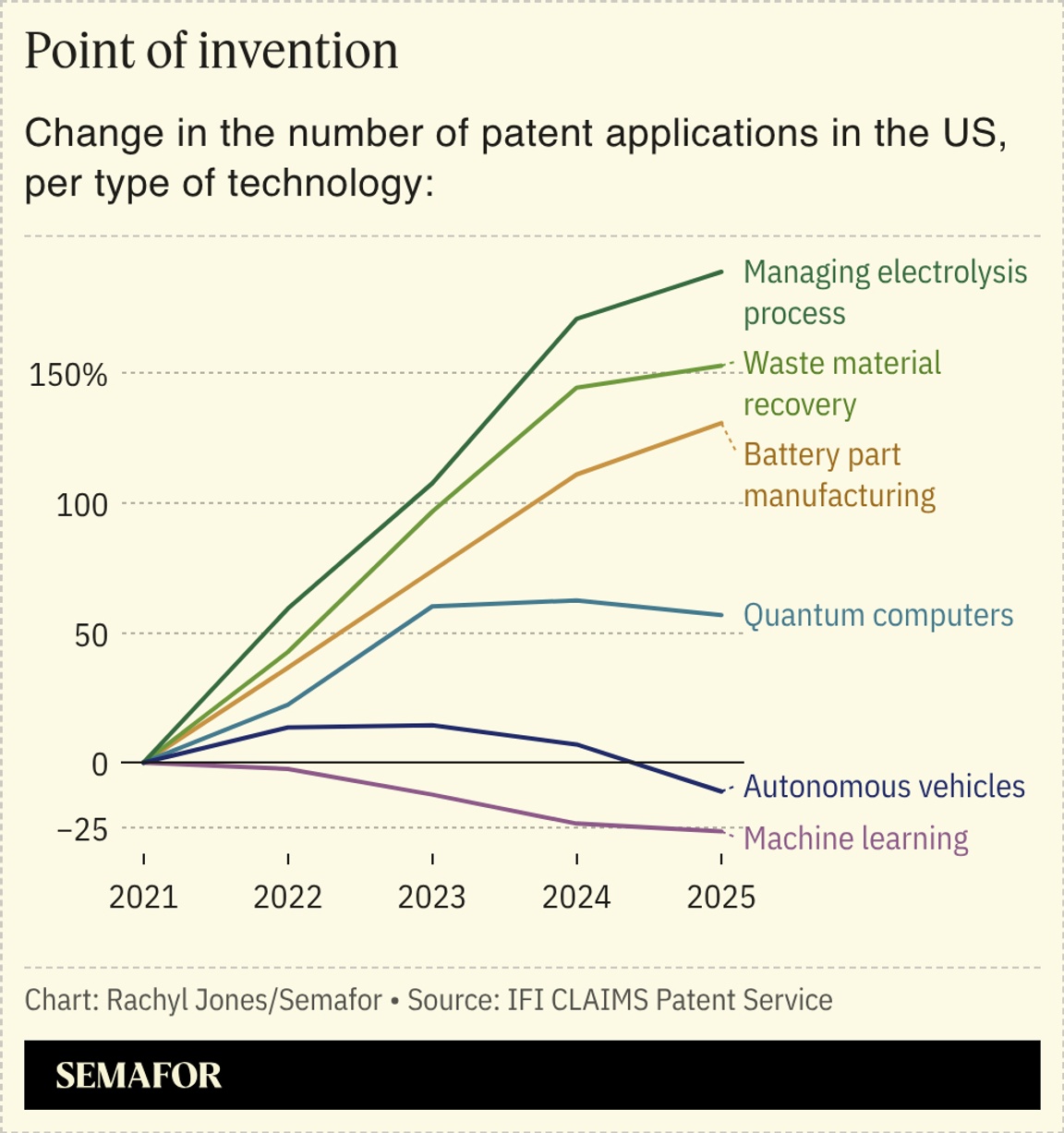 The push for green inventions comes from car companies, with Honda and auto component-maker Toshiba dominating those grant filings. It’s a signal that companies continue to see real business value in developing those new technologies, outside of the political ESG discourse that has tempered in recent years. And as energy becomes a focal point in the AI race, innovation on the battery front will continue in the coming years. |
|
H200s require approval: Report |
 Steve Marcus/Reuters Steve Marcus/ReutersIn the latest turn in the Nvidia-China saga, Beijing told some domestic tech companies that purchases of H200 chips would only be approved in special cases, The Information reported. It’s the latest hint of how China is planning to balance domestic infrastructure growth with available semiconductor power, suggesting that what could have been a slam dunk for Nvidia may not completely materialize. Meanwhile, Chinese AI leaders have expressed concerns about the nation’s ability to catch up to the US in the race to dominate in AI. Alibaba technical lead Lin Junyang blamed compute during a panel discussion in Beijing, saying Chinese companies are stretched thin on chips and other equipment while the US’ resources are “one to two orders of magnitude larger,” allowing it to invest more in research. For all the frenzy over DeepSeek last year, the comments suggest China’s investments in its domestic chip industry are not yet sufficient to cover the demand by tech companies. |
|
Rework reality hurts AI time-saving claims |
 Hannah McKay/Reuters Hannah McKay/ReutersBorrowed time. Yes, using AI is saving employees time, but it’s more complicated than that. AI tools are speeding up work for most people, who report saving between one and seven hours of work each week. But nearly 40% of the saved time is spent on rework — like rewriting, fact-checking, and correcting errors — according to a new study by Workday. This finding rings true for me. I spend more time verifying a query through multiple sources, or asking AI to organize data in tables, but then having to confirm each cell’s value is correct. To some extent, this is part of the new world order: We are increasingly managing our own AI assistants. As AI becomes integrated into our jobs, our everyday tasks are morphing. But while AI can help us work faster, the expectations for accuracy and accountability don’t change. Until tech companies can improve their track record on hallucinations and getting the facts right, that trust gap will remain, and workplaces won’t be able to capture the full value of AI technology. — Rachyl Jones |
|
Tech firms vow to cover energy costs |
 Jonathan Ernst/Reuters Jonathan Ernst/ReutersUS tech giants, under pressure from politicians and communities, vowed to take more aggressive steps to keep their data centers from hiking electricity costs. Microsoft’s president said Tuesday that the company will pay utility rates that are high enough to cover their energy costs, replenish more water than the facilities use, and add to local tax bases where it has data centers. Google, which recently bought an energy developer, is pushing federal regulators to speed up approvals for data centers that supply their own power. US President Donald Trump is urging Big Tech companies to “pay their own way” to avoid raising electricity prices, as the AI boom pushes power-grid operators to the brink. |
|
 Semafor has expanded the Semafor World Economy Global Advisory Board, a group of visionary business leaders representing nearly every sector across the US and G20 — who will help guide the largest gathering of global CEOs in the United States of America. Our co-chairs — Ken C. Griffin, founder and CEO of Citadel; Henry R. Kravis, co-founder and co-executive chairman of KKR; Penny S. Pritzker, former US Secretary of Commerce; and David M. Rubenstein, co-founder and co-chairman of the Carlyle Group, continue to lead this effort joined by a broadened roster shaping this year’s program. Joining the Advisory Board at this year’s convening will be our inaugural cohort of Semafor World Economy Principals — an editorially curated community of innovators, policymakers, and changemakers shaping the new world economy with front-row access to Semafor’s world-class journalism, meaningful opportunities for dialogue, and touchpoints designed for connection-building. Applications are now open here. |
|
 Kevin Mohatt/Reuters Kevin Mohatt/ReutersCases of AI-generated errors making their way into court documents are piling up, and lawyers are facing increasing fines for the oversight. But a New York district judge flipped the script on Tuesday, encouraging the industry to charge ahead with AI — or potentially face consequences. “I heard somebody say employers are risking malpractice by relying too much on AI,” Judge Jesse Furman said, according to Bloomberg Law. “I think there may come a point where it’s the opposite — where you’re committing malpractice if you don’t incorporate AI into your practice.” While it will take several years to reach the reality Judge Furman described, it is not difficult to imagine a time when AI becomes so good that avoiding the technology isn’t only inefficient, but improper practice. Take fees, for example. If a lawyer bills a client for thousands of hours of work that could realistically be done much quicker by an AI model, the client could have a case to contest the charges, Judge Furman said. |
|
|


