| | In today’s edition: The US sells $500M of Venezuelan oil, and how Rubio convinced senators to fall i͏ ͏ ͏ ͏ ͏ ͏ |
| |  | Washington, DC |  |
| |
|
 - First Venezuela oil deal
- War powers resolution stalls
- Greenland scramble on Hill
- Welch’s Trump outreach
- Mixed signals on Iran
- Execs fear AI threat
- Senate crypto drama
PDB: New push to close Hong Kong representative offices in US  Machado meets Trump … Dimon speaks at Chamber of Commerce event … Morgan Stanley, Goldman Sachs, BlackRock report earnings |
|
US makes first Venezuelan oil sale |
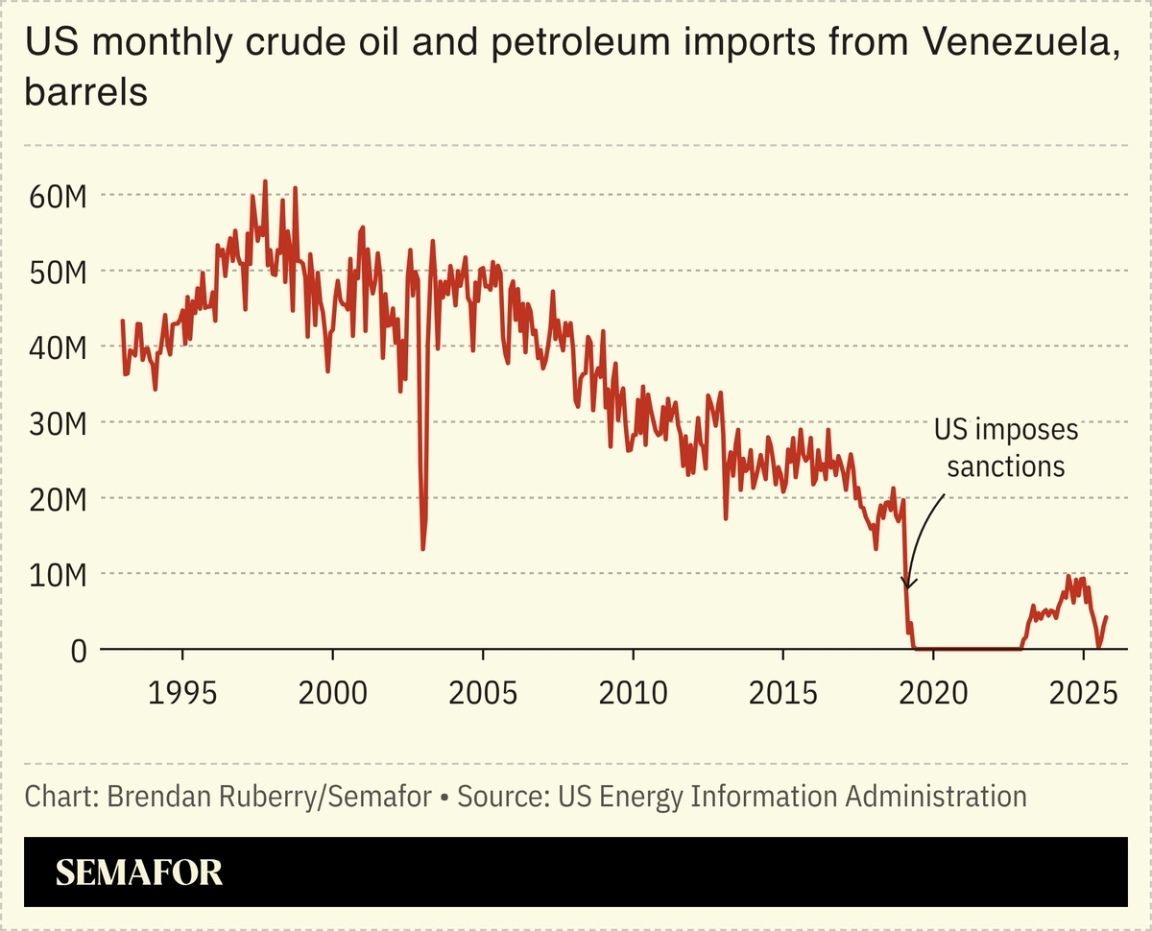 The Trump administration’s first sale of Venezuelan oil is valued at $500 million, Semafor’s Shelby Talcott and Eleanor Mueller scooped. It represents an initial milestone for the US after the ouster of Venezuela’s former leader Nicolás Maduro. Revenue from the oil sales is currently being held in bank accounts controlled by the US government, with the main account located in Qatar, a senior administration official said. Qatar was described by the official as a neutral location where money can flow freely with US approval and without risk of seizure, though it’s likely to cause consternation among Democrats who have expressed concerns about the prospect of offshore accounts being used. And while US oil companies are skeptical about investing in Venezuela, the Trump administration remains confident that more sales and deals will happen. — Shelby Talcott |
|
How Rubio sidelined Senate resolution |
| |  | Burgess Everett |
| |
 Evelyn Hockstein/Reuters Evelyn Hockstein/ReutersPresident Donald Trump went nuclear on five Republican senators for advancing a resolution that could constrain his military power in Venezuela. But Secretary of State Marco Rubio helped sideline the resolution with more subtle congressional diplomacy. The Trump administration and Senate GOP leaders successfully lobbied two key GOP senators — Josh Hawley of Missouri and Todd Young of Indiana — to bottle it up because US troops are not currently on the ground in Venezuela. Plus, Rubio told Young in writing that if Trump decides to enter US troops in “major military operations,” he would seek congressional authorization. It was a big show of force by Trump to defeat an attempt to restrict his power — and showed Rubio has the chops to move votes. It’s also a counterpoint to signs that the GOP Congress is breaking with Trump. |
|
Dem senator lobbies Trump, RFK Jr |
 Evelyn Hockstein/Reuters Evelyn Hockstein/ReutersDemocrats don’t get a lot of White House invitations, so Sen. Peter Welch, D-Vt., made good use of his attendance at a bill signing for a legislation allowing whole milk at schools. Welch spoke directly to Trump and Health and Human Services Secretary Robert F. Kennedy Jr. and “urged them to back an extension of the [Affordable Care Act] premium tax credits,” a spokesperson said. “I’m still totally committed to making every effort to extend these tax credits,” Welch told Semafor. “We’ve got the framework of a doable deal, but nothing will happen unless the president gives it his OK.” Sen. Bernie Moreno, R-Ohio, is leading the GOP side of the negotiations, which are stalled until later this month as Trump angles to put out his own health care plan and both parties fight over how to handle Hyde Amendment abortion restrictions. — Burgess Everett |
|
Congress sweats Greenland campaign |
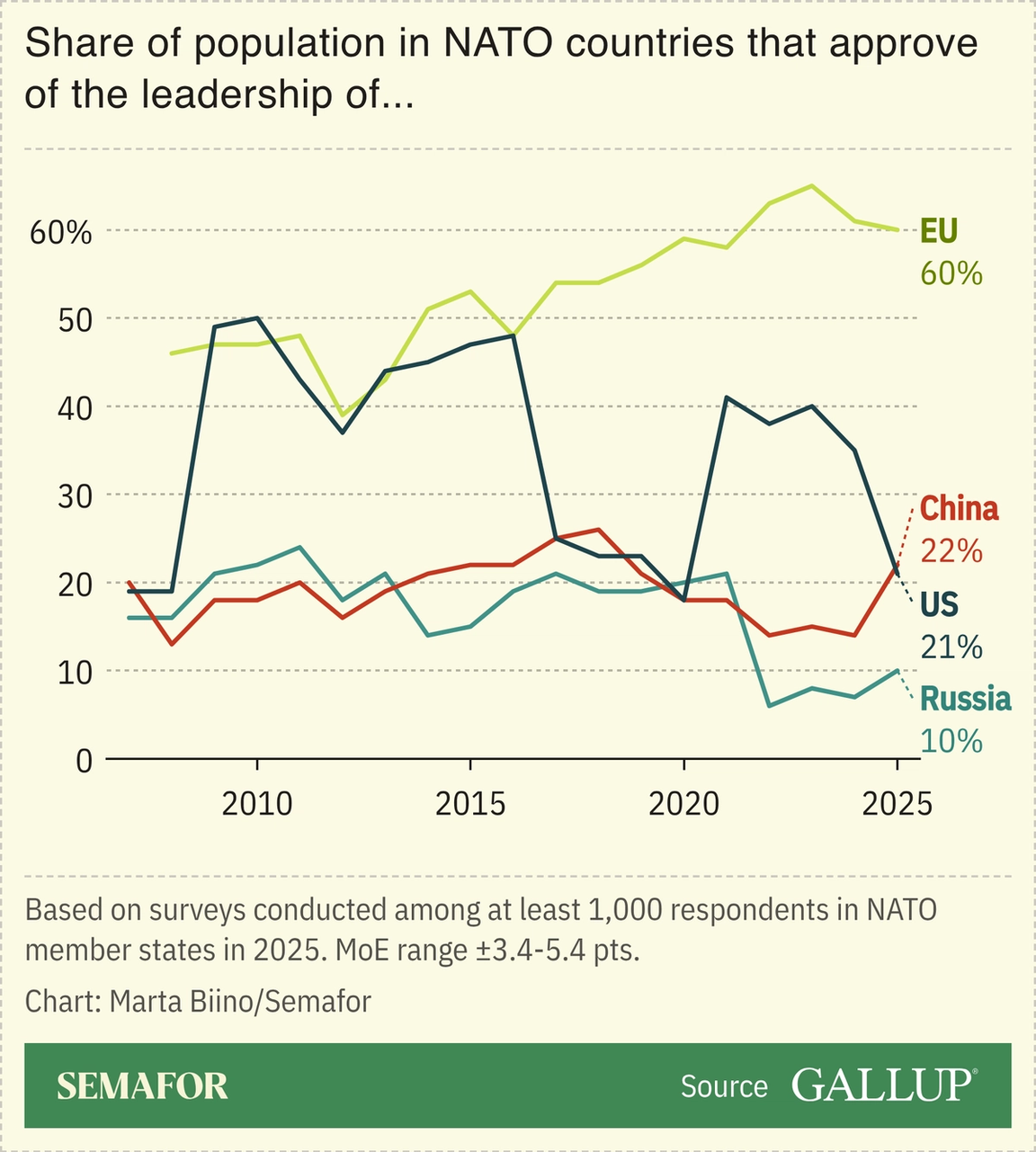 The Trump administration is at a stalemate with Denmark over Greenland and it’s prompting a flurry of action in the US Capitol, Semafor’s Morgan Chalfant and Burgess Everett report. Take Alaska Sen. Lisa Murkowski: She convened a Wednesday meeting of the Arctic Caucus with the foreign ministers from Greenland and Denmark, will travel to Copenhagen on Friday and introduced a longshot bill that would block funds for a US incursion on any NATO ally. “If you had asked me a few weeks ago if I thought we needed a bill like this, I would say, of course not,” she said. Trump’s calls for the US to control the Danish territory put both sides in “fundamental disagreement,” Danish Foreign Minister Lars Løkke Rasmussen told reporters following the meeting with Vice President JD Vance and Marco Rubio. The next step: a high-level working group. |
|
Trump appears to soften tone on Iran |
 Demonstrators march in solidarity with Iranian protesters in Washington. Kevin Lamarque/Reuters Demonstrators march in solidarity with Iranian protesters in Washington. Kevin Lamarque/ReutersThe Trump administration is sending mixed signals on Iran as Trump weighs potential strikes over ongoing protests. After days of heightened rhetoric, Trump suddenly softened his tone on Wednesday, saying that the US had been told that Iran halted its killing of protesters and will not move forward with reported execution plans. The US president offered few details, but said that “very important sources on the other side” had told him the news. “I hope it’s true, who knows,” he added. Trump said this even as reports indicated he is growing increasingly convinced he should intervene in Iran, where the estimated number of deaths is in the thousands. One senior administration official told Semafor earlier Wednesday that people “do not see diplomacy as a realistic option.” Meanwhile, the US evacuated some military personnel from a base in Qatar in a sign of potential action. — Shelby Talcott |
|
Firms see AI as bigger threat than Trump |
 Priyanshu Singh/Reuters Priyanshu Singh/ReutersCompanies see greater risks to their reputation from the misuse of artificial intelligence than from targeting by the Trump administration, according to a new report shared exclusively with Semafor. The Reputational Risk Index for the fourth quarter of 2025 — produced by the Global Situation Room, a public affairs agency, and based on opinions from dozens of executives — found that organizations are more worried about AI-related problems like deepfakes than they are about Trump singling them out for criticism. The finding represents a shift from the third quarter report, which found the US president to be the biggest reputational risk for corporate brands. “Artificial intelligence has emerged as the single greatest driver of reputational risk, reshaping how trust is built — or lost — across sectors,” said Isabel Guzman, a former Biden official who chairs the Global Risk Advisory Council, which informs the report. — Morgan Chalfant |
|
Senate committee delays crypto vote |
 Elizabeth Frantz/Reuters Elizabeth Frantz/ReutersThe Senate Banking Committee is punting a vote on landmark crypto legislation after lawmakers proved unable to win consensus on and off Capitol Hill. Chair Tim Scott, R-S.C., made the call to postpone today’s markup late Wednesday after Coinbase CEO Brian Armstrong said the firm would oppose “the bill as written” and despite other corners of the digital assets industry signaling a desire to move forward anyway. Unresolved issues include how to restrict firms’ ability to pay customers yields on stablecoins — which has become a power struggle between crypto and banks — and how to rein in government officials’ ability to make money off digital assets. Sen. Ruben Gallego, D-Ariz., said Democrats had yet to strike “a verbal agreement” on the latter with the White House, including the requisite “public assurances” and “game plan,” after a meeting with administration officials fell through. — Eleanor Mueller |
|
 Stories that are being largely ignored by either left-leaning or right-leaning outlets, curated with help from our partners at Ground News. What the Left isn’t reading: The Trump administration said that the ICE agent who last week shot and killed a woman in Minneapolis, Renee Good, experienced internal bleeding after the confrontation. What the Right isn’t reading: Former South Carolina Republican lawmaker RJ May was sentenced to more than 17 years in jail for sharing videos of children being sexually abused. |
|
 Rich Lesser, Global Chair of Boston Consulting Group, is joining the Semafor World Economy Global Advisory Board — a forum of visionary business leaders guiding the largest gathering of global CEOs in the US. The expanded board represents nearly every sector across the US and G20. Joining the Advisory Board at this year’s convening will be our inaugural cohort of Semafor World Economy Principals — an editorially curated community of innovators, policymakers, and changemakers shaping the new world economy with front-row access to Semafor’s world-class journalism, meaningful opportunities for dialogue, and touchpoints designed for connection-building. Applications are now open here. |
|
 Beltway NewslettersPunchbowl News: The backlash against ICE is leading House Democrats to turn against the DHS full-year funding bill. “Right now, there’s no bipartisan path forward for the Department of Homeland Security,” House Minority Leader Hakeem Jeffries said. Axios: The SECURE Minerals Act — being introduced by a bipartisan group of lawmakers today — would create a $2.5 billion strategic stockpile of critical minerals to shore up the US’ supply. Playbook: “For me, the ‘MAHA moment’ was just becoming a mom and obviously wanting what’s best for my children,” White House press secretary Karoline Leavitt said. WaPo: The Bench, a Democratic organization launching today, wants to recruit a diverse field of unusual candidates who can “ |
|
|


