|
 |
Emergency Triad: Another American Has Been Murdered by Our Government
It’s worse than it looks and it looks plenty bad.
|
| |||||||||||||||


Programming note: Bill Kristol, Sam Stein, and Adrian Carrasquillo plan to go live at 9:00 a.m. EST tomorrow for Bulwark on Sunday. (This is a few hours earlier than originally planned.) We’ll send an email with a link as they get started and post the replay on the site.
 |
1. Witness
I’m not quite sure what to say tonight, but it seemed important to get some words down—because the only thing we can really do in this moment is bear witness.
So here are the things we know:
On Saturday morning, Alex Jeffrey Pretti was observing DHS agents on a public street. He was using his phone to record their actions.
At some point a DHS agent approached Pretti and began pushing him backward.
More DHS agents mobbed Pretti and began beating him. In multiple videos you can see Pretti, on the ground, with a scrum of agents assaulting him.
One agent appears to pistol whip Pretti about the head.
Then an agent shoots Pretti from point-blank range.
Other agents begin shooting Pretti.
Quickly, Pretti is motionless on the ground while at least one agent continues firing his weapon at him from a short distance away.
Pretti was quickly pronounced dead.
If this were all that had happened it would have been bad enough. But it got worse.
At least some of the DHS agents involved in the killing attempted to leave the scene.
When local law enforcement arrived to begin an investigation, the DHS agents attempted to send them away and deny them access to the crime scene.
Someone—presumably within DHS—leaked to Fox that Pretti had a gun.
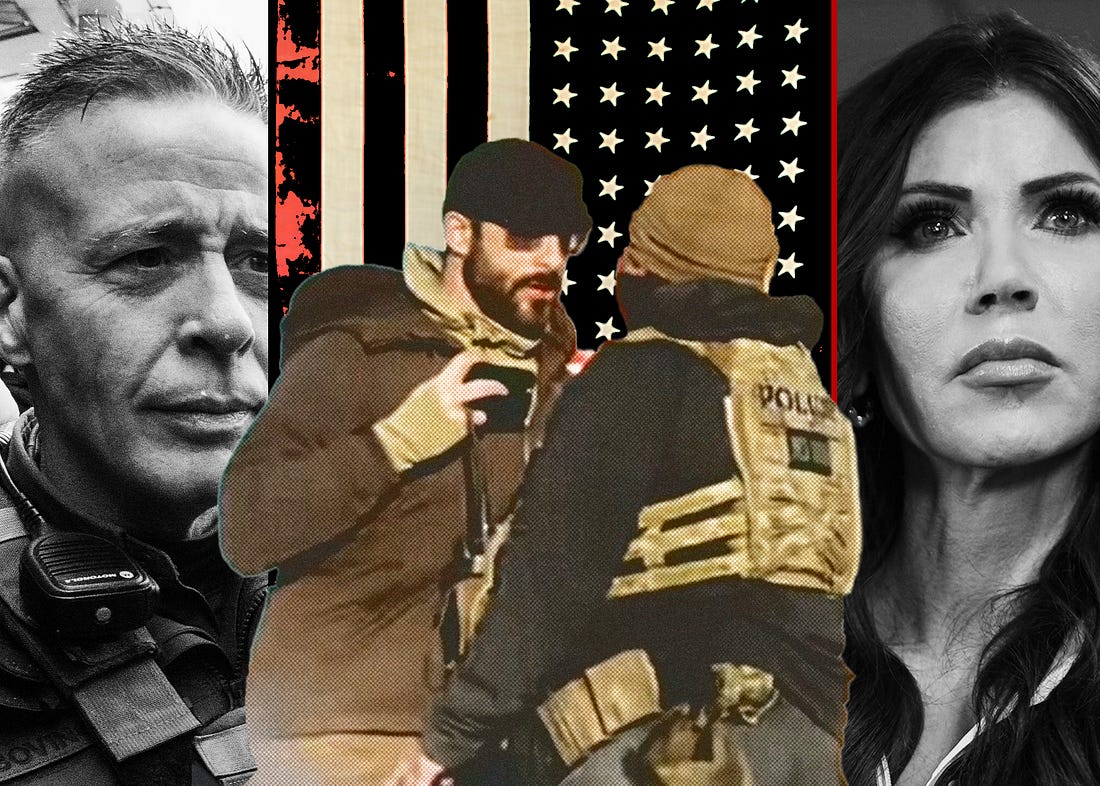
DHS put out a statement (repeated by Border Patrol official Greg Bovino in his press conference) claiming that “an individual approached US Border Patrol officers with a 9 mm semi-automatic handgun. . . . The officers attempted to disarm the suspect but the armed suspect violently resisted. . . . Fearing for his life and the lives and safety of fellow officers, an agent fired defensive shots. . . . The suspect also had 2 magazines and no ID—this looks like a situation where an individual wanted to do maximum damage and massacre law enforcement.”
These statements seems to be lies.
According to local law enforcement, Pretti had a concealed-carry permit and so was legally allowed to possess a firearm in public.
There is no evidence to suggest that Pretti brandished—or even touched—his weapon.
Instead, the available video evidence shows him holding his phone in front of him, in his right hand, and his left hand empty before being pepper-sprayed while attempting to help a fellow observer.
The deputy White House chief of staff, Stephen Miller, called Pretti a “domestic terrorist” and an “assassin.” In fact, Pretti was a registered nurse working in intensive care at a Department of Veterans Affairs hospital.
So the government didn’t just use masked, armed, unidentified agents of the state to execute a citizen on the street, in broad daylight and in front of dozens of witnesses—it lied about the victim and what happened in the most brazen manner possible.
The government killed him. Then it smeared him.
And there is one more layer to consider: Less than three weeks ago DHS agents murdered another Minneapolis resident, Renee Nicole Good, in cold blood. And the agency’s response to that killing was not to regroup, retrain, and investigate, but to surge hundreds more of its agents into the city and deploy even more force against the city’s residents.
Which is where our obligation to witness comes in. The murder of Alex Jeffrey Pretti was not a mistake, or a tragedy, or a misunderstanding. It was a choice. The president of the United States and his regime saw what its masked agents had done to Renee Good and decided to do more of it, at a larger scale.
Killing Alex Jeffrey Pretti was the Trump administration’s policy.