Timeline and simulation to teach about the alliance
CFR Education


January 25, 2026

Dear Educator, 


When students hear "North Atlantic Treaty Organization," they might think of government officials discussing trade or a regional group that holds negotiations. The fact that the world's largest alliance has carried out military operations in over ten countries on three continents might come as more of a surprise. 


What started as an alliance to preserve a free, integrated, and democratic Europe has evolved over nearly eight decades. NATO is the perfect vehicle for teaching about key concepts in modern history and international relations, as well as current events. 


Use the timeline, readings, and simulation in this newsletter to engage your students on all things NATO. 


Happy learning, 


Caroline Netchvolodoff 
Vice President, Education 
Council on Foreign Relations 


New Blog! Help Students Understand Why Greenland is in the News

Your students might have recently read or heard about NATO in the news through the talks over Greenland. This blog breaks down why Greenland has garnered attention and helps you integrate the discussion into your classroom. 

Read now
 

NATO in the 21st Century

Since its creation in 1949, NATO has endured, even as the common foe that it was organized to guard against—the Soviet Union—dissolved as a sovereign state and was replaced by an independent Russian state. It has successfully protected its members against Soviet and, subsequently, Russian aggression and played a crucial role in keeping Europe mostly conflict-free.


In the opening years of the new century, NATO adopted a more expansive definition of what it meant to protect its members’ national interests. The traditional defensive alliance transformed into a collective of like-minded countries willing to pursue broader objectives.

2001: 9/11 Response


The September 11th attacks on America, carried out by the terrorist group al-Qaeda, prompted the first—and only—invocation of Article 5, under which NATO considered the attacks to be against all of its members.


In response, NATO spearheaded an anti-Taliban coalition in Afghanistan. The intervention in Afghanistan constituted its first mission outside the North Atlantic. The mission was sustained to varying degrees over two decades until NATO forces pulled out in 2021.


2011: Questions on Expanded Mission After Chaos in Libya


In early 2011, NATO intervened in Libya’s civil war in an effort to stem the fighting between dictator Muammar al-Qaddafi and rebel forces. But NATO’s mission quickly expanded from simply grounding Qaddafi’s air force into a broader political mission to remove Qaddafi from power.


In the following months, NATO-backed rebels took over most of Libya and executed Qaddafi. NATO leaders hoped Qaddafi’s ouster would mark the end of Libya’s violence. However, the country soon spiraled into even greater chaos.


2014: Renewed Relevance in Face of Russian Aggression


After Russia annexed the Ukrainian territory of Crimea and began arming separatists to fuel conflict in the southeastern part of Ukraine, NATO was reminded that Russia still threatened democracy in Europe. In response, NATO suspended all military and civilian cooperation with Russia and promised to send more troops to its members in Eastern Europe.


2022: War in Ukraine


Russia's earlier provocations and NATO's earlier fears came to a head in 2022 when Russia fully invaded Ukraine, initiating a destructive conflict that has led to the deaths of hundreds of thousands. NATO's member states worked together to deliver billions of dollars' worth of military and financial assistance to Ukraine, and NATO itself has supported the training of Ukrainian troops.

Explore the full timeline 

Simulation: Ukrainian NATO Membership

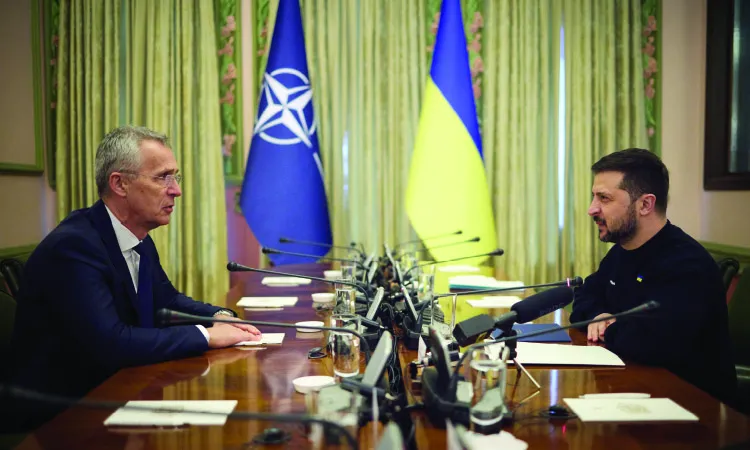
While NATO has supported Ukraine after Russia's invasion, Ukraine itself is not a member of the alliance. Put your students in the shoes of NATO members as they consider Ukraine’s request for NATO membership and decide whether to invite the country to join, reject its application, or delay a decision.

Try the simulation

NATO in 2026

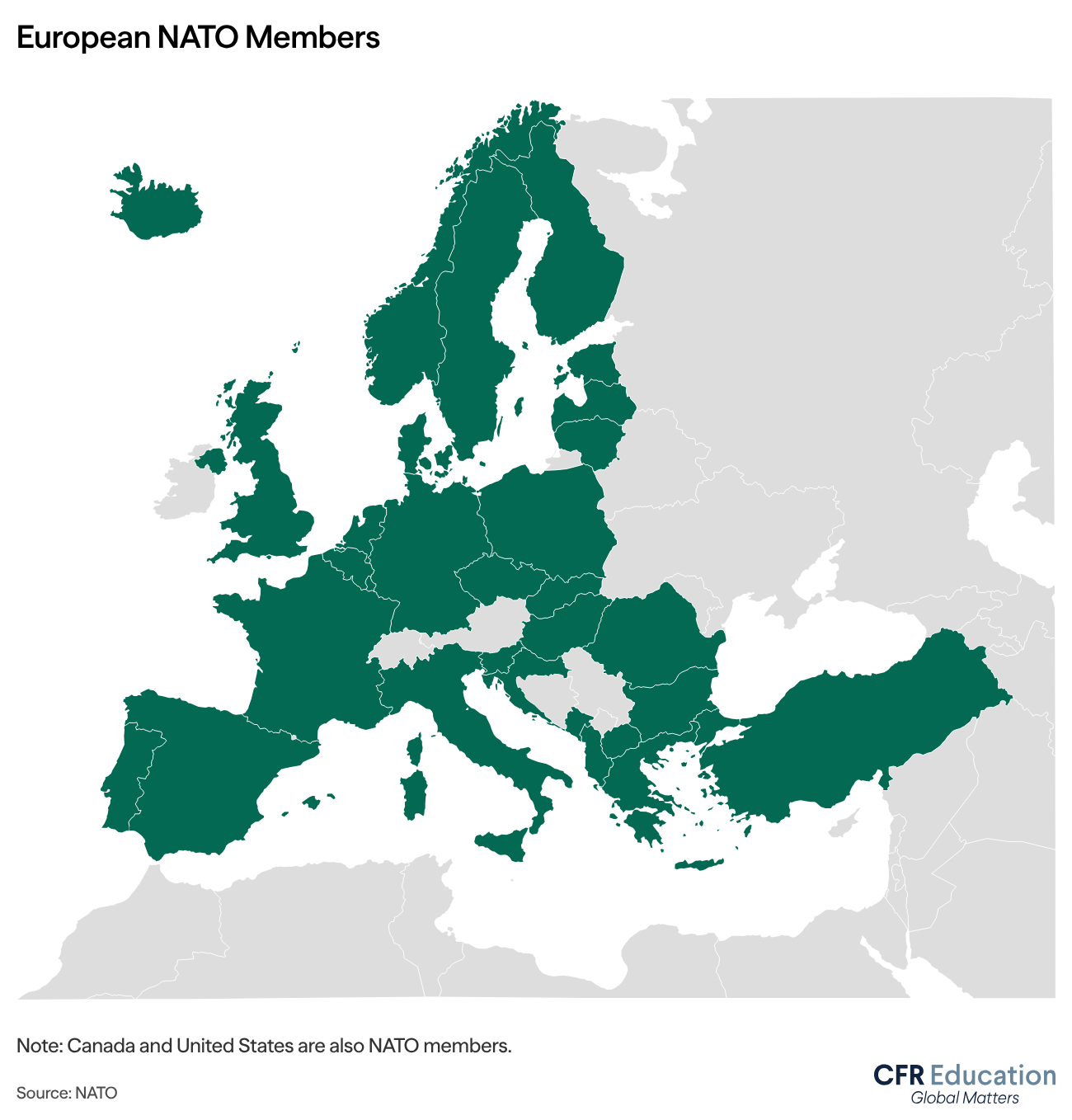
Many NATO countries consider Russia a renewed threat to Europe’s security following its aggression in Ukraine. This prompted Sweden and Finland, two countries that had previously maintained a more neutral stance outside the alliance, to join it. 


The alliance has come under increased scrutiny amid charges that some NATO members, by spending less on defense than others, are not pulling their weight.


Despite new challenges, NATO remains a mainstay of European security and the world's largest alliance.  


Stay up to date on NATO news and analysis at CFR.org. 

Image

Council on Foreign Relations. All rights reserved.

58 East 68th Street – New York, NY 10065

1777 F Street, NW – Washington, DC 20006

 
FacebookTwitterYouTube

Manage Your Email Preferences