|
|
|
|
Good morning. Incomes may be outpacing inflation, but Canadians are still feeling the squeeze at the grocery checkout – more on that below, along with Toronto’s snow woes and World Cup asylum claims. But first: |
|
|
|
|
|
|
|
|
|
|
|
|
|
|
|
|
|
|
|
|
|
|
|
|
|
|
|
Mark Carney at an Ottawa grocery store yesterday. Adrian Wyld/The Canadian Press
|
|
|
|
|
|
|
|
|
|
|
|
|
|
|
|
|
Canadian economists would have you know that the affordability crisis is an illusion. Oh, sure, the price of goods and services has climbed 21 per cent since 2019, but average weekly wages are up 29 per cent over the same period. That means incomes in this country have grown faster than inflation, which in turn means the average household is in better financial shape than it was at the start of the pandemic. |
|
|
|
|
Except few Canadians actually feel that way. In a recent Abacus survey, 67 per cent of respondents said the cost of living is the absolute worst in memory. And they’re in wide agreement about the main culprit: 81 per cent cited grocery prices as their biggest concern. |
|
|
|
|
|
|
|
|
On the one hand, grocery bills can be especially stressful because – unlike insurance, utilities, rent or mortgage payments – we have to pay them every week. On the other, wallet-clutching hand: Groceries do cost a mint right now. Coffee prices hiked 63 per cent over the past five years, while beef is up 62 per cent and pasta nearly 40. (These are, unfortunately, among my personal top food groups.) Grocery prices continue to rise at roughly double the rate of inflation, so a family of four can expect to shell out an extra $1,000
on their food bill this year. |
|
|
|
|
|
|
|
|
|
|
Yesterday, Mark Carney announced plans to bring short-term relief to low- and moderate-income Canadians reeling from that sticker stock. At a grocery store in Ottawa, standing before some distractingly beautiful fruit, the Prime Minister unveiled a multibillion-dollar boost to the GST credit, now pointedly renamed the Canada Groceries and Essentials Benefit. |
|
|
|
|
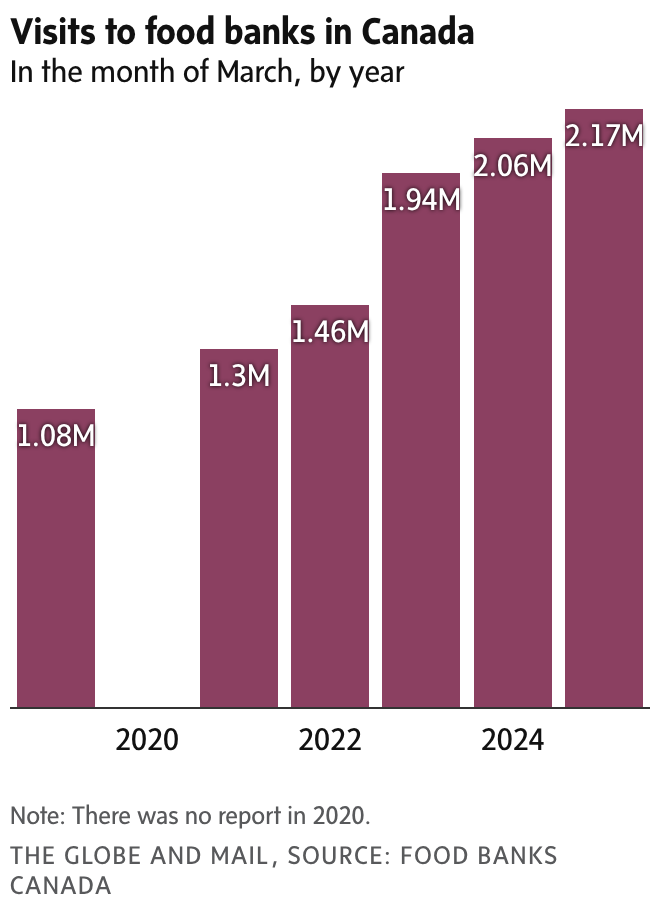
Those eligible for the quarterly rebate will see it increase by 25 per cent for five years starting in July, Carney said, alongside a one-time 50-per-cent top-up this year. He calculated that the measures combine to give a single person as much as $950 in 2026, then $700 annually over the next four years. A family of four stands to receive as much as $1,890 this year and about $1,400 annually through 2030. The government said the credit will help more than 12 million Canadians at a time when food-bank visits have only gone up.
|
|
|
|
|
|
|
Opposition House leader Andrew Scheer wasn’t wildly impressed with the credit, dismissing it as a “recycled Trudeau-era policy.” (Justin Trudeau doubled the GST rebate for six months amid high inflation
in 2022.) Scheer added that this latest rebate won’t bring down the cost of food in Canada or “even cover one trip to the grocery store for an average working family.” Despite these criticisms, he said “Conservatives will always support measures that provide relief, even if it is temporary.” It seems, then, that the minority Liberals will have enough votes to pass the tax credit in the House of Commons. |
|
|
|
|
|
|
|
|
|
|
Permanently lowering food costs is a tall order for any government. There are just too many factors – climate events, global conflicts, trade wars, currency fluctuations, shipping fees, worker salaries, cattle shortages – that affect the price of groceries. |
|
|
|
|
Carney did announce other measures yesterday to ease the affordability crunch, including earmarking $500-million to help businesses manage supply-chain disruptions without passing along costs to Canadians. Ottawa will offer $20-million to support organizations that provide food to families directly. If you bought a greenhouse after Nov. 3, you can also now write it off in full. |
|
|
|
|
But there could be one change coming to grocery stores soon. Carney suggested rolling out per-unit pricing, requiring retailers to display the cost of a product using a set unit of measurement. That way, it’s easier to compare the price of a 2.63-litre jug of orange juice with a 1.36-litre bottle. Quebec is the only province that has implemented unit pricing – and although some stores offer the information voluntarily, plenty don’t do it at all. |
|
|
|
|
These sorts of labels won’t single-handedly drop the cost of OJ, which Carney said rose by 12 per cent last year. But they might dissuade companies from reducing the size of their products while leaving prices the same. And that, at least, would deliver a blow to shrinkflation, another major scourge of the grocery aisle. |
|
|
|
|
|
|
|
|
|
|
|
|
|
|
|
|
‘I don’t think we need to bring in the army.’ |
|
|
|
|
|
|
|
|
|
The valiant effort to move a mountain of Toronto snow. Sammy Kogan/The Globe and Mail
|
|
|
|
|
Toronto Mayor Olivia Chow said it’ll take a while to clear the 60 centimetres of snow that Sunday’s storm dumped on the city, snarling traffic and transit, cancelling flights and closing schools. Read more about the efforts to dig out Toronto here. |
|
|
|
|
|
|
|
|
|
|
|
|
|
|
|
|
|
|