| | In this edition, it’s not yet time to freak out about AI leaps, and tech CEOs are politically divide͏ ͏ ͏ ͏ ͏ ͏ |
| |  | Technology |  |
| |
|
 - Tech speaks up
- Off to the robot races
- Waiting for the tech ‘pop’
- Lasered in on data centers
- Paying to play
 Why the world is freaking out about AI again, and astronomers are using AI to explain some mysterious images taken with the Hubble telescope. |
|
 Something is in the air right now. My feed on X is full of people warning of an AI capability leap. It’s over. We’re about to be replaced. Anthropic CEO Dario Amodei has a new essay out. He can feel it coming. So can Andrej Karpathy, the former Tesla AI director who coined the term “vibe coding.” I’m not immune to this. It hits the dopamine receptors in my brain, just like I imagine it does for most people. I’m sure I’m not the only one who has moments of internal panic, thinking “Oh God, have I waited too long to get all of my vibe coding projects done, automating every professional and personal aspect of my life for maximum efficiency? Am I about to be replaced by a swarm of AI agents?!” Investors have dopamine receptors, too. And I’m sure there are quite a few who think they should have invested in the last round, when they thought maybe the valuations were getting too high. Now they’ll need to invest in this round, at an even higher valuation, because AGI is imminent! On the other side of the debate, you have the AI naysayers claiming it’s still a bunch of hype. Clearly, it’s not moving as fast as some in the AI industry would hope, or many of us fear. And therefore, the bubble is about to collapse under impossible valuations and unprecedented fundraising. The truth, as with most things in life, is somewhere in the middle. AI models will be better than humans at almost everything — and they’re already replacing some workers’ everyday tasks. But what a lot of people miss is that “better than humans” isn’t actually good enough. Take driving. AI models are already better drivers than humans, but Waymos and Robotaxis haven’t replaced human drivers and probably won’t for a while. Forget the regulatory issues and society’s natural resistance to change. The reason we’re not there yet is more fundamental: AI models make strange errors that humans wouldn’t make and we don’t understand why. Amodei, for instance, talks about “mechanistic interpretability” being used to improve safeguards. This is the effort to understand, down to individual neurons, why large language models do what they do. But it’s still an open area of research that some people believe is impossible on a large scale. I’d argue that interpretability isn’t a safety feature. It’s the product. Solve it and AI models become controllable and a million times more useful. That’ll really be the time to freak out. |
|
Tech CEOs speak out after Minnesota killings |
 Carlos Barria/Reuters Carlos Barria/ReutersTechnology executives have spent much of the past year cozying up to Trump, but the killings in Minneapolis are testing that support. OpenAI CEO Sam Altman notably broke his silence on the immigration crackdown, telling employees in an internal Slack message, per The New York Times: “What’s happening with ICE is going too far.” He echoed Anthropic CEO Dario Amodei, no stranger to confrontation with the White House, who called the situation a “horror” this week. Apple’s Tim Cook — one of the business leaders who attended a screening of Amazon’s Melania Trump biopic at the White House the day federal officers shot Alex Pretti — told employees he’d had a “good conversation” with Trump and urged “deescalation,” Bloomberg reported. A growing cadre of Silicon Valley leaders is speaking up, the Times reported, harkening back to some of the clashes of Trump’s first term. |
|
Anduril’s AI Grand Prix ups challenge for robotics |
 Nir Elias/Reuters Nir Elias/ReutersIt’s unlikely that robots will ever replace humans in professional sports, even if they become better tennis players or make 100% of their three-pointers. But there’s something kind of enticing about the AI Grand Prix, a drone racing competition announced Tuesday by defense tech company Anduril. Contestants won’t need to own drones or even a set of controls to compete. Instead, they’ll submit an algorithm that will be used to pilot a standard model drone built by Neros Technologies. Dreamed up by Anduril founder Palmer Luckey, the contest offers a top prize of $500,000 and a job at the company for the winner (unless the winner is from China, due to national security concerns). Drone racing hasn’t really gained mass appeal, even with human pilots, so there’s no guarantee the AI Grand Prix will be a hit with spectators during a race in Ohio later this year. But the convergence of AI world models and robotics is going to create more opportunities for contests like this, that invite ambitious computer scientists to bring new innovations into the arena on full display. At the very least, they’ll help companies like Andruil (or perhaps the US government) identify talent. But they could be genuinely fascinating in contests that include more strategy and planning. Imagine an elaborate game of robot-capture the flag, or even football. And the ability for these models to operate the robots as a “black box” means creators might retain their secret sauce — the same way athletes don’t reveal their preparation for a big game. You can get a hint of this when AI models play computer games in two dimensions, but it will be even more mind-blowing in the physical world, kind of like an Ender’s Game meets ChatGPT. |
|
Orlando Bravo warns of AI contagion |
 Courtesy of Thoma Bravo Courtesy of Thoma BravoThe venture capital industry and AI are “absolutely in a bubble,” according to one of the biggest tech investors in the world, and it won’t easily be deflated by policymakers. “I think you just have to wait for it to pop,” Orlando Bravo, founder and managing partner of the $180 billion tech private-equity firm Thoma Bravo, told Semafor’s Liz Hoffman. “People are taking enormous risks for small probabilities of enormous returns.” Thoma Bravo’s portfolio companies, which sell everything from cybersecurity defense to CFO planning software, closely reveals corporate AI spending and whether there is enough appetite to justify Silicon Valley’s huge investments. Bravo also lived through the dot-com bubble, which scarred a generation of tech investors but didn’t spill over into the broader economy. He thinks we won’t be so lucky this time, as blue-chip companies and twitchy, overleveraged retail investors load up on AI bets. “It would just spread,” he said. “That market cap dwindling would have a big effect.” Beyond the AI bubble, Bravo talked about where his own software empire is vulnerable to vibe coding; how CEOs are using AI as an excuse for cost cuts; and if his junior employees are secretly using bots to do their work. Find Liz’s full interview with Bravo here. → |
|
|
Data center buildout inspires new laser |
 A chip developed by Lightmatter. Courtesy of Lightmatter. A chip developed by Lightmatter. Courtesy of Lightmatter.With everything going on in the world, it’s understandable that startup Lightmatter’s announcement Tuesday of a new laser for the data center market drew less attention. We thought it was worth highlighting because it’s a good example of how the massive scale of the AI buildout is making new kinds of hardware innovation feasible. Lightmatter’s view is that accelerated computing is going to eventually go optical. First, the copper wires that connect GPUs and memory inside data center racks will be replaced by optical cables, removing one of the major bottlenecks of data center performance: The slow, copper wires connecting hundreds of thousands of GPUs. Eventually, the silicon itself will give way to photons. (That’s still a sci-fi concept, but read Lightmatter’s Nature paper for more on that). Photonic computing, if proven possible, could reignite Moore’s law, improving the speed of processors exponentially. For now, Lightmatter determined existing lasers just weren’t as economical as they could be and decided to launch a new one. This would have all seemed a bit silly a few years ago. But today, no data center architecture is sacred. The way chips and memory are organized inside racks is no longer set in stone. And that means there’s a wide open field for new entrants in the stack and plenty of potential for disruption of existing, entrenched players. |
|
Chinese AI apps turn to cash handouts |
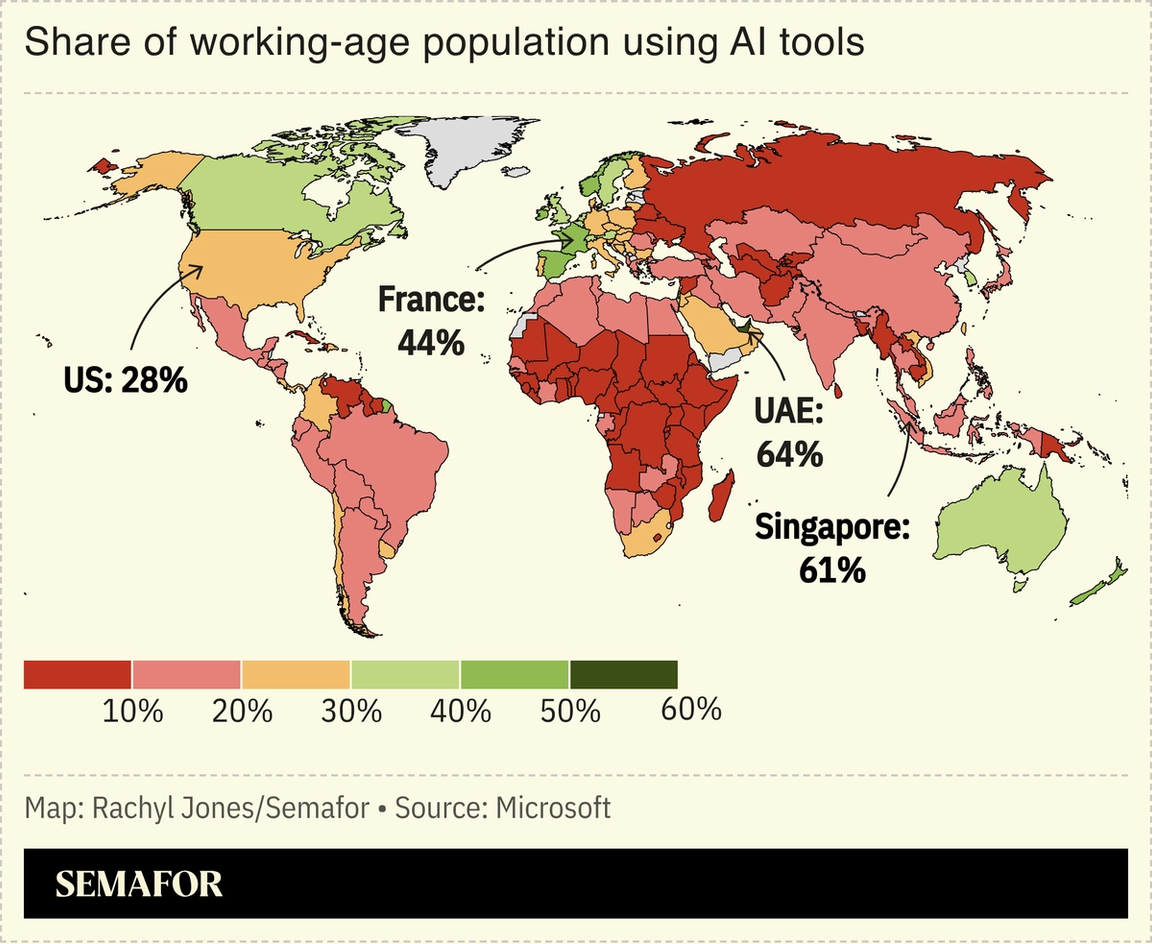 As AI companies race to get people to use their products, Chinese AI apps are turning to a tried-and-true strategy to attract users: cash. Tech giants Baidu and Tencent are both offering virtual “red envelopes” as signup and usage incentives — a nod to the cash gifts given to loved ones during Lunar New Year. Tencent’s chatbot app Yuanbao is giving away 1 billion yuan ($144 million), with users able to win up to 10,000 yuan through raffles and games, the South China Morning Post reported. Baidu is offering 500 million yuan to users who interact with its AI assistant’s features. AI apps have emerged as the next frontier in China’s tech arms race, as firms rush to inject their chatbots with shopping and payment tools. Companies are paying for proliferation over profitability — and real business models “still haven’t been figured out,” a Trivium China analyst said on a recent podcast. Consumer-facing apps “do have subscriptions, but nobody’s paying for them.” US companies face a similar problem. While it often feels like AI is the only thing anyone is talking about, only about a quarter of American adults use the technology at least once a month, according to a recent Microsoft analysis. In Europe, where adoption figures are slightly higher, the EU has committed €1 billion ($1.2 billion) to help drive adoption across industries. |
|
 From boardrooms to basements, more than 200,000 thinkers are using Mindstream to unlock AI’s full potential. The daily newsletter delivers practical, cutting-edge insights in a clear, concise format. Subscribe today and step into the future with confidence. |
|
 NASA, ESA, David O’Ryan (ESA), Pablo Gómez (ESA), Mahdi Zamani (ESA/Hubble) NASA, ESA, David O’Ryan (ESA), Pablo Gómez (ESA), Mahdi Zamani (ESA/Hubble)European astronomers are using AI to help explain mysterious images across NASA’s catalog of Hubble Space Telescope data, spanning 35 years. The team at the European Space Agency developed a neural network called AnomalyMatch, which analyzes patterns in images and detects unusual objects, according to NASA. They applied the tool across 100 million image cutouts, identifying 1,300 rare phenomena pictured — 800 of which had never been previously documented. The process took less than three days, significantly shorter than having humans do the same work. Among these phenomena are discoveries around previously unknown and merging galaxies, including some that are jellyfish-shaped and several that researchers can’t fit into existing classifications. “It’s an example of the kinds of new and unusual finds that can be made by AI-assisted data processing, even from well-known datasets,” NASA wrote about the previously unknown galaxies. NASA has faced budgetary pressure in recent years, with tight pursestrings meaning programs are getting clawed back or put on ice. The most recent funding agreement effectively killed one major project: NASA’s yearslong efforts to bring samples from Mars back to Earth. Tools like AnomalyMatch help NASA shepherd breakthroughs without having to spend significant financial or human resources. |
|
|


