Hello!
The United States’ deadly winter storm is the focus of today’s newsletter as heavy snow, sleet, and freezing rain have killed at least 38 people across 14 states and left more than 296,000 homes and businesses without power.
We’ll be diving into the areas affected by power outages, and we'll also talk to Heather Black, vice president at the U.S.-based charity United Way Worldwide, about the affordability of heating and utilities during spells of extreme weather. Britain’s residents are also struggling with the affordability of bills and goods, which I highlight in today’s top “Talking Points”.
Please also have a look at a selection of stories about workers’ rights, and we had quite a few major headlines this week on the issue: |
|
|
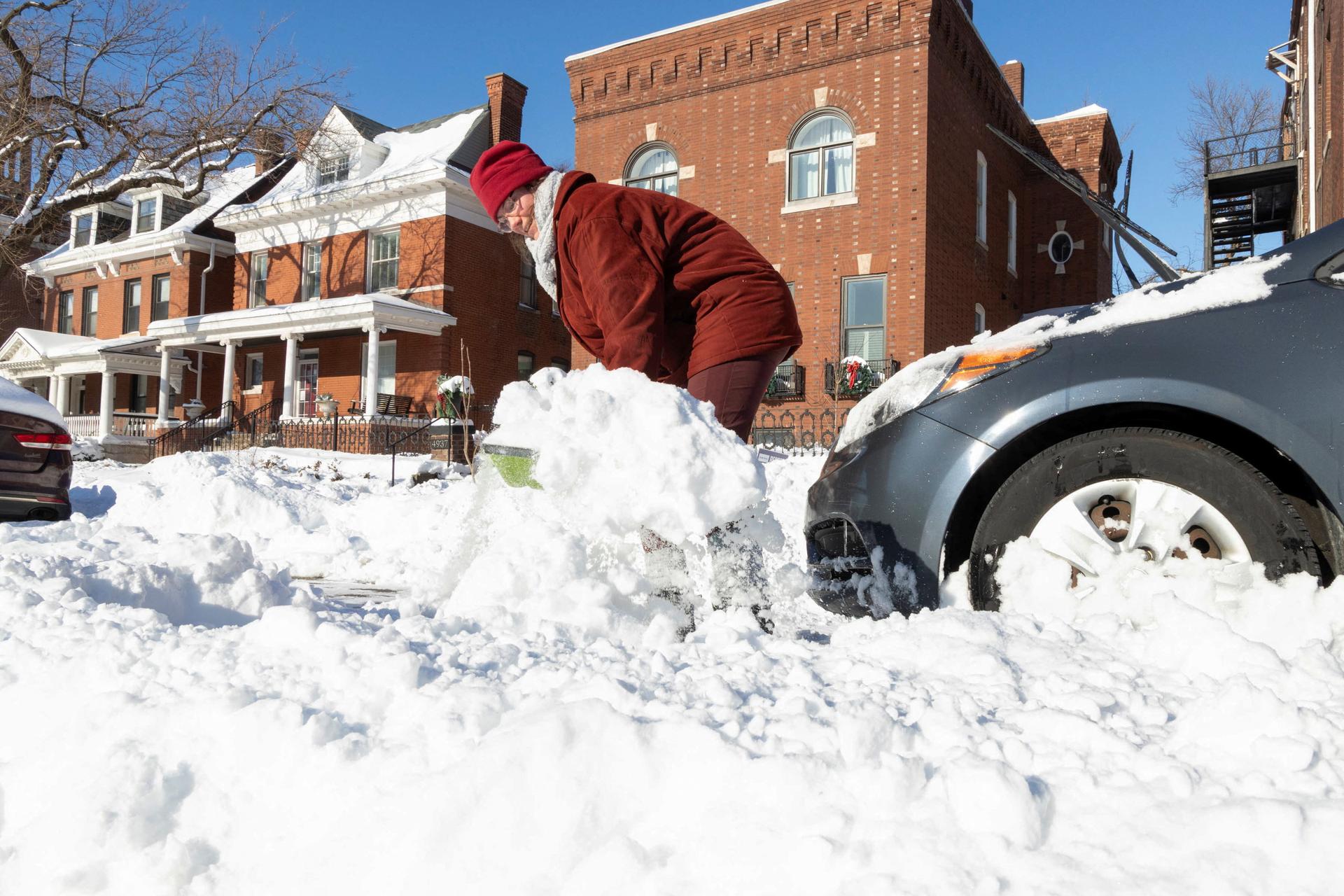
A resident clears snow from around a parked car on a residential street in the aftermath of a winter storm in the St. Louis area, Missouri, U.S. REUTERS/Lawrence Bryant |
Back to the power, or lack thereof, as Americans have suffered outages up and down the country.
The hardest-hit utilities included Nashville Electric Service (NES) in Tennessee, where 95,687 of 463,455 customers were without power, and Entergy, which serves Arkansas, Louisiana, Mississippi, and Texas, and which had more than 77,000 of its 3.05 million U.S. customers affected, according to PowerOutage.us. "Both NES and contractor lineworkers from Florida, Maryland, Kentucky, Indiana, Ohio, Mississippi, and Tennessee continue their work to restore electricity to those still without power after Winter Storm Fern took down half of all NES customers last Sunday," NES said in a post on X late on Tuesday.
The storm is set to become the costliest severe weather event since the Los Angeles-area wildfires in early 2025, with preliminary damage and economic losses estimated at between $105 billion and $115 billion, AccuWeather said. "All Entergy Arkansas and Texas customers who could safely receive power were restored yesterday. Restoration for affected Louisiana and Mississippi customers is well underway," Entergy said in a release on Tuesday.
|
|
|
The chilling financial impact |
As people try to stay home and keep warm during the harsh Arctic snowstorm, there’s still a looming sense of anxiety as the heating stays on - the costs.
Black, who heads the strategy of the United Way’s call centre, 211, said conversations now centered on the affordability of bills and advising those affected by power cuts to head to warming centers.
“It's about the financial impact of the event and just wondering how they're going to pay an increased utility bill, or maybe they were already struggling to pay their existing utility bill, and they're worried about their utilities being turned off, and they're calling us to get connected to local resources to help them with those expenses,” said Black.
“We know that there are a lot of families that are working hard and still struggling to make ends meet – we refer to them as ‘ALICE’, which is Asset Limited Income Constrained Employed.” Click here to listen to the full interview on SoundCloud.
Families around the world are struggling with winter utility bills and the cost of living. Keep scrolling for a Reuters story on the rise of poverty in Britain. |
A protest outside the Treasury building, organised by the End Child Poverty Coalition, over the two-child limit to benefit payments, in London, Britain. REUTERS/ Maja Smiejkowska. |
-
UK poverty: Poverty in Britain has deepened, according to a report by the Joseph Rowntree Foundation (JRF). The foundation, which conducts research aimed at solving poverty in Britain, said in the report that there were about 6.8 million people now living in "very deep poverty", the highest level in three decades. Click here to learn more about the reasons behind the rising poverty rate.
-
U.S. pregnant worker rights: The Pregnant Workers Fairness Act is facing scrutiny from conservative lawmakers, which may curb pregnant workers’ support. The 2022 U.S. law requires employers to reasonably accommodate pregnant workers under the Equal Employment Opportunity Commission regulations. But those rules may change dramatically under Republican EEOC Chair Andrea Lucas, who said in 2024 that the regulations were written too broadly. Click here for more.
-
U.S. abortion case: In keeping with U.S. reproductive rights, the office of Texas' Republican Attorney General, Ken Paxton, sued a Delaware-based nurse for allegedly prescribing and mailing abortion pills to women in Texas, a new front in a nationwide battle over access to abortion drugs. Click here for the full Reuters report.
-
Meta AI child safety case: A new lawsuit against Meta Chief Executive Mark Zuckerberg alleges that the company approved allowing minors to access AI chatbot companions that safety staffers warned were capable of sexual interactions, according to internal Meta documents filed in a New Mexico state court case. Click here to learn more about the case.
|
|
|
Sticking with the theme of energy affordability, Cassidy DiPaola, communications director for the “Make Polluters Pay” campaign, shares her thoughts on U.S. President Donald Trump’s power and finance policies: “Trump’s energy policy is failing Americans.
“Climate change is making winter weather more volatile and more destructive, and our energy system is still tied to fuels that freeze up, spike in price, and fail when we need them most. “We’re watching that play out in real time as constrained gas supplies and frozen gas infrastructure force plant outages and send electricity prices to astronomical levels even as millions are thrown into darkness.
“Meanwhile, clean energy and batteries have repeatedly proven they can keep the lights on when fossil fuel systems crumble. “Independent grid assessments show that when storms hit hard, the biggest failures come from gas infrastructure, not wind turbines or solar arrays.
“But instead of expanding the clean energy resources and smart grid investments that actually make electricity more reliable and affordable, this administration is slashing billions in clean energy loans, freezing approvals for renewable projects, and doubling down on fossil fuels that have proven to be a liability in extreme weather.
“Trump likes to talk about ‘energy dominance,’ but right now that dominance looks like an outdated grid tied to fuels that don’t hold up in a crisis, astronomical price spikes, and a nation scrambling to stay warm in subzero temperatures.
“If he truly cared about affordability, he’d stop kneecapping the very solutions that lower costs and protect communities like clean energy, grid modernization, and real resilience. Instead, he’s giving polluters a hall pass while the rest of the country pays the price.” |
Britain's Archbishop of Canterbury Sarah Mullally gestures after the service of confirmation of her election at St Paul’s Cathedral in London, Britain. REUTERS/Isabel Infantes |
Today’s spotlight shines a light on women breaking the glass ceiling, as Sarah Mullally was officially confirmed as the first woman to lead the Church of England as Archbishop of Canterbury in a traditional ceremony at St Paul's Cathedral in London.
"These are times of division and uncertainty for our fractured world. I pray that we will offer space to break bread together and discover what we have in common – and I pledge myself to this ministry of hospitality," the 63-year-old Mullally said in a written statement shared by her office. |
|
|
Sustainable Switch was edited by Tomasz Janowski. |
|
|
|