|
 |
Welcome. This week’s edition of Receipts is a deep-dive into the massive own goal our government is committing right now by purging scientists from the civil service and driving away global talent from everywhere else. Much of this is happening through Trump’s sabotage of the legal immigration system, including sweeping bureaucratic changes that are less visible than the violent thuggery happening in the streets. Trump is expected to cut legal immigration by between a third and half over four years.
Our loss will be other countries’ gain, since top talent will go abroad and make new discoveries and found new businesses. As one headline in an Irish newspaper put it: “The idiot wind now howling through the US offers Ireland a transformative windfall.” Honestly, we’d be lucky if they ended up in Ireland rather than, say, China, which has been investing heavily in R&D for the technologies of the future.
Are there other ways that we’re driving away top-tier talent? Drop me a note in the comments. And if you don’t already subscribe to Bulwark+, I hope you’ll consider doing so. Our country may be experiencing brain drain, but we still have some decent brain power here—we hope!
–Catherine
Trump Is Making America Stupider
How MAGA is purging scientists and other skilled workers from both the private and public sectors.
|

| |||||||||||||||


 |
“I LOVE THE POORLY EDUCATED,” Donald Trump once declared. That was back in 2016, during his first presidential campaign.
Now, a decade later, he and the rest of the MAGA movement have manifested that love into policy, with a series of changes that have hobbled America’s entire knowledge sector.
It’s been both disruptive and deeply damaging. For over a century, America’s knowledge economy has been our golden goose. Thanks to both private and public R&D, we have developed the strongest military, the most cutting-edge tech companies, and global dominance in the fields of science and medical research. These successes didn’t happen by accident. They were the result of deliberate policy choices going all the way back at least to the Morrill Act of 1862.
That’s the law that created land-grant colleges during the middle of the Civil War, just to give you a sense of how long America has prioritized higher education even in the direst of circumstances.
Over subsequent decades our policymakers made other choices to invest in and harness knowledge creation. They did so through our regulatory regime and federal investment in R&D. Perhaps most importantly, they opened up our immigration system in the mid-twentieth century to attract the best and brightest scientific talent from around the world. By one estimate, foreign STEM workers immigrating to the United States accounted for between 30 to 50 percent of all U.S. productivity growth between 1990 and 2010. These international STEM workers came to the United States to study, research, and collaborate with native-born scientists; they invested their skills in growing the U.S. economy. They also founded blockbuster businesses.¹
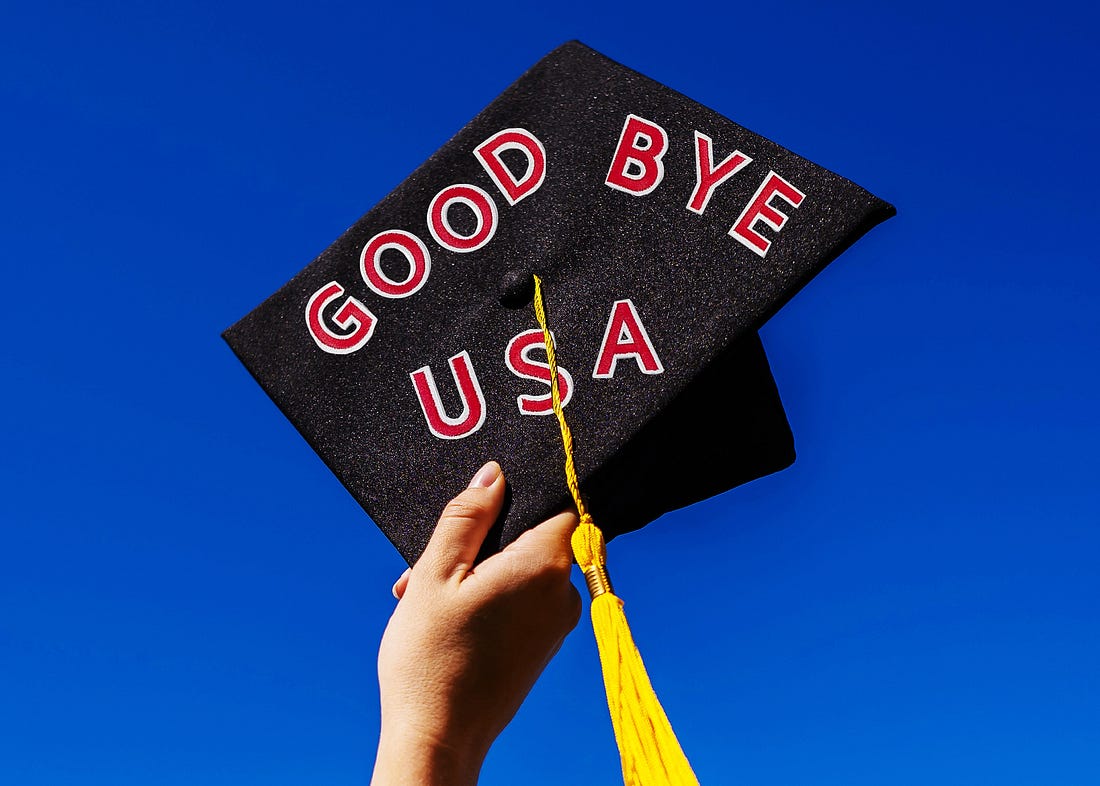
Today, as other countries invest in developing the technologies of the future, our advantage is being rapidly unwound. This, too, is not something that has just happened on its own. It was not inevitable. It was a choice. It’s the Great American Brain Drain, courtesy of MAGA.
TRUMP SOMETIMES CLAIMS he wants more high-skilled immigration. But his record shows the opposite. In the past year, Trump has made it dramatically harder for high-skilled workers to come to or stay in the United States, where they would otherwise be able to contribute their talents to our economy. Some of these actions have gotten some press coverage, such as the $100,000 fee he’s tacked on to the so-called skilled-worker visa, known as an H-1B.² This is, needless to say, prohibitively expensive for virtually any employer, who already must certify that the workers they’re sponsoring are being paid the prevailing wage and are not taking the job of an equally qualified U.S. citizen.
But the six-figure visa fee is hardly the only brick in Trump’s wall keeping out high-skilled immigrants. In December, the administration finalized a