| | US job cuts pile up, Japan gears up to vote, and Starlink becomes a geopolitical disruptor.͏ ͏ ͏ ͏ ͏ ͏ |
| |  | Flagship |  |
| |
|
The World Today | 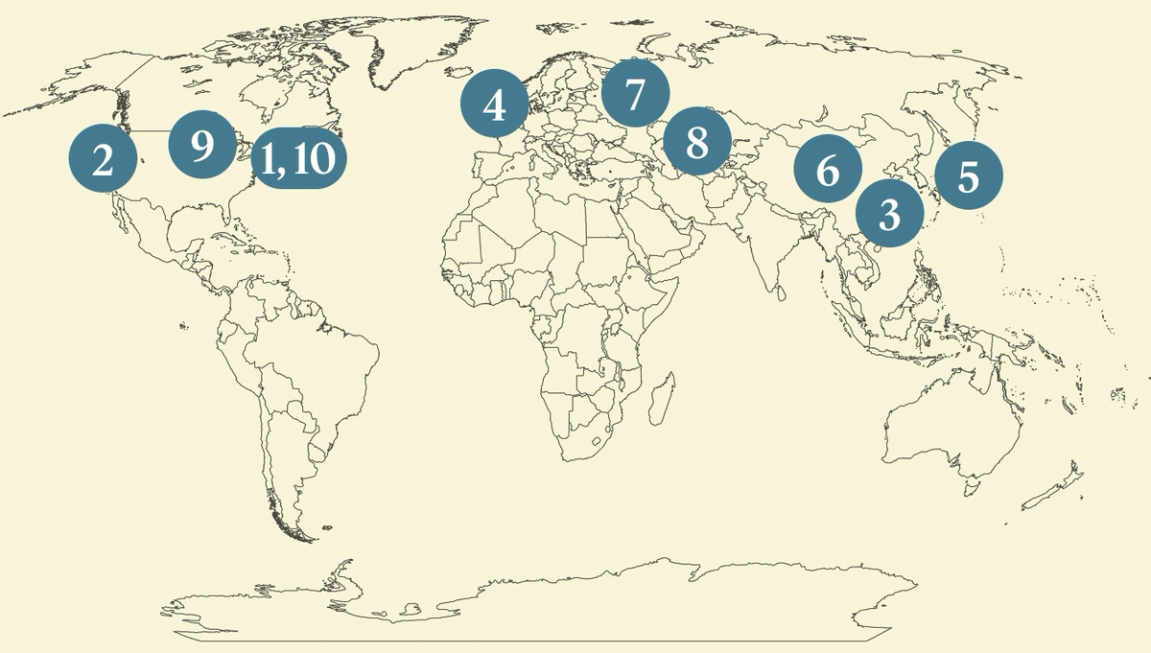 - Massive US job cuts
- Software investors spooked
- Chinese tech stocks hit
- Keir Starmer under pressure
- Sanae Takaichi on a roll
- China’s energy paradox
- The geopolitics of Starlink
- Central Asia builds new cities
- US faces housing crisis
- Rewriting bible of psychiatry
 A delightfully weird documentary to get amped up about the Winter Olympics. |
|
AI impact unclear as US job cuts pile up |
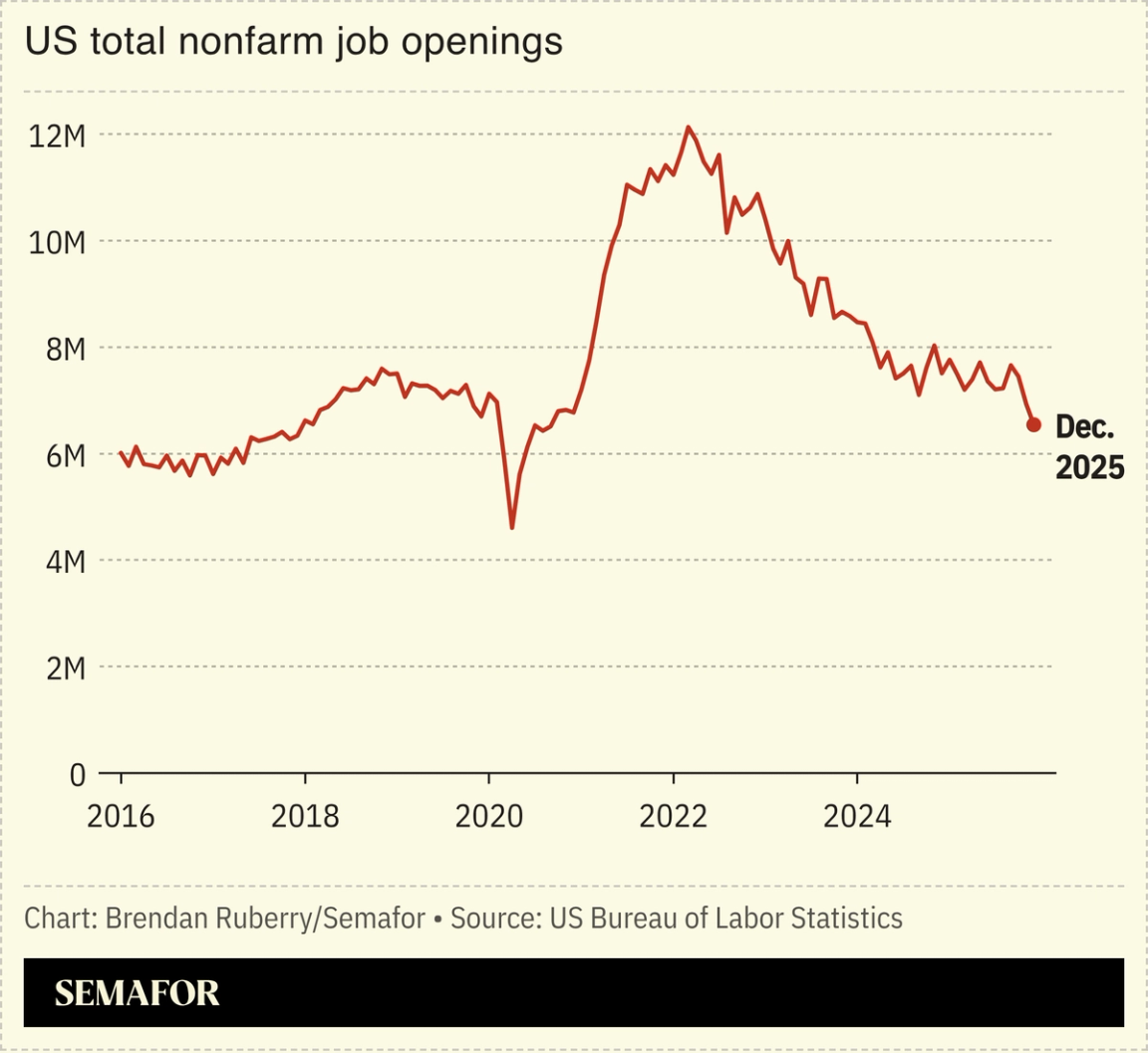 US employers cut more jobs last month than in any period since 2009, new data showed. Several large companies announced massive layoffs, while hiring was the slowest for any January on record, suggesting the low-fire, low-hire dynamic that has kept the US labor market in an anxious balance may be tipping. Companies blamed AI for only 7% of the cuts, but it will take “more clarity about what AI can and can’t do for companies to get back to more normal hiring levels,” one economist said. Tech investor Orlando Bravo told Semafor in a recent interview that CEOs are using AI as a “cover” for margin-padding layoffs; the real AI job losses are yet to come. |
|
New Claude tool targets financial work |
 Brendan McDermid/Reuters Brendan McDermid/ReutersAI startup Anthropic launched a financial service-focused AI model on Thursday, days after its new legal tool sparked a broad software selloff. The newly updated Claude can run analyses using company data and filings that might normally take a human days to complete, prompting financial service stocks to fall. Enterprise sales form about 80% of Anthropic’s business: “We are now transitioning almost into vibe working,” its head of product for enterprise told CNBC. Rival OpenAI is now hiring hundreds of new staffers to boost its enterprise sales, The Information reported. While spooked investors are dumping software shares, one analyst said security concerns will likely keep large companies from deploying such AI tools: “Panic over this is probably misplaced.” |
|
China tech caught up in global rout |
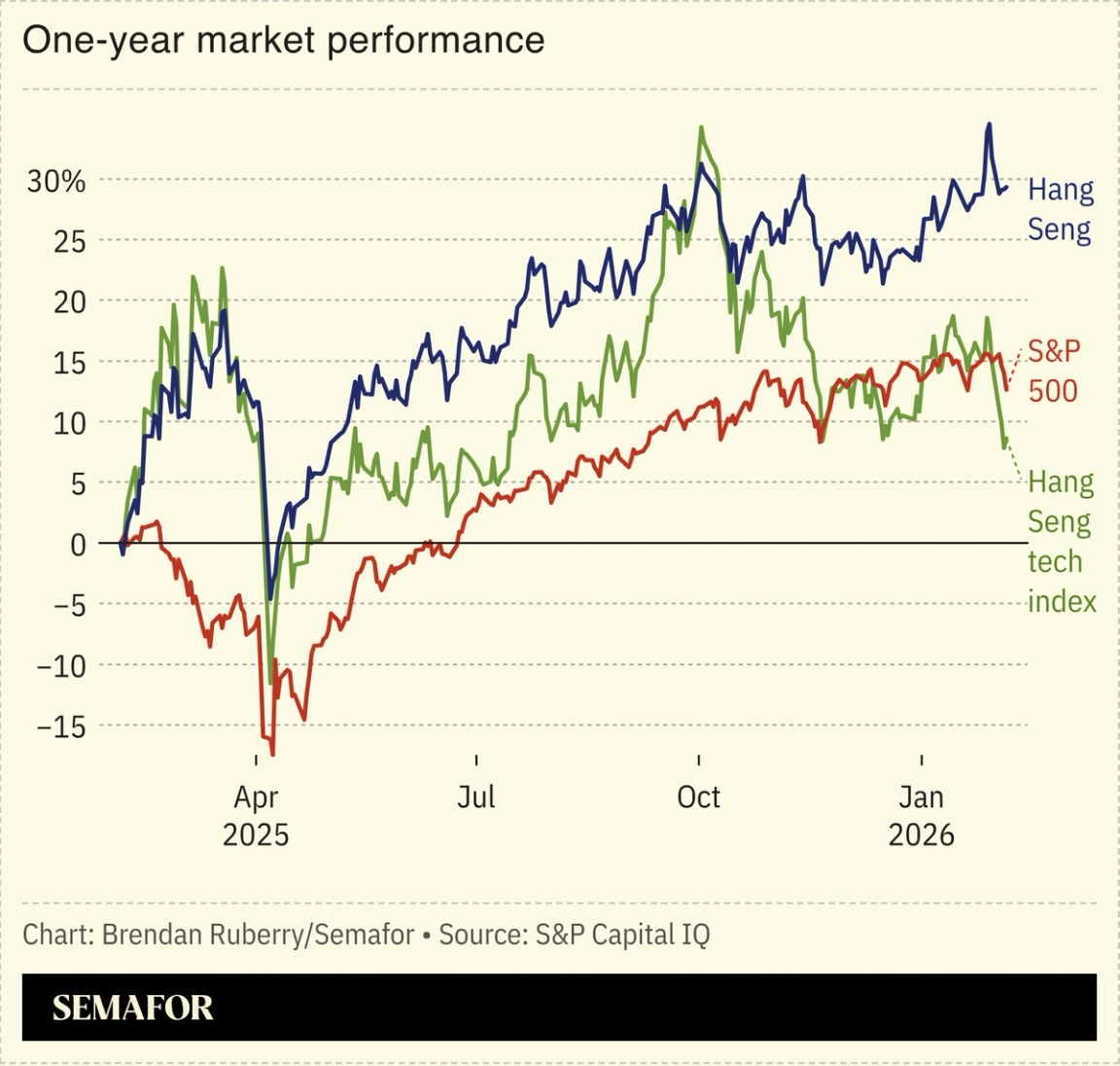 China tech companies were swept up in the global stock rout stemming from AI’s disruptive potential. Hong Kong-listed tech stocks, which are mostly mainland firms, fell into bear-market territory Thursday, on both AI spending concerns and rumors of an impending tax increase on internet services. Some analysts see the selloff as an overdue correction rather than the beginning of a downward spiral. Chinese tech valuations have surged in the past year on AI excitement, but some worry those gains may have outpaced fundamentals. Investors are also concerned that China’s tech giants could get pulled into another round of money-burning competition, after Tencent’s app announced cash giveaways as a Lunar New Year promotion. |
|
Starmer embattled over Epstein files |
 Peter Nicholls/Pool via Reuters Peter Nicholls/Pool via ReutersUK Prime Minister Keir Starmer is facing swelling scrutiny over his former US ambassador’s close relationship with Jeffrey Epstein. Starmer said Thursday that he didn’t know “the depth and darkness” of Peter Mandelson’s ties to the sex offender; Mandelson quit the House of Lords over the revelations, and is now being investigated by UK police. This is the “deepest crisis to engulf [Starmer’s] premiership,” said an expert at Eurasia Group, which put the possibility of Starmer’s removal by the end of 2026 at 80%. The pound fell nearly 1% against the dollar on Thursday. Electorates are “less tolerant of hypocrisy than of sex scandals or corruption,” The Economist wrote, meaning repercussions “over the Epstein affair will not be evenly distributed.” |
|
 Kim Kyung-Hoon/Reuters Kim Kyung-Hoon/ReutersJapan’s prime minister is on track for a decisive win in a Sunday snap election, setting her up to deliver expansive fiscal policies and a more assertive stance toward China. Sanae Takaichi took office just three months ago, but wants to cement power in the country’s legislature to build a more “outspoken and powerful Japan,” Bloomberg wrote. Stocks have risen the past week on bets that Takaichi will hold office for a long time and push shareholder-friendly policies benefiting the tech and defense sectors, even as some analysts caution against overreach. Key to Takaichi’s success is her unexpected popularity among young people: A type of “sanamania” has taken off, with people buying up pens and bags that Takaichi is spotted with. |
|
The paradox of Chinese energy |
|
Starlink’s growing geopolitical role |
 Inna Varenytsia/Reuters Inna Varenytsia/ReutersElon Musk’s Starlink satellite internet venture is increasingly being seen as critical infrastructure that can be targeted or exploited in geopolitical conflicts. French authorities on Thursday accused two Chinese nationals of trying to intercept sensitive military data using Starlink from an Airbnb rental. And Russia, which is not allowed to use Starlink, has been illegally mounting Starlink systems on its attack drones, according to researchers. However, Ukraine said Thursday that Moscow’s terminals had been “cut off,” in a blow to Russia’s military communications. Activists in Iran also used Starlink after Tehran imposed internet blackouts during anti-government protests last month. But relying solely on Starlink, given Musk’s strong political views, “can be really dangerous from a country’s sovereignty perspective,” one expert argued. |
|
Central Asia builds new cities |
 Bishkek. Pavel Mikheyev/Reuters Bishkek. Pavel Mikheyev/ReutersCentral Asian countries are looking to ease their urban overpopulation problem by building new cities. Kazakhstan, Kyrgyzstan, Turkmenistan, and Uzbekistan all have outdated Soviet-era infrastructure and growing populations; the UN predicts that Central Asia’s 84 million people will become 114 million by 2050. The four countries are all building major new cities — called Alatau, Asman, Arkadağ, and New Tashkent, respectively — each designed for about 250,000 people. They hope that the move will attract new foreign investment, as the region tries to integrate with the world economy, a Jamestown report noted: Three of the cities are actively seeking Chinese investment, and none are looking to Russia, a sign of Moscow’s dwindling influence in a region it once controlled. |
|
US housing crisis balloons |
 Bing Guan/Reuters Bing Guan/ReutersThe scale of the US housing crisis is unknown, but may be huge, analysts warned. Estimates put the number of houses needed between 2 million and 20 million. The US has low housing vacancy — the homeowner vacancy rate is just above 1%, while experts say the healthy range is between 3% and 13% — and high land values, caused in part by restrictive zoning laws, The Washington Post reported. Home prices went up 50% between 2019 and 2024, and polls show young people think housing is unaffordable. But President Donald Trump recently said that he wanted “to drive housing prices up for people that own their homes.” Housing is both “a basic necessity [and] a financial asset,” The New York Times noted, making it “the double-edged sword of economic policy.” |
|
US psychiatry bible gets an update |
The US “bible” of psychiatry is getting a rewrite, and could end up looking very different. The Diagnostic and Statistical Manual of Mental Disorders was first published in 1952; the most recent edition, DSM-5, came out in 2013. It lists the conditions acknowledged by the American Psychiatric Association, from autism to Alzheimer’s. It’s unclear when the next one will be released, but the APA has begun its groundwork. The name itself is changing: “Statistical” will be dropped for “Scientific,” Nature reported. More profound possibilities are that the DSM could become an online “living document,” constantly edited, rather than one giant tome released every decade or two. Another is that it will use sliding scales of shared symptoms rather than fixed conditions. |
|
|


