While Google Trends data shows the searches you’d expect around the Super Bowl, like “what time does the Super Bowl start” and “last time Seahawks went to Super Bowl,” every season, searches for “roman numerals” also spike, with search volume hitting a new peak this February. At least stumped football fans in 2026 trying to decode Super Bowl LX have an easier time than fans will in the year 12,965, who’d have to refer to the Big Game as Super Bowl MMMMMMMMMMDCCCCLXXXXVIIII.
The S&P 500, Nasdaq 100, and Russell 2000 all climbed higher yesterday, with the benchmark index trading just below its record closing high. Tech was the best-performing sector for the second consecutive session. |
|
|
Hims & Hers aired its second Super Bowl commercial on Sunday, questioning a healthcare system it describes as built for the wealthy and again painting itself as a disrupter of the status quo. “Disruption” can cut both ways, though. |
- A day earlier, the telehealth giant bowed to pressure from the Food and Drug Administration and said it would stop selling a product it had launched just two days earlier: a copy of Novo Nordisk’s new weight-loss pill.
-
The next day, Hims was hit with a lawsuit by the Danish pharmaceutical giant alleging patent infringement.
-
GLP-1 drugs have been a major source of growth for Hims. The company disclosed that it generated about $420 million in GLP-1 revenue in the first half of 2025, nearly double the roughly $225 million it reported for all of 2024.
|
Hims is now facing down well-heeled opponents from two different angles. |
- First, the government: on Friday, the top lawyer at the Department of Health and Human Services referred Hims to the Department of Justice “for investigation for potential violations by Hims of the Federal Food, Drug, and Cosmetic Act and applicable Title 18 provisions.”
-
A DOJ investigation opens the door to civil or criminal enforcement that goes beyond the FDA’s usual administrative tools, such as warning letters or recalls.
- Second, Novo Nordisk: Novo sued Hims on Monday, accusing it of infringing on one of its key patents for semaglutide, the active ingredient in Ozempic and Wegovy.
-
John Kuckelman, head of intellectual property at Novo, told Stat on Monday that Hims has been infringing on its IP since the shortage ended, but said its launch of a pill “was a tipping point.” He said the “safety issues at stake” led the company to take action.
|
It has been long speculated that Novo may bring a suit defending its IP. The suit carries some risk: if the drugmaker were to lose, it could invalidate the patent on its most lucrative drugs. Kuckelman said the company has “full confidence in the validity of our compound patent.” He said “at minimum,” the drugmaker wants reasonable royalties, but it also intends to recover lost profits. |
|
|
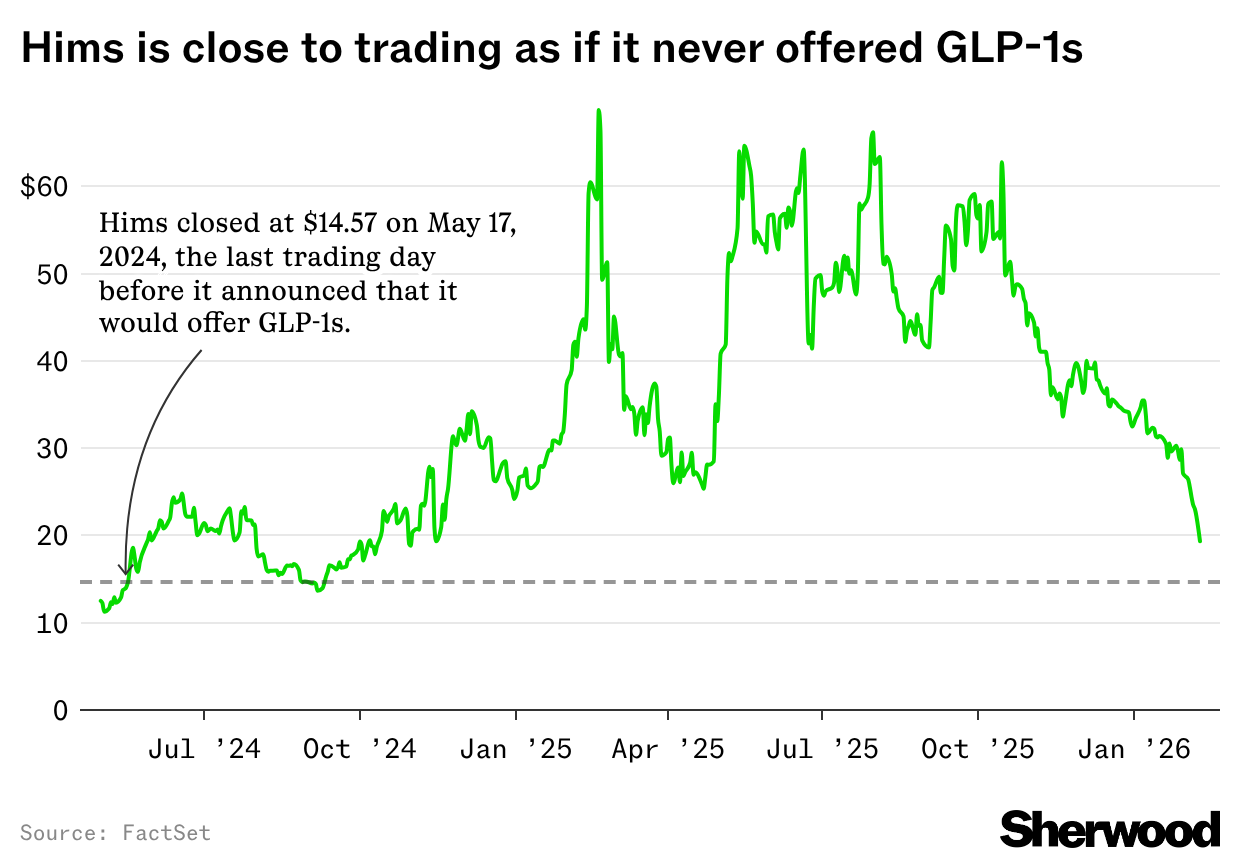
Hims has a reputation in the industry for making bold moves, which until recently it has done largely without consequences. But as its legal troubles mount, the company’s stock has taken a hit. Hims is now trading at roughly the same level as when it first began selling copies of Novo’s GLP-1 drugs in May 2024. |
|
|
-
In a blog post, OpenAI reiterated that ads wouldn’t affect ChatGPT’s responses and would be “clearly labeled as sponsored and visually separated from the organic answer.”
-
“Our goal is for ads to support broader access to more powerful ChatGPT features while maintaining the trust people place in ChatGPT for important and personal tasks,” the company wrote. “We’re starting with a test to learn, listen, and make sure we get the experience right.”
-
Advertising is one way the company, which is expected to go public late this year, could offset the massive cost of running its service.
|
|
|
The competition between OpenAI and Anthropic continues to intensify. That comedic Anthropic ad during the most watched television event of the year poked fun at OpenAI’s plans to add advertisements to ChatGPT, something it says it will not do to its Claude chatbot. Both companies released new models last week with improved coding capabilities.
In case OpenAI employees were beginning to sweat from all the pressure, CEO Sam Altman sought to assure the team that the company has gotten its mojo back, telling employees in an internal Slack group that the company is “back to exceeding 10% monthly growth” and is seeing “insane” growth in its Codex coding tool. Per the report, Altman said another new model is coming this week.
|
|
|
|