|
 |
The People Are Leading. The Leaders Should Follow.
Congressional Democrats should take a page from the people of Minneapolis.
|


| |||||||||||||||


[Editor’s note: This newsletter was delayed by a technical malfunction at Substack. We appreciate your understanding.]
Who would’ve thought America’s greatest weapon against Donald Trump’s authoritarian campaign of legal revenge against enemies would turn out to be grand juries? This week, yet another grand jury refused to give federal prosecutors indictments Trump wanted against yet another set of political foes: the six Democratic lawmakers who posted a video last fall reminding spooks and troops they had an obligation not to obey unlawful orders. Here’s the New York Times:
It was remarkable that the U.S. attorney’s office in Washington . . . authorized prosecutors to go into a grand jury and ask for an indictment of the six members of Congress, all of whom had served in the military or the nation’s spy agencies.
But it was even more remarkable that a group of ordinary citizens sitting on the grand jury in Federal District Court in Washington forcefully rejected Mr. Trump’s bid to label their expression of dissent as a criminal act warranting prosecution.
Ordinary citizens: What can’t they do? Happy Wednesday.
 |
Public Sentiment Isn’t Everything
by William Kristol
“There go the people. I must follow them, for I am their leader.” In yesterday’s newsletter I quoted this famous (if perhaps apocryphal) remark by Alexandre Ledru-Rollin, a French politician in the early days of the Revolution of 1848. I was commenting on a poll showing the public’s alarm about the possibility of Trump’s Department of Homeland Security interfering in this year’s elections. And I was struck by the relative silence of congressional Democratic leaders on that issue—even though they’re in the midst of a fight this week over funding for the Department of Homeland Security.
Yesterday, Senate Minority Leader Chuck Schumer emphasized again how much he hopes to work things out with Republicans: “There’s no reason we can’t get this [a deal with Republicans] done by Thursday.” And he didn’t rule out supporting a short-term DHS spending bill to buy more time for negotiations with the Trump administration.
Schumer and some of his colleagues remain strikingly unwilling to go on offense. Why not aggressively make the case for no new funding for Immigration and Customs Enforcement and the Border Patrol (while making clear they’re willing to separate out funding for the unproblematic parts of DHS)? Why not take the position that ICE and the Border Patrol should have to draw down at least some of the massive five-year appropriation Republicans gave them in last year’s reconciliation bill? Why give those agencies additional money now?
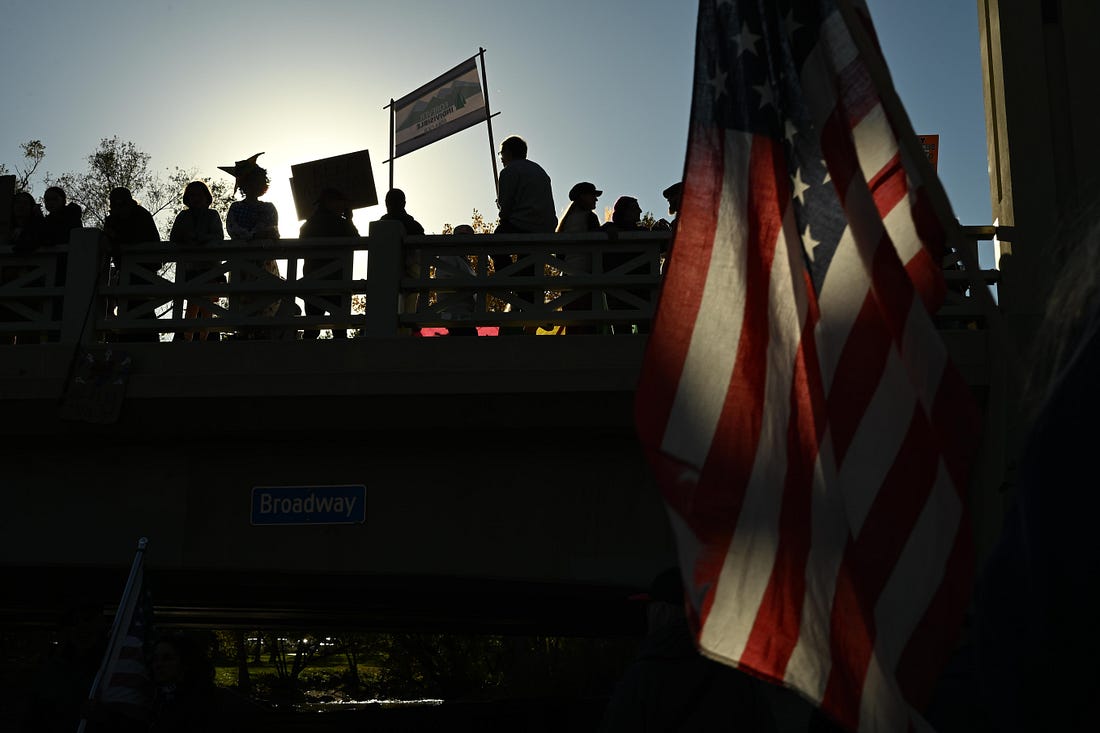
There’s no reason to do so. You know who understands this? The citizens of Minneapolis. Their sustained and exemplary civic action, taken at real risk to themselves to help defend their neighbors against Trump’s paramilitary forces, is a rebuke to the timidity of our political leaders.
We see this kind of pattern across the board. The massive turnout at the No Kings demonstrations in June and October showed that many in the public were more energized than their ostensible leaders. The amazing courage and persistence of the Epstein survivors led Congress to pass legislation in November compelling the release of the Epstein files. It’s the continued refusal of the survivors to accept a massive coverup by Trump’s Justice Department, and their persistence in calling out the administration’s clear failure to comply with the legislation Congress passed, that is leading to further congressional resistance.
And last night, as mentioned above, ordinary citizens serving on a grand jury in Washington, D.C. rejected an attempt by Trump’s Justice Department to prosecute elected officials who had served in the military for exercising their First Amendment rights to remind service members to obey the law.
The public’s rallying to the cause of democracy and liberty is the most heartening development of the last twelve months. But there are limits to what the public can do. In one of his debates with Stephen Douglass in 1858, Abraham Lincoln famously said, “Public sentiment is everything.” But as Lincoln well knew, that’s an overstatement. Power matters. That’s why Lincoln ran for the Senate in 1858 and for the presidency in 1860. Public sentiment isn’t self-effectuating. Elected officials have to translate public sentiment into political action. They have to turn public opinion into political power.
So the public can register its sentiments. But it’s Democratic senators who have to refuse to further empower ICE and the Border Patrol. The public can make known its disgust at what Epstein and his associates did, and at the coverup. But it’s members of Congress who have to insist that the legislation they passed is enforced. Citizens on grand juries can resist Trump’s politicization of the Justice Department. But it’s Congress that can pass legislation clarifying or changing the laws the Justice Department claims to be enforcing, thereby making it far easier for judges and juries to resist the corruption of the legal system.
President Trump’s State of the Union address is scheduled for two weeks from now. Perhaps Democratic members of Congress should accept that we aren’t living in business-as-usual times? Perhaps they should choose not to attend the State of the Union as long as ICE continues its rampages and the Justice Department continues its Epstein coverup? Some of them could choose to travel to Minneapolis to show solidarity with the intrepid citizens there. Some could spend the evening meeting with hearing from the brave Epstein survivors. Some could meet and show solidarity with other citizens around the country who have courageously stood up to Trump’s authoritarianism.¹
Protesters in Minneapolis. Survivors of Epstein’s sex crimes. A grand jury in Washington, D.C. These are the true leaders of the resistance to Trump’s authoritarian project. Surely it’s time for our elected officials to hurry to catch up.
Besides demonstrating, responding to polls, contacting our senators and representatives, and actually voting, what more can we do translate this overwhelming public sentiment into official policy? Share your ideas.