|
 |
Hey Bulwark fam, while Liam Ramos is back home, there are many children and parents who are still inside Dilley, suffering and asking to get out. These are some of their stories.
–Adrian
The Kids Aren’t Alright in Dilley
A baby who needs medicine. A toddler whose detained mom may have breast cancer. A suicide attempt.
|
| |||||||||||||||


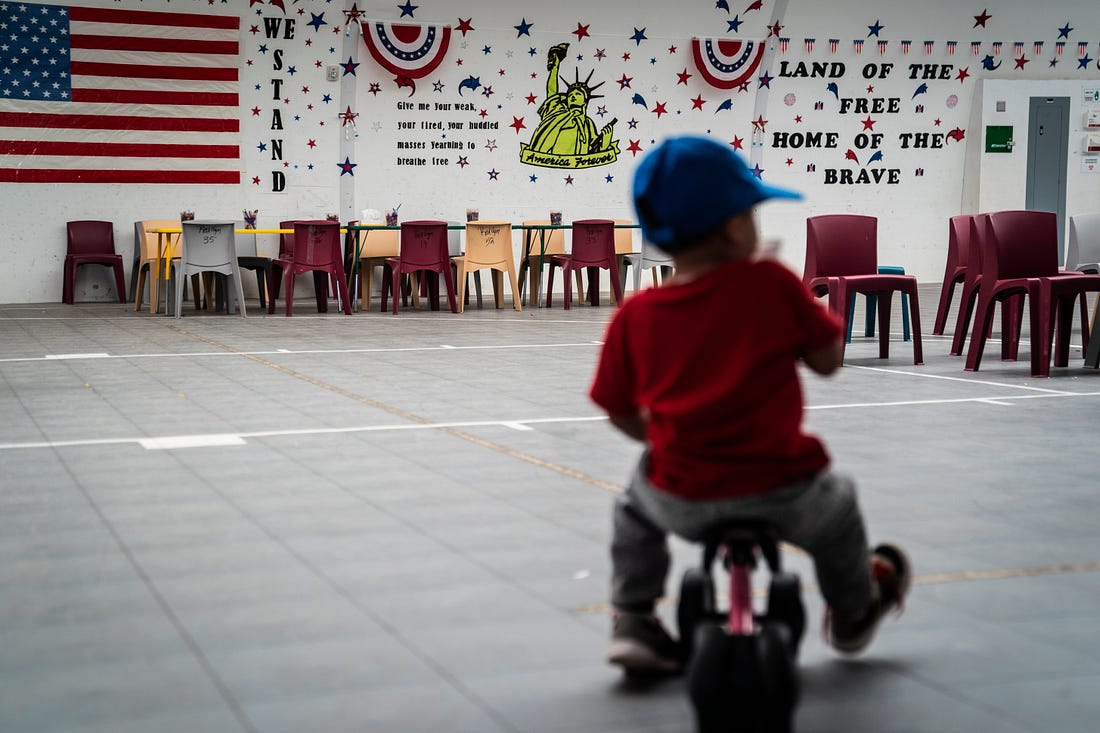 |
LIAM RAMOS WAS THE TIP OF THE ICEBERG. Dilley Immigration Processing Center, the facility from which 5-year-old Liam and his father were discharged on February 1, is a place where many other children are still being detained. Their stories are almost too much to bear.
There was the 18-month-old baby, Amalia, who was suffering from respiratory failure and was rushed to the hospital, where she spent much of the next ten days on oxygen. Upon release, federal officers took her right back into detention at Dilley, words that boggle the mind to write, and there she was denied daily medication prescribed after her hospital visit, according to a new lawsuit filed last week. Amalia and her family were finally released last Friday in response to an emergency habeas petition, but for many families in similar situations, there is no clarity about when they or their children might leave, or under what conditions.
Carmen Ayala, an aide to Rep. Jasmine Crockett (D-Texas), has been in contact with many of the detainees at Dilley, as well as with their families. She told me about Valery, a 13-year-old who attempted self harm at Dilley with a knife from the cafeteria.
Valery’s family arrived at Dilley on December 13, one day after they were detained near their home in South Florida. The family fled Colombia for the United States because the father was sexually abusing the two daughters, aged 8 and 13, Ayala was told by the girl’s family. But after the asylum claim for Valery’s family was denied in January, they faced deportation.
“It was a sense of hopelessness,” Ayala said of Valery’s suicide attempt. “They’ve been in there for months, she’s depressed and wants to get out. She saw no way of getting out, she thinks she’ll be there forever, and that was her way out.”
Crockett’s office received a privacy waiver from the family and has opened a congressional inquiry to advocate on the family’s behalf. When I asked why Valery’s treatment for self-harm seems to be exclusively a prescription for sleeping pills, ICE did not respond.
THEN THERE IS THE CASE of Mariela Sobrero Chillitupa, 31, who was in the hospital for a few days in December for tests to determine if she had breast cancer. The tests weren’t conclusive, so her doctors called for a biopsy in the new year to know for sure. Mariela wanted to delay biopsy until after a court date she had scheduled for January 14. She didn’t think it would be anything major. She spent the night in a hotel with her three children, aged 2, 8, and 11, and had breakfast with her sister-in-law the next day. They said their goodbyes and Mariela told her sister-in-law to wait nearby, it would likely only be two hours. Later, however, she received a call: “We’ve been detained, don’t wait for us.”
Her sister-in-law, Mari, who asked to be identified by only her first name, said that Mariela has complained to her about her deteriorating health and treatment inside Dilley.
“Mari, they don’t give me my medication, only when they want,” Mari says Mariela told her, adding that her breast “gets hard like a rock,” and she is only given her medication when the nurse arrives. If the nurse doesn’t come, she doesn’t get her medication. Ayala was also told by Mariela that her breast is turning beet red. She told Mari that a week ago she asked a guard to give her fussy 2-year-old to his father, who is also in detention, because her breast was causing her so much pain; she was told “No, you have to keep him, he can’t be with his father.”
DHS spokesperson Tricia McLaughlin did not respond to specific questions about Mariela’s treatment, why her medication has been withheld, whether she will be allowed to seek outside medical attention, or if she will be released given her medical condition. She said only, “That doesn’t sound right but we’ll run this down,” before asking for identifying numbers for the children, which I provided.
ICE did not respond to questions about operations inside Dilley. For example, why can’t Mariela pass her 2-year-old to his father when she is in pain? And what is being done to follow up on the biopsy ordered during those inconclusive tests in December?
Mari told me she can’t understand why people like Mariela are being treated this way.
“As a Latina . . . and as a mother, it worries me more the situation for the mothers because they’re in there with their kids suffering, but they have to hold in the pain to protect their kids,” she said in Spanish, adding that her 2-year-old nephew doesn’t understand where he is and is getting aggressive in a way that he never was before.
“I think the conditions and the suffering is inhumane and they shouldn’t be going through that. They should have respect because of the kids. Adults, we can suffer, but the kids don’t deserve to be treated this way,” she said.
She called for Dilley to be shuttered. “It’s inhumane and they should let Mariela come home with her children.”
AS I WROTE THIS NEWSLETTER on Thursday, Ayala told me of a promising new development for Mariela. The court gave her more time, until March 10, to fight to remain in the United States, but unfortunately, they ignored the medical records she brought with her. The judge said that there is nothing he can do regarding her medical issues and that the detention center is responsible for her treatment.
Sadly, these stories aren’t outliers—they are more common than we’d like to admit. ProPublica reported this week that 3,500 detainees have been at Dilley since it reopened, and more than half of them have been minors. And while a