|
 |
Why everyone’s talking about art in the Middle East right now
Museums, big brand fairs, and record-breaking auctions are reshaping the global art map
|
| |||||||||||||||


Hi all, happy Sunday.
Last week, we—along with the rest of the art world—travelled to the Middle East.
While most of our peers veered towards Doha for the inaugural edition of Art Basel Qatar, we headed further east to spend the week in Dubai.
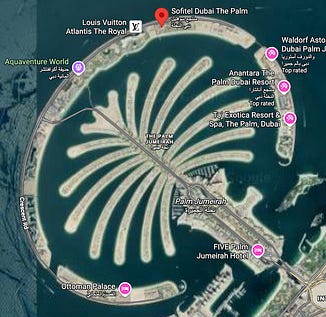
We stayed at the Sofitel Dubai The Palm and couldn’t recommend it more. The rooms were beautiful, the restaurants consistently great, and the staff exceptional from the moment we arrived. The hotel leans into its French roots and comes with perks such as a L’Occitane spa on site, their products in the room, and miniature L’Occitane treats delivered throughout our stay, from pillow spray to their glorious hand cream. The hotel was also in a prime location next to the coveted (but out of budge) Atlantis and Atlantis The Royal.
All three sit upon this tiny palm tree-shaped island, built from sand.
 |
While the purpose of this week was mostly to get some much needed R&R, we couldn’t go all the way to the UAE without checking out some of it’s most renowned cultural sites.
Dubai is not a museum city, but just a short drive down the road, the UAE capital, Abu Dhabi, is the mainstay of the regions cultural economy.
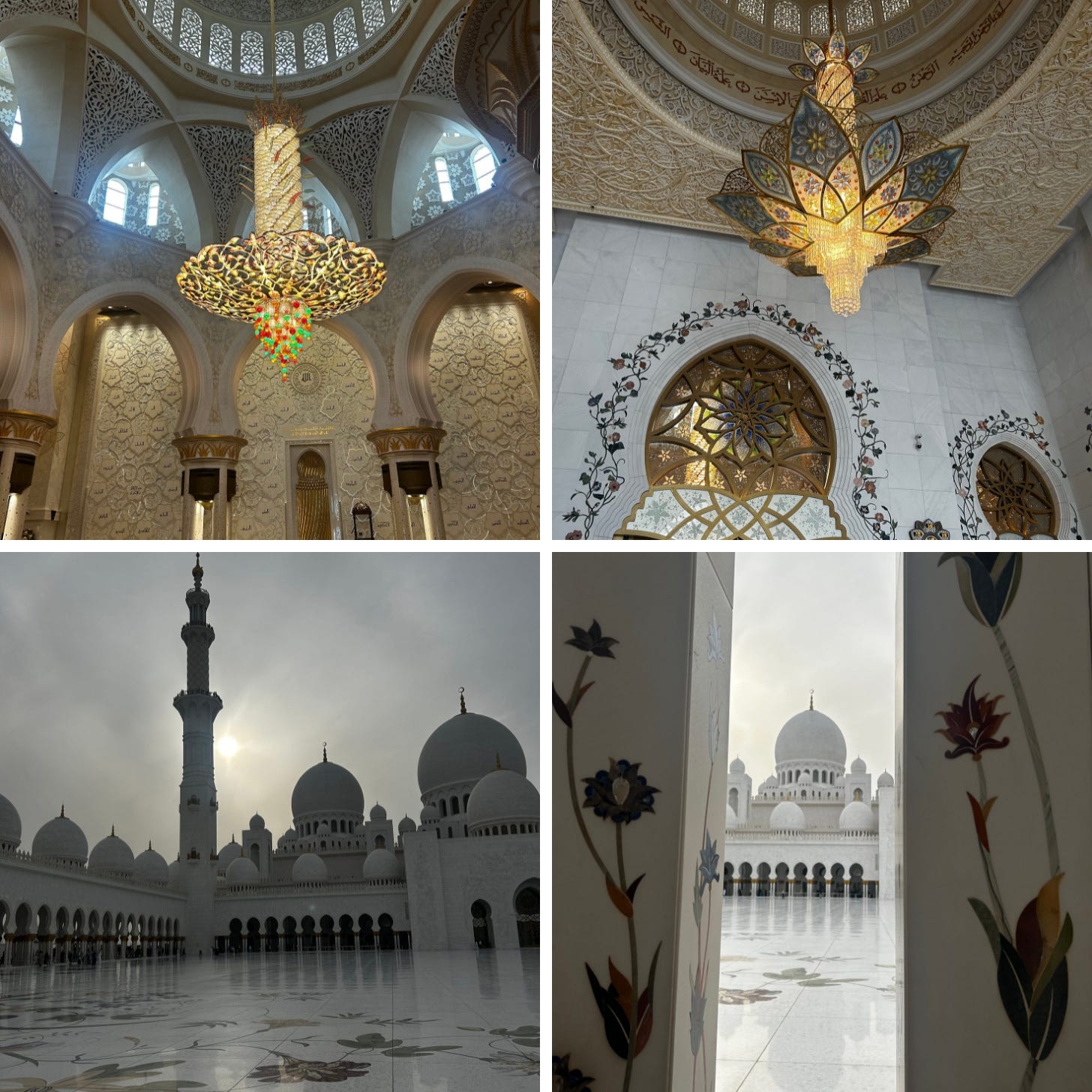
Our first stop was the Sheikh Zayed Grand Mosque, one of the largest mosques in the world. Inside sits the world’s largest hand-knotted carpet laid beneath colossal Swarovski crystal chandeliers, while its vast courtyard is home to the largest marble mosaic ever created. Attending as a visitor, rather than a worshipper, means your experience of the mosque swiftly turns into a kind of tourist conveyor belt, but the sheer scale and opulence of the architecture and interiors makes it well worth the trip.
Next we ventured over to what is colloquially known as ‘museum island’, the Saadiyat Cultural District, home to the Zayed National Museum, the Natural History Museum, and immersive spaces like teamLab Phenomena. Soon to join them will be the Guggenheim Abu Dhabi, designed by the late Frank Gehry, which we caught mid-construction on the horizon.
We, however, were there for one reason and one reason only: to visit the Jean Nouvel-designed, Louvre Abu Dhabi, where we spent the rest of the day.
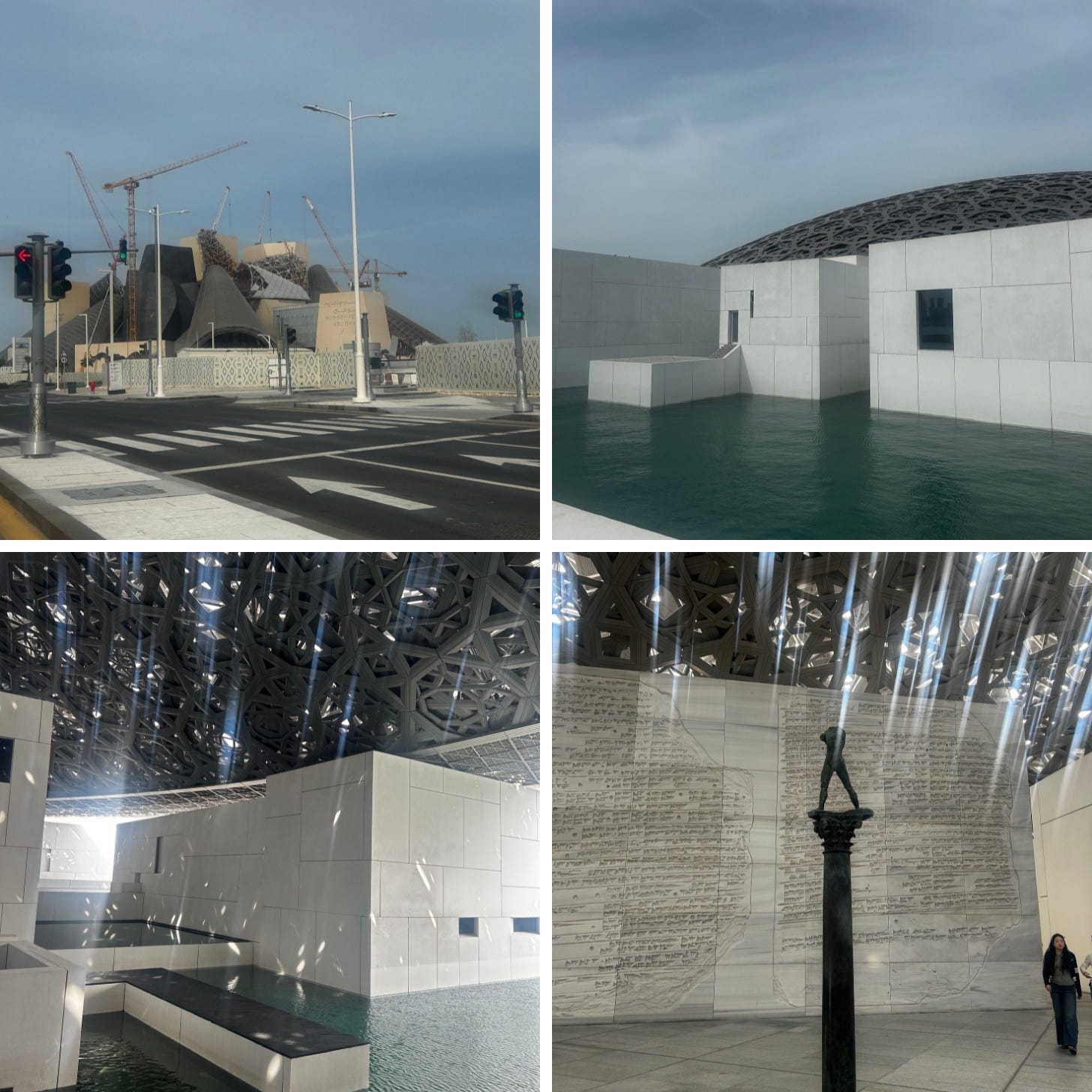
While some might see the Louvre in Abu Dhabi as part of a larger state-backed effort to parachute in world-class museums and build cultural clout almost overnight, the Louvre makes more sense here than you might think. France and the Arab world have shared centuries of trade, diplomacy, and cultural exchange. That history is woven in throughout the Louvre Abu Dhabi, giving its galleries a depth that feels deliberate and considered, rather than imported.
We went primarily to see Picasso: The Figure, an exhibition that tracks Picasso’s figurative work across his career. It’s worth saying that while Picasso was Spanish, not French, he spent most of his life in Paris, titled his works in French, and is largely grouped among the great figures of twentieth-century French modernism. The exhibition was fantastic. What made it compelling wasn’t just the familiar arc from early academic studies to fractured late bodies, but the curatorial decision to punctuate the show with works by Middle Eastern artists, who were clearly influenced by or responding to Picasso.
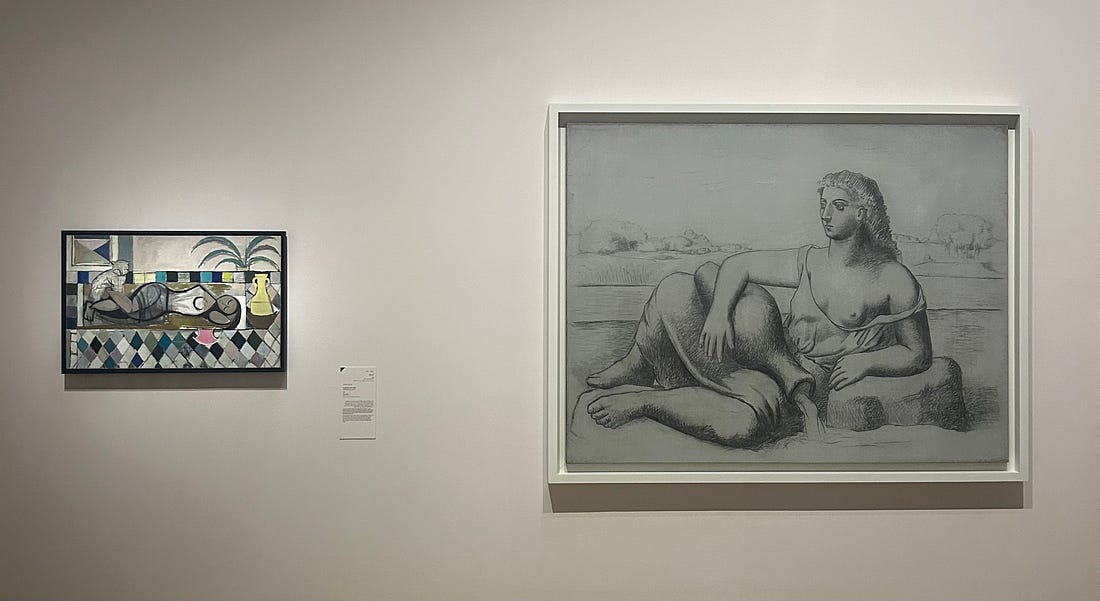
For example, Jewad Selim’s Alqailoula (The Nap) (1958; left) hangs alongside Picasso’s The Spring (1921; right). Jewad Selim is considered to be the founder of modern art in Iraq and having first encountered Picasso’s work in Paris, here he reinterprets the reclining figure, channelling Cubist abstraction while fusing Islamic and Mesopotamian motifs, rooting the nude in a distinctly Iraqi context.
 |
The most striking comparison came in a room devoted to Dia Al-Azzawi’s Elegy to My Trapped City (2011), a powerful reinterpretation of Picasso’s most famous work, Guernica (1937). Al-Azzawi’s vast painting, which spans 2.4 x 8 metres, is comprised of fragmented monochrome forms that reflect the post-2003 destruction of Iraq, channeling human suffering through a political lens that Azzawi has explored since the 1970s.