|
 |



How committed is the Trump administration to erasing the history of slavery? Last month, the National Park Service removed exhibits about slavery from the Philadelphia site where George Washington—and some of the people he enslaved—and John Adams lived before the capital moved to D.C. A judge ordered them to restore the exhibits. And now the administration has appealed the ruling.
“The National Park Service routinely updates exhibits across the park system to ensure historical accuracy and completeness,” the Department of the Interior said in a statement. “Completeness” is doing some interesting work there.
Programming note: Our shows tonight and tomorrow at the Pantages Theatre in Minneapolis are pretty much sold out, but there’s a smattering of tickets left if you’re in the neighborhood and want to squeak in under the wire. It’s been an amazing couple of few months in Minnesota—we look forward to seeing some of you there tonight. Happy Wednesday.
 |
The Minnesota Model
by William Kristol
Minneapolis, Minn.—I’ve always been pro-Minnesota.
When I was a kid, New York baseball fans were divided into Yankee lovers (boring power-worshippers) and Yankee haters (daring fans of scrappy underdogs). As you’ve perhaps guessed, I was firmly in the latter group. And so I was pleased when the Minnesota Twins won the American League pennant in 1965, deposing the mighty Yankees, who’d been AL champs for fifteen of the preceding eighteen seasons.
My affection for the Twins only increased when they lost a dramatic seven-game World Series to the Dodgers and Sandy Koufax, who pitched complete-game shutouts in the fifth and seventh games, the latter on two days’ rest. So I was grateful to the Minnesotans both for winning the regular season and losing in the Series.
Three years later, in 1968, Minnesotans reappeared on my horizon. I spent part of my summer between tenth and eleventh grade as a volunteer for Hubert Humphrey’s presidential campaign. I admired Humphrey both for his leadership on civil rights and his liberal anti-communism, and some of that admiration spilled over to the state that elevated him to public office. And I’ll add that though I didn’t support him, I rather admired Humphrey’s rival and fellow Minnesotan, Eugene McCarthy, as well.
Then, a decade later, in the winter of 1978, as I was finishing up grad school, I visited Minneapolis for the first time for my first job interview. I remember only three things about that visit: It was really cold; I was nervous; and the University of Minnesota political scientists were nice to me. (I didn’t end up with the job—it would have been too much of a shock to my system to leave the East Coast.)
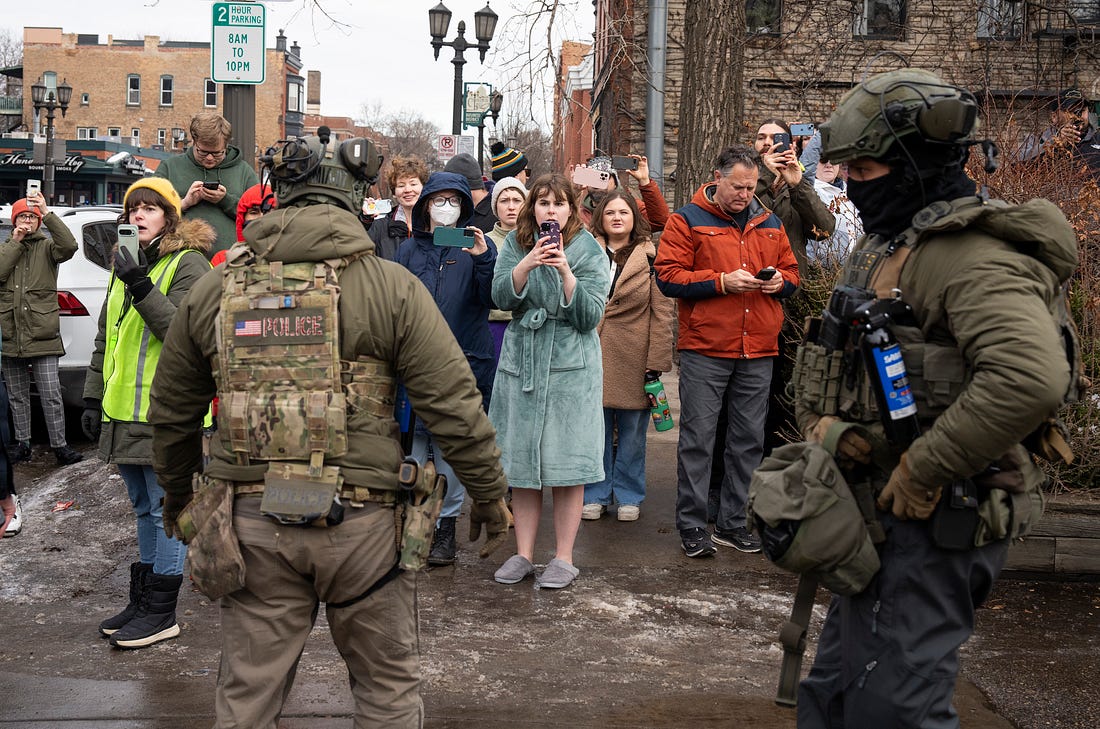
I can’t say I was excessively preoccupied with goings-on in the North Star State for the next several decades. But, over the past couple of months, who hasn’t been focused on events here? And who hasn’t admired the example of civic courage and citizen responsibility Minnesotans have provided for the rest of us?
I’m in Minneapolis now for Bulwark events tonight and tomorrow night. A friend arranged a dinner last night with a group of locals, some of them traditional liberals and some ex-Republicans. None of them seemed by career or disposition to have been long-time take-to-the-streets activists. But all of them have been very involved in the recent anti-authoritarian activism. And as they described what they and their friends and acquaintances have been doing to help immigrants and to try to check ICE’s depredations, as they explained the Signal text chains and the modes of cooperation among both neighbors and strangers, as they detailed the bottom-up, spontaneous character of the overall effort, I came away even more impressed than I expected.
These proud Minnesotans gave a lot of credit for their success to the state’s strong network of civic organizations and to its culture and tradition of public-spiritedness. Perhaps the people of Minnesota were especially suited to organize themselves for this moment. But surely this state isn’t that different from many others. My main takeaway was less the specialness of Minnesota, and more that the rest of us need to follow in Minnesota’s footsteps.
And we need to do so not just when DHS launches a surge in the streets of a particular city. We need the grass-roots, spontaneous exercise of civic leadership in the fight against authoritarianism on every front for the next three years.
After all, if you look at the overall balance of power between the Trumpist authoritarians and the pro-democracy resistance, it’s not great. The federal government generally has more power than state and local governments, and especially a federal government ruthless and relatively united in the service of its aims. Big business and many other powerful institutions are mostly going along to get along. Congress can’t be counted on to provide much resistance over the next year, and even if Democrats take both houses this November, a weaponized executive branch will remain powerful. The situation with big media is problematic.
The elites and the establishment, the big organizations and the august institutions, are unlikely to save us. Widespread citizen activism and resistance could make the difference, though.
And we need to be imaginative about what that would look like. We need citizens acting in many ways and at all levels. We need protests and organizing, but we also need more forms of resistance from within big organizations, sometimes publicly, sometimes privately, and yes, sometimes surreptitiously. We need internal dissidence and help for dissidents. We need leaks and exposés, and support for leakers and truth-tellers. We need to get beyond thinking about politics as usual—though conventional politics remains critically important. We need to think not only of election campaigns but of popular campaigns. We need to learn lessons from the civil rights movement of the 1950s and 1960s, and from Eastern European dissidents in the 1970s and 1980s.
The Trumpists, like the Southern segregationists and the Soviet-bloc communists before them, have been pretty effective in mobilizing the executive branch and associated organizations behind their deplorable actions, their crude propaganda, and their efforts at intimidation. And so we need an all-of-society resistance to defeat the all-of-government conspiracy against our liberties and democracy.
That’s why it’s important that Minnesota be not just a shining example of what can be done. It needs to be a harbinger of what’s going to be done. It needs to be a model not just admired but emulated. We should all be Minnesotans now.
Besides the civil rights movement and the Soviet-bloc anti-communist movements, what other models should we draw inspiration from? Who else has fought authoritarianism and won? Share your ideas in the comments.