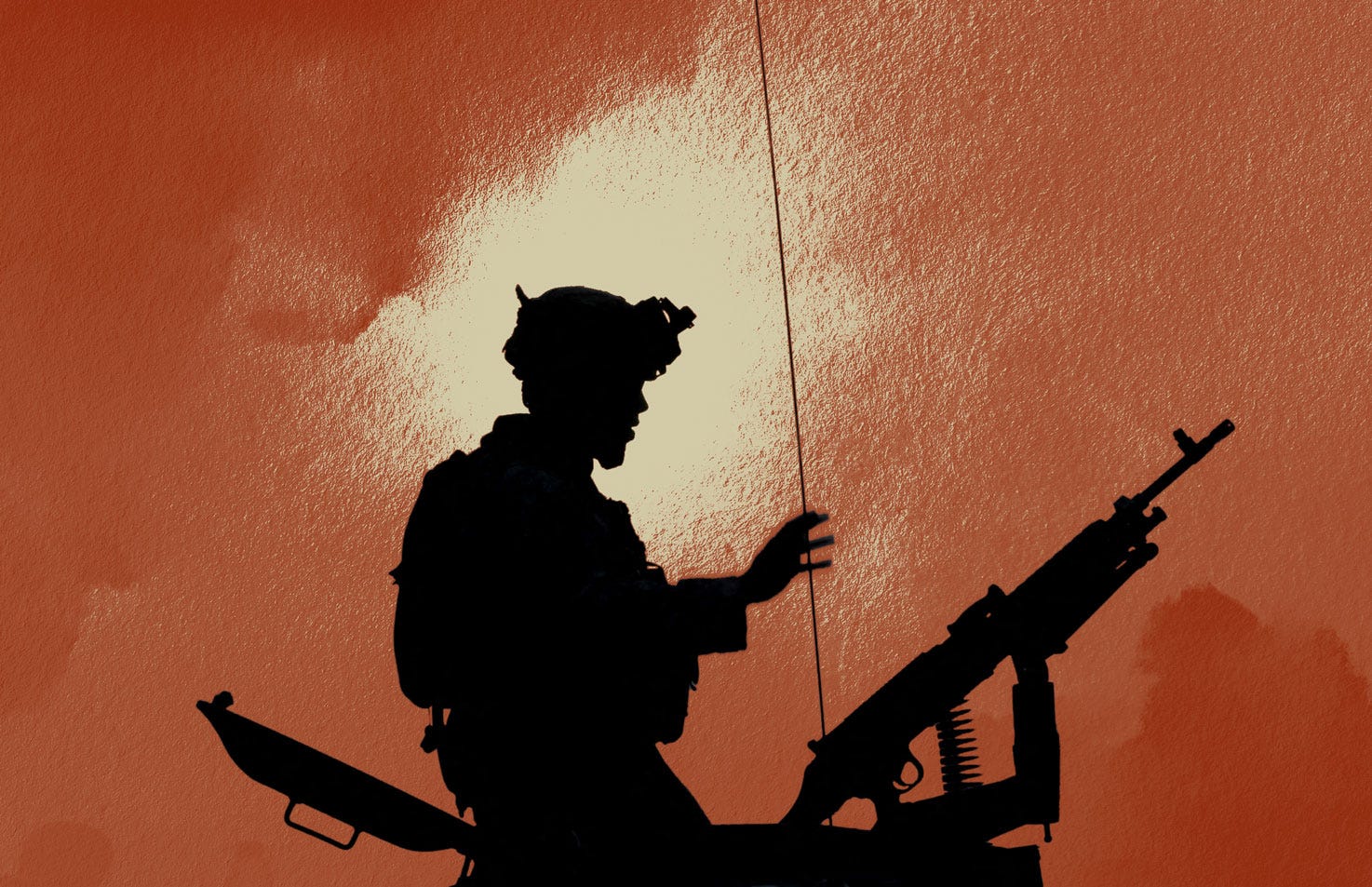
What Went Wrong with the American Man? The war on terror ended without victory. In its wake, a new archetype emerged: the aggrieved man convinced he has been betrayed.
“Without the aura of its military power, the American mythos that justified its wars curdled into a bad joke,” writes Jacob Siegel. (Illustration by The Free Press; photo by Hassan Ammar/AFP via Getty Images)
From the rise of manosphere influencers to skyrocketing rates of gambling addiction, the evidence that American men are not okay is all around us. But what, exactly, went wrong? That’s the question at the heart of a bracing new essay published by our friends at Tablet magazine. It’s by Jacob Siegel and it examines how the war on terror reshaped men’s understanding of themselves. In the piece, which we’re republishing below, Siegel argues that America’s failed wars abroad did more than sap military strength or political capital; they destabilized the confident, self-assured archetype that once defined American masculinity. And in their wake has emerged an embittered, and perhaps familiar figure, convinced he’s been humiliated, misled, and betrayed. —The Editors
What America did probably better than any empire in history was to produce culture-defining ideas that could be packaged and exported to people around the world who all became a bit American in the process. High up on that list stood the ideal of the American man, which appeared just as captivating and as tantalizingly attainable as the hat he wore or the car he drove. This article is featured in Culture and Ideas. Sign up here to get an update every time a new piece is published. Through most of the 20th century, at the height of its powers, America minted iconic male types. Men who exuded strength, ambition, freedom, and sexual fascination at home and in the world market. Rather than being some manner of pure breed, the ideal American, the kind who launched businesses and trans-Atlantic flights, liberated Europe and starred in Hollywood movies, was a man of mixed origins. He was made up of parts Puritan, pioneer, Southern Baptist, Midwestern salesman, black bluesman, Mormon homesteader, and Irish-Italian-Polish-Jewish big-city ethnic. The 1920s produced both the macho archetypes of Ernest Hemingway and the romantic vulnerability of F. Scott Fitzgerald’s Gatsby. That’s how the character of American manhood tended to evolve. Not in a straight line but through iconographic variations on a shared experience, like the settling of the frontier and the First World War...
Become a paid subscriber Get access to our comments section, special columns like TGIF and Things Worth Remembering, tickets in advance to our live events, and more. UPGRADE TODAY |