|
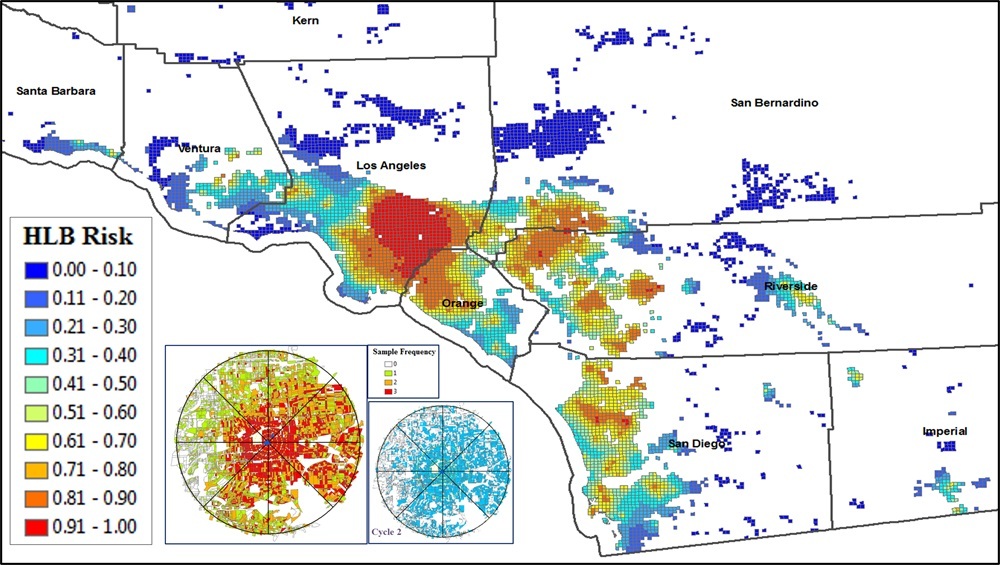
A screenshot of the risk-based survey for detecting huanglongbing (HLB) in Southern California. Colors represent the probability of HLB establishment or development, ranging from low risk (blue, near 0.0) to high risk (red, near 1.0). (Image provided by Weiqi Luo, North Carolina State University)
Surveying Citrus Greening Risks in Southern California
Huanglongbing (HLB), also known as citrus greening, is the most devasting disease of citrus worldwide and has cost billions of dollars in economic losses. HLB has severely affected the citrus industry in Florida before any remedial action could be taken by growers. In California, HLB has been reported in urban backyard citrus trees that are a potential source of the pathogen. These infected backyard citrus trees threaten surrounding commercial citrus groves.
ARS researchers in Fort Pierce, FL, and their research partners developed a refined risk-based survey (RBS) to help stakeholders survey for HLB in complex urban and suburban landscapes in Southern California. Learn more...
The Agricultural Research Service is the U.S. Department of Agriculture's chief scientific in-house research agency. Daily, ARS focuses on solutions to agricultural problems affecting America. Each dollar invested in agricultural research results in $20 of economic impact.
|