|
 |



The primary focus this week is probably going to be on the State of the Union address. Will any of the Justices show up in the wake of Trump’s Friday afternoon press conference, where he excoriated the ones who ruled against him in the tariffs case and called them an embarrassment to their families? Will Trump continue to talk about his ability to destroy other countries? We will see what Tuesday brings.
But he heads into SOTU with a new Washington Post-ABC poll showing that his approval rating is at 39%—the last time it dipped below 60% was in the wake of January 6. Forty-seven percent of Americans strongly disapprove of the job the president is doing.
Late last week, there was reporting on a tremendously important story, one that should be topping every news cycle, but doesn’t seem to be. On this administration’s watch, a DHS agent shot and killed an American citizen living in Texas during a traffic stop last March. According to the report, released as part of a FOIA request, 23-year-old Ruben Ray Martinez is now the earliest known shooting by federal agents associated with the Trump administration’s mass deportation policy. We’re only finding out about it now.
Once upon a time, we would have taken the government’s version of an officer-involved shooting at face value. Here, according to the New York Times, the government’s report claims that, “Mr. Martinez initially did not follow officers’ instructions but eventually slowed to a stop after receiving verbal commands. Agents surrounded the vehicle and told him to get out of the car before Mr. Martinez accelerated and hit a federal agent, who landed on the roof of the car according to the documents. Another agent then fired multiple times through the driver’s side window. Mr. Martinez was transported to a hospital in Brownsville and later died.” NBC filed essentially the same report, but noted that the agent landed on the hood of the car when the driver accelerated after “Agents then surrounded the vehicle.”
Maybe the government’s story is true. Maybe it’s not. It doesn’t make a lot of sense—we’re to believe Martinez came to a stop and then, while surrounded by agents, managed to accelerate with enough force that he hit one of them, who ended up on either the hood or the roof of his vehicle. Were there bystanders nearby? The agent fired into a vehicle, an apparent violation of DHS policy. And was the agent still on the hood or roof when the other agent fired? Did they put him in danger? I’m having trouble envisioning it. The documents apparently reflect that the agent was treated for a knee injury at a local hospital and released.
One problem when the government consistently lies is that it’s hard to know when (if) it might be telling the truth. And the fact that this report was concealed for so long doesn’t do anything to calm suspicion. There was reporting of his death at the time it happened, but federal and state officials failed to disclose that ICE agents were involved.
The report that was released under FOIA does not disclose the reason Martinez was stopped by officers working on an immigration detail. He was a brown-skinned American citizen. We have a phrase that describes this in Alabama—driving while brown—and to state the obvious, it is not a legitimate reason for police, including federal agents, to make a traffic stop.
Martinez’s mom, Rachel Reyes, described her son as a hard-working young man who had no history of confronting law enforcement officials. She said he worked at an Amazon warehouse in San Antonio and was out celebrating his birthday when he was killed. “He was a good kid. He doesn’t have a criminal history. He never got in trouble. He was never violent.” She also said she was told by Texas Rangers that there was video that contradicted DHS’ version of events, but did not provide any details.
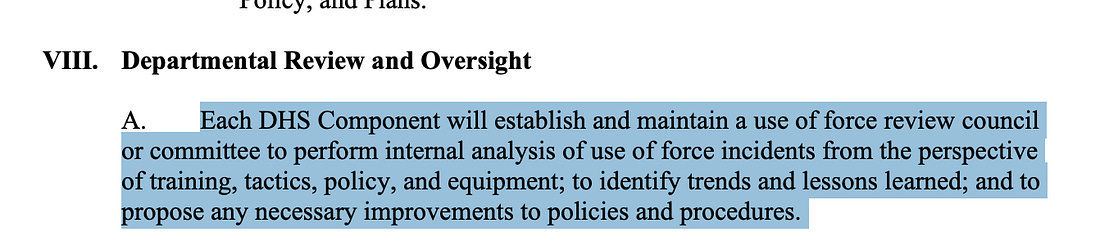
Under existing policy, every DHS component, including ICE, is required to have a “use of force review council or committee” to analyze incidents. The use of deadly force “must be reasonable in light of the facts and circumstances confronting the LEO [law enforcement officer] at the time force is applied.” It can only be used if agents reasonably believe there is an imminent threat of death or serious injury to an agent or someone else. It’s not clear whether a review was taken here and if so, what the results were.
 |
There has been no outrage from Martinez’s senators, John Cornyn and Ted Cruz. It is essential that there be a full accounting for Martinez’s death. The facts matter.
There are also ongoing reports of deaths at immigration detention facilities, even as the government is reportedly ramping up to literally warehouse human beings, including children, in actual warehouses, being snapped up with your taxpayer dollars. The Texas Tribune, a local paper that still does independent journalism, has a report calling out horrific conditions in Texas prisons, including the death of Geraldo Lunas Campos, which we’ve previously discussed. The official report says he tried to hang himself. The medical examiner ruled it a homicide, and a witness allegedly backs that up. There have been six deaths in six weeks at ICE-run facilities in Texas.
Although the Supreme Court released its decision in the tariffs case last week (6-3, IEEPA, the statute that doesn’t use the word “tariff” doesn’t authorize the president to issue them), we haven’t heard that last word on the issue yet. Trump is serious about tariffs. During the campaign, he called “tariff” the most beautiful word in the English language. He withdrew his support for incumbent Colorado Congressman Jeff Hurd, calling him a “RINO,” because he opposes tariffs. And Trump has said that he will issue new ones.
He has the authority to do that. Although Congress has the power to impose tariffs, it can and has loaned some of it to the president. What Congress intends to do that, it knows the right way—it uses the word “tariffs” in the statute and places limitations on their use, like a time limit or a limit on how high the percentage of the tax can be. It also provides conditions under which the tariffs the specific law allows for can be imposed by a president.
That was the whole reason Trump used IEEPA: Because it didn’t give him any tariff powers, it necessarily didn’t impose any limits on what he could do. It would be as if you told your teenager they could go to a movie so long as they were home by 10 p.m. and it didn’t cost more than $10. You also have a rule that it’s a good idea for family members to be happy. Using the happiness rule, the kid then goes to a movie that doesn’t get out until 11 p.m. and costs $15. It’s an imperfect analogy, but you get the point of what Trump did and why.
Now he’s stuck in a world where he can only use the specific tariff authority Congress has granted him. So here’s what he had to say, in a Truth Social post:
“Based on a thorough, detailed, and complete review of the ridiculous, poorly written, and extraordinarily anti-American decision on Tariffs issued yesterday, after MANY months of contemplation, by the United States Supreme Court, please let this statement serve to represent that I, as President of the United States of America, will be, effective immediately, raising the 10% Worldwide Tariff on Countries, many of which have been “ripping” the U.S. off for decades, without retribution (until I came along!), to the fully allowed, and legally tested, 15% level. During the next short number of months, the Trump Administration will determine and issue the new and legally permissible Tariffs, which will continue our extraordinarily successful process of Making America Great Again - GREATER THAN EVER BEFORE!!! Thank you for your attention to this matter. President DONALD J. TRUMP”
Trump seems to be contemplating tariffs under Section 122 of the