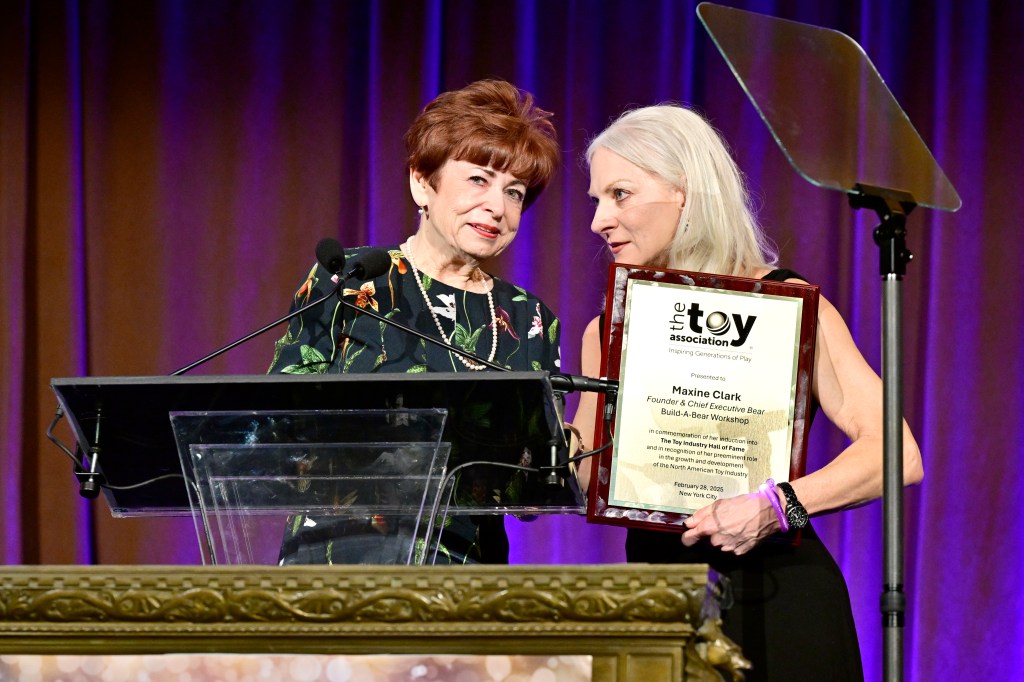
Hello from snowy NYC! Just before the city was blanketed in snow, I spent this weekend at Columbia Business School’s Retail and Luxury Goods Conference. I had the pleasure of interviewing Maxine Clark, the founder of Build-A-Bear, alongside the company’s current CEO, Sharon Price John.
Our conversation covered Build-A-Bear’s business in front of this audience of MBAs. Clark essentially invented the category of experiential retail, and she left a high-paying job in retail at Payless to bet on her idea in 1997. Price John came in more than a decade later, with stints at the biggest toymakers on her resume, to help Build-A-Bear shore up its business. Following the 2008 recession, the company was burdened by high real estate costs and struggling to keep up with changing ways of shopping.
I’ve interviewed Price John
about Build-A-Bear before, which is a fascinating story on its own—she has taken what was once a purely in-person business and added a valuable e-commerce segment by capitalizing on adults looking for nostalgia moments, something that many children’s brands can tap when they turn 25. It’s a phenomenon she calls “kidulting. And adults are happy to buy their favorite bears online, while kids can still experience the magic of building their own bear in store. Both factors have helped Build-A-Bear become an almost $500 million business.
In this conversation, what struck me most was how Clark and Price John are truly a dynamic duo. In conversation with the pair, you can see the friendship and respect that drives their relationship. That is certainly not always the case between a founder and the CEO brought in to take over the company after them.
I asked both leaders the secret to building this strong relationship. It came down to one thing: “We wanted to,” they told me. Both respected the other’s expertise, with Clark understanding what Build-A-Bear needed to succeed in the years ahead and Price John asking Clark for her opinion or filling her in on changes big and small. Price John says she doesn’t understand why operator or turnaround CEOs
don’t value the perspective of the founder; clearly something they did worked, or there wouldn’t be a company to run, she says. Still, building such a strong partnership took intention and effort.
That’s how more than a decade later, the pair are onstage together sharing their unique perspectives on retail—something any company transitioning from founder leadership can learn from.
Emma Hinchliffeemma.hinchliffe@fortune.comThe Most Powerful Women Daily newsletter is Fortune’
s daily briefing for and about the women leading the business world. Subscribe here.