| | US consumer confidence rebounds, Shein’s low-profile founder makes a rare appearance, and South Kore͏ ͏ ͏ ͏ ͏ ͏ |
| |  | Flagship |  |
| |
|
The World Today |  - AI-driven selloff tempers
- Anthropic-Pentagon standoff
- AMD strikes Meta deal
- US consumer confidence up
- Case for China EVs in US
- Shein CEO’s rare appearance
- Four years of war in Ukraine
- AI enthusiasm in S. Korea
- Economist at a crossroads
- Dennises the Menace turn 75
 A remarkably revisionist account of the Japanese-American war. |
|
AI-fueled stock slide subsides |
 Jeenah Moon/Reuters Jeenah Moon/ReutersAn AI-induced stock slide subsided on Tuesday as traders grew more confident that the tech can augment, rather than replace, traditional software businesses. AI startup Anthropic — whose Claude tools sparked the rout earlier this month — announced partnerships with software firms on Tuesday, a message that amounted to: “We’re here to help, not hurt,” one analyst said. The relief rally spurred some strategists to temper their expectations of a broad meltdown at the hands of AI, with a JPMorgan Chase expert arguing, “The catastrophizing seems overdone.” But investors are so skittish that a recent viral blog post imagining a bleak AI future was enough to spark a selloff. The market is “looking for an excuse to fall,” a Financial Times columnist wrote. |
|
Anthropic-Pentagon feud heats up |
 Bhawika Chhabra/Reuters Bhawika Chhabra/ReutersThe Pentagon gave Anthropic until Friday to provide the US military unrestricted access to its AI model or face penalties. Defense Secretary Pete Hegseth met with Anthropic CEO Dario Amodei on Tuesday following a weekslong feud between the American startup and US officials who want to deepen the integration of AI for military uses. Anthropic already has a $200 million contract with the government, but wants carve-outs that prohibit its AI’s use for mass surveillance and autonomous weapons deployment, Semafor reported last week. Anthropic has taken a hard line on those issues compared to competitors including xAI and OpenAI. The Pentagon threatened to deem Anthropic a supply-chain risk if it doesn’t comply. |
|
Meta spreads out its chip bets |
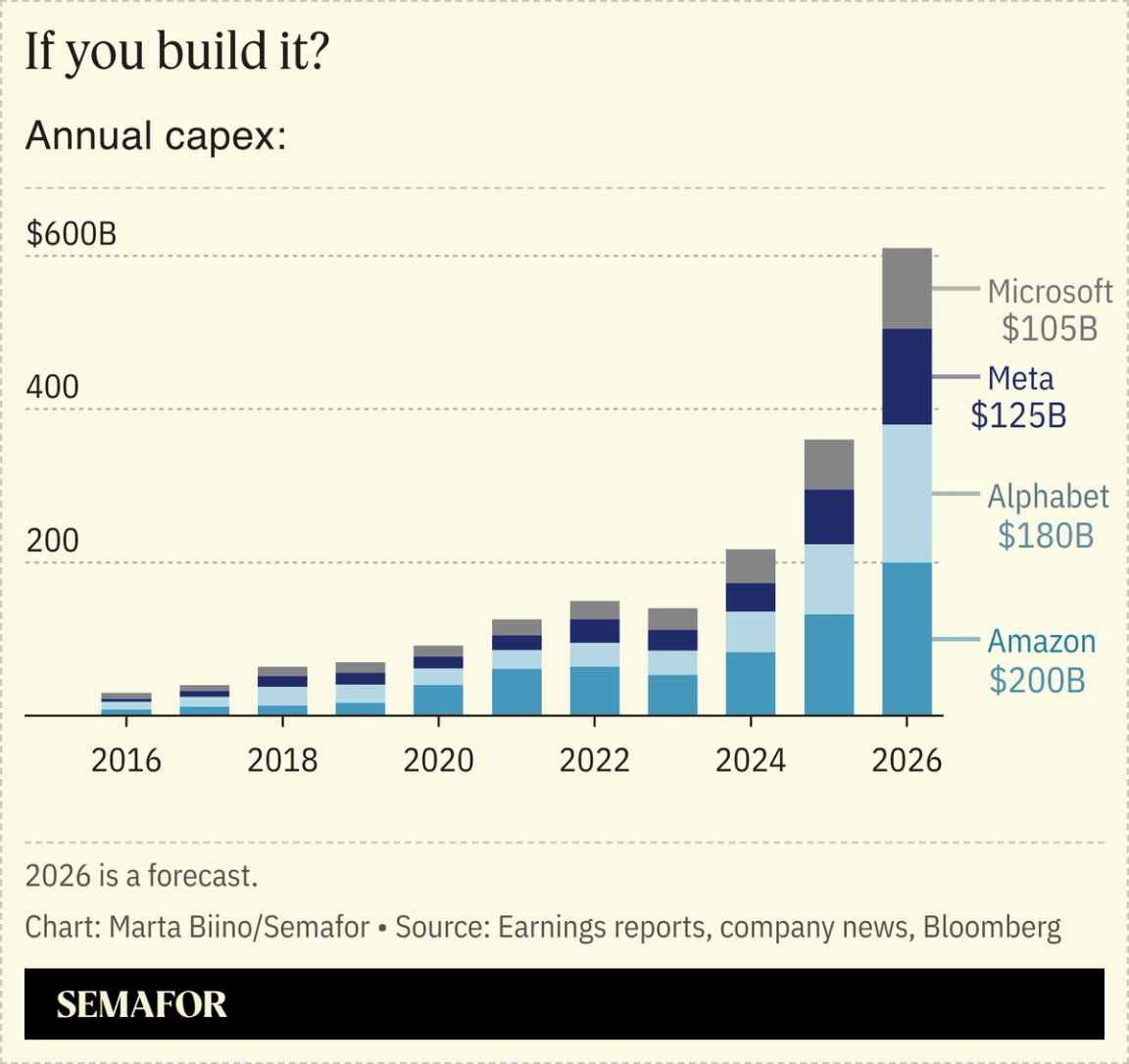 Meta struck a deal with AMD that would give the social media company a stake in the chipmaker in exchange for a heap of chips big enough, in energy-consumption terms, to power 4.5 million homes. The deal is nearly identical to the one AMD struck last year with OpenAI, and shows AMD using the potential appreciation of its stock as bait to land big chip customers. It’s the latest bit of circular financial engineering that tethers the contestants in the AI race to each other, Semafor’s Rohan Goswami wrote. It also represents a “coup” for AMD, The Wall Street Journal wrote, in its quest to catch up to Nvidia, which just last week struck its own deal with Meta. |
|
US consumer confidence rebounds |
 Brendan McDermid/Reuters Brendan McDermid/ReutersUS consumer confidence rebounded more than expected in February, new data showed Tuesday, though worsening sentiment around job prospects could signal turmoil ahead. While Americans’ short-term expectations for incomes and businesses improved, the share of consumers that view jobs as “hard to get” hit a five-year high. The economy has been growing and inflation has cooled, but a downbeat public has dented President Donald Trump’s narrative of an economic turnaround. Trump will aim to sell Americans on his handling of the economy during his State of the Union speech Tuesday night, but it will be a tough task given that polling shows voters remain concerned about costs and are increasingly souring on the president’s performance. |
|
Chinese EVs as US ‘salvation’ |
 Rafael Martins/Reuters Rafael Martins/ReutersUS restrictions on Chinese EVs are misguided and, in fact, the vehicles’ entry into the American market could offer salvation for Detroit’s automakers, Semafor’s China columnist argued. Wary of the possible security risks, policymakers in Washington have maintained sky-high tariffs on China’s EV makers. Solar panels, drones, and surveillance cameras have all met a similar fate. EVs, however, are different, Andy Browne noted, because they drive the development of other key technologies like batteries. Washington’s diagnosis of the problem they pose, and how to address it, illustrates how deeply officials risk misunderstanding China. But there is some prospect of a shift: US President Donald Trump has said he’d “love” to see Chinese carmakers opening factories in the US. |
|
 We are ramping up our global coverage: We’ve just launched Semafor China, an ambitious briefing for leaders on how the world’s second-biggest economy is changing the world around it. Helmed by Andy Browne — a Pulitzer Prize-winning reporter and editor who has covered the country for decades — and featuring a new CEO interview series by Clay Chandler, a decorated Asia-focused journalist who has covered the region for The Wall Street Journal, Washington Post, and Fortune, our weekly briefing will tackle the vast financial, economic, and technological impact China is having across the globe, from Africa to the Americas. Our inaugural edition had scoops on a Chinese industrial giant’s expansion into Europe, AstraZeneca’s strategy in China, and the extent of US allies’ courting of Beijing over the first year of Donald Trump’s second term. Subscribe to Semafor China for your weekly look at the biggest stories and best analysis on the country, and its huge impact on the world. |
|
Shein founder makes rare appearance |
 Jorge Silva/Reuters Jorge Silva/ReutersThe mysterious founder of Shein made a rare public appearance Tuesday to hail local government support that helped the Chinese fast-fashion giant grow into a global juggernaut. Xu Yangtian’s speech was remarkable in part because of his incredibly low profile: Shein never made photos of him available, and even some of the company’s employees have reportedly struggled to identify him. Xu’s remarks, which came as the EU is investigating Shein, also contrasted with the company’s yearslong efforts to distance itself from its Chinese roots and present as a Singapore-based e-commerce platform to attract global capital and avoid Western regulatory pressure. “So much for the past 2 years China-shedding,” one China business consultant wrote. |
|
Kyiv marks four years of war |
 Valentyn Ogirenko/Reuters Valentyn Ogirenko/ReutersThe Russia-Ukraine war is at the “beginning of the end,” Volodymyr Zelenskyy told the Financial Times, as the conflict entered its fifth year Tuesday. Through it, Ukraine has remained resilient, commentators said. Shortly after Russia’s full-scale invasion on Feb. 24, 2022, many thought Kyiv could fall within days. But Ukrainian forces are showing they have “plenty of fight left,” The Wall Street Journal wrote. Even as Russia intensifies attacks on Ukrainian power plants, “it’s clear that the most… prolonged military campaign against energy infrastructure in history has failed,” Semafor’s Kyiv-based energy editor wrote. But the siege means “normal life has become untenable” in Ukraine, Russian American journalist M. Gessen wrote, and “whatever lies ahead feels as if it will last forever.” |
|
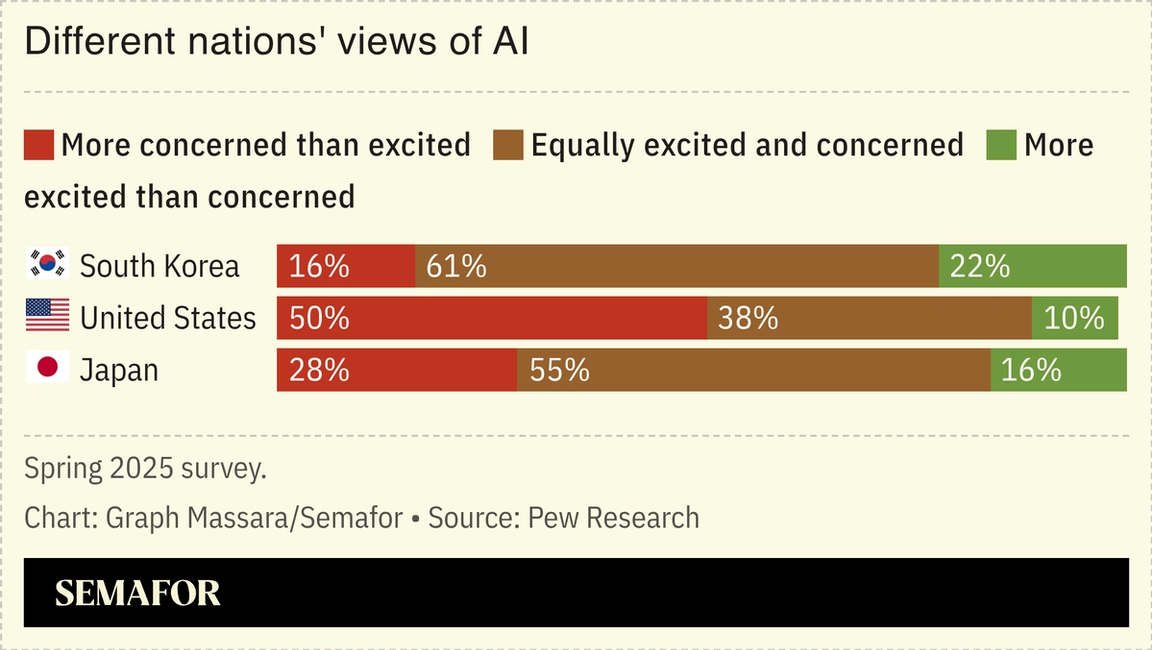 While the West is panicking about AI, South Korea feels good vibes. Polling finds just 16% of Koreans are more concerned than excited about the technology’s rise, compared to 50% in the US; Korean businesses proudly proclaim they use AI to make promotional images. This “immense AI optimism” has specific historical and cultural bases, Politico reported: The country is resource-scarce and tech-heavy, so new technologies are a source of pride rather than fear, and there is a belief that AI will promote productivity to bolster a dwindling workforce as South Korea rapidly ages. This also points to a situation the West may have to confront, where falling birthrates and restrictive immigration policies will lead to a shortfall of workers. |
|
The Economist is at a crossroads |
 Economist Editor-in-Chief Zanny Minton Beddoes. Screenshot/The Economist/YouTube Economist Editor-in-Chief Zanny Minton Beddoes. Screenshot/The Economist/YouTubeThe Economist, unusually for a journalistic outlet, has remained consistently profitable for nearly two centuries — but, like Indonesia, is at a crossroads. The magazine, which calls itself a newspaper, made “a few smart digital bets,” emphasizing subscription revenue and elite readership over mass advertising, Semafor’s Max Tani reported. Its 1.25 million subscribers puts the publication “in a tiny global top tier, on par with The Atlantic and The New Yorker.” But a key shareholder is seeking to sell, and its readership is aging: The median subscriber is now 61, up from 51 in 2015. The Economist’s no-bylines model could also limit its reach at a time when readers “increasingly want their news from individuals rather than institutions,” Tani noted. |
|
|


