|
|
|
|
Good morning. Donald Trump used last night’s State of the Union address to outline plans to Make America Affordable Again. (MAAA!) But with about 250 days to go until midterms, the U.S. President is in a race with accelerating inflation. |
|
|
|
|
|
|
|
|
|
|
|
|
|
|
|
|
Tariffs: After having his emergency tariffs ruled unlawful by the Supreme Court, analysts say Trump’s new levies might also be illegal. |
|
|
|
|
Pharma: Toronto-based Apotex Inc. plans to go public this year with a share sale worth up to $1-billion that will allow its private equity owner to cash in on the generic drugmaker it acquired after the murder of its founder, Barry Sherman. |
|
|
|
|
Tumbler Ridge: B.C. Premier David Eby is calling on the federal government to introduce rules for when artificial intelligence providers such as OpenAI must contact police in response to how users are interacting with their platforms. |
|
|
|
|
|
|
|
|
|
|
|
|
|
|
|
Trump delivers his State of the Union address last night. Andrew Harnik/Getty Images
|
|
|
|
|
|
|
|
|
|
|
Why Trump’s greatest affordability challenge might be tariffs |
|
|
|
|
The U.S. President is vowing to make America more affordable, but the price effects of his policies are still working their way through the economy. |
|
|
|
|
Tariffs imposed on all imports into the U.S. last year have already nudged prices higher, though much of the impact was delayed as companies leaned on inventories rushed in ahead of the levies. |
|
|
|
|
|
|
|
|
Rising prices earlier in the supply chain, growing consumer anxiety, and more businesses planning price hikes are pointing to inflation pressures sticking around as the midterm campaign season approaches. |
|
|
|
|
In his State of the Union address last night, Trump highlighted a mix of economic measures: a proposed ban on institutional investors buying single-family homes, a requirement that major tech companies provide for their own data centres’ power needs, and a vision for tariffs that would “substantially replace” income taxes. |
|
|
|
|
In less than a year, tariffs had caused “the biggest” economic turnaround in U.S. history, Trump said. “The roaring economy is roaring like never before,” he said. |
|
|
|
|
It’s possible he’s misinterpreting the source of that roar. Two-thirds of respondents blamed Trump’s tariff policies for higher prices in a poll last week from the Council on Foreign Relations,
and the U.S. Conference Board reported earlier this month that consumers’ 12-month inflation expectations remain elevated. |
|
|
|
|
Voters don’t seem happy about this wherever they sit on the political spectrum. Economists are projecting the price of services, especially those tied to goods and labour, to weigh more heavily on affordability in the coming months. Costs for things like medical care, insurance, transportation and other labour-intensive categories account for roughly two-thirds of household spending, and have shown little tendency to reverse, RBC economists said in a recent report. |
|
|
|
|
They are the “main hurdle” for inflation’s path back to 2 per cent, and among the reasons the analysts are eyeing something closer to 3 per cent throughout 2026. |
|
|
|
|
|
|
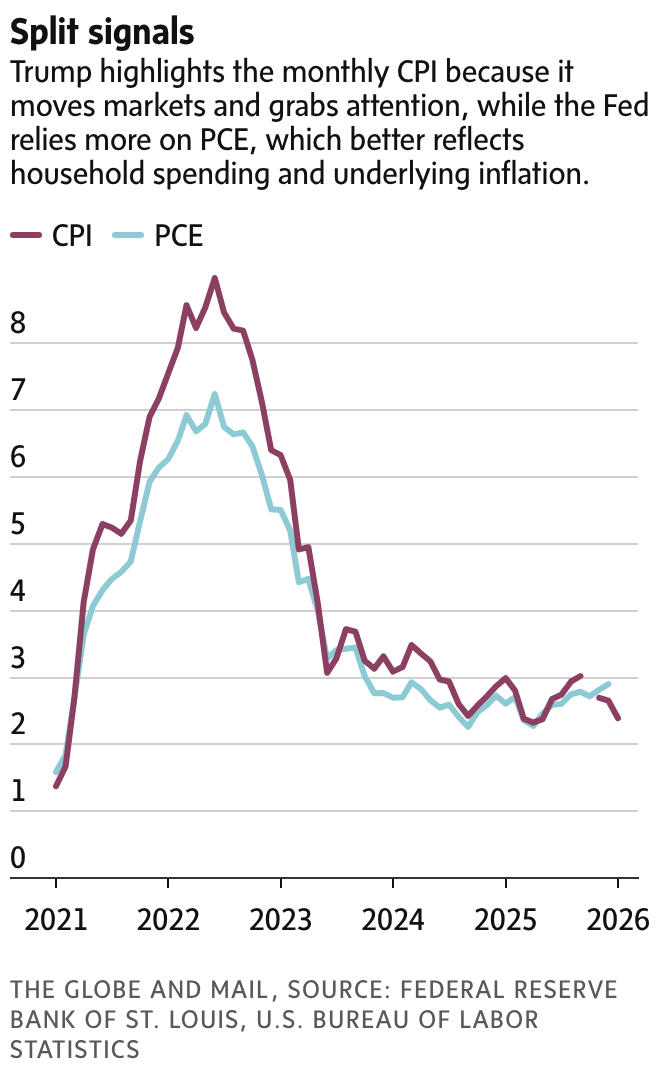
The headline consumer price index is the most widely cited measure of inflation and the one that draws the most political attention – most visibly from Trump, who has taken to using their monthly releases as arguments for rate cuts. But the Federal Reserve relies more heavily on Personal Consumption Expenditures, a broader gauge of the prices households pay for goods and services. |
|
|
|
|
That measure captures a wider slice of household spending and places less weight on housing, where prices adjust slowly and can lag current conditions. It includes both goods – where recent wholesale and producer price reports show tariff-related costs moving through the system – and services tied to those goods. |
|
|
|
|
It is also the measure that has largely kept the Fed from cutting rates as aggressively as Trump would prefer. It remains to be seen how Kevin Warsh, the man set to replace Powell in May, plans to respond to pressure from the White House. Regardless, he’ll take the helm of the world’s most important central bank at an interesting time. |
|
|
|
|
Priscilla Thiagamoorthy, a senior economist at the Bank of Montreal, said the central bank’s restraint earlier in 2025, in the face of what she described as “stirring price pressures,” helped offset some of the tariffs’ effects. |
|
|
|
|
“Without the tariffs,” she said, “the Fed likely would have been able to move sooner.” |
|
|
|
|
Eli Nir, a U.S. strategist at TD Securities, said inflation had been easing before Trump took office as the Fed held rates high. But “the administration’s tariff policy – and even the anticipation of that tariff policy – caused a backup in core goods prices.” |
|
|
|
|
“Essentially, in our view, tariffs delayed the path to 2 per cent,” he said. |
|
|
|
|
|
|
|
|
|
|
|
|
|
|
|
|
|