| | In today’s edition: Gulf countries’ AI infrastructure buildup may help to ensure US protection, and ͏ ͏ ͏ ͏ ͏ ͏ |
| |  | Gulf |  |
| |
|
 - Gulf AI’s security benefits
- Saudi’s data center costs
- Global data center delays
- Bahrain ratings downgrade
- Kuwait nationality law tweaks
 The world’s largest mural, in Saudi Arabia. |
|
 US Navy/Mass Communication Specialist Seaman Daniel Kimmelman/Handout via Reuters US Navy/Mass Communication Specialist Seaman Daniel Kimmelman/Handout via ReutersAs the US bids to “win the AI race” (as the White House puts it), Gulf states are betting that if they become critical partners to the likes of Google, Microsoft, and OpenAI, Washington will back their security too. In the words of Steven A. Cook, a senior fellow at the Council on Foreign Relations, “AI is the mother of all insurance policies,” a geopolitical calculation that adds to the economic diversification goal usually cited for the multibillion-dollar technology investments by Abu Dhabi, Doha, and Riyadh. As the Gulf waits for President Donald Trump’s next move on Iran, amid a prodigious buildup of US forces in the region, the argument for AI-as-protection is an untested one. Qatar locked in a non-binding security guarantee from the US after Iran struck Doha last June, and Saudi Arabia also secured a strategic defense agreement with the White House last year, but those deals arguably came as a result of old-fashioned diplomatic lobbying rather than investment pledges. But perhaps it’s still too early in the race. — Kelsey Warner |
|
Saudi spending shifts to data centers |
 The share of Saudi construction contract awards in January linked to a single project: the Saudi Data and Artificial Intelligence Authority’s $2.7 billion Hexagon data center in Riyadh. After a bruising 2025, when the value of contract awards dropped by 60%, state-backed tech spending is offering some hope for the construction industry, with the 480-megawatt data center one of the clearest examples of where government capital is landing. Enterprise News said a structural pivot was underway, as AI and digital infrastructure take on a larger role while gigaproject timelines stretch. Saudi Arabia is one of the region’s fastest-growing data center markets, with recent deals including a $1.5 billion partnership between Groq and Aramco Digital and a $500 million investment from Salesforce; capacity in the kingdom is expected to expand nearly twice as fast as in Abu Dhabi and Dubai through 2027. |
|
The delays hitting data centers |
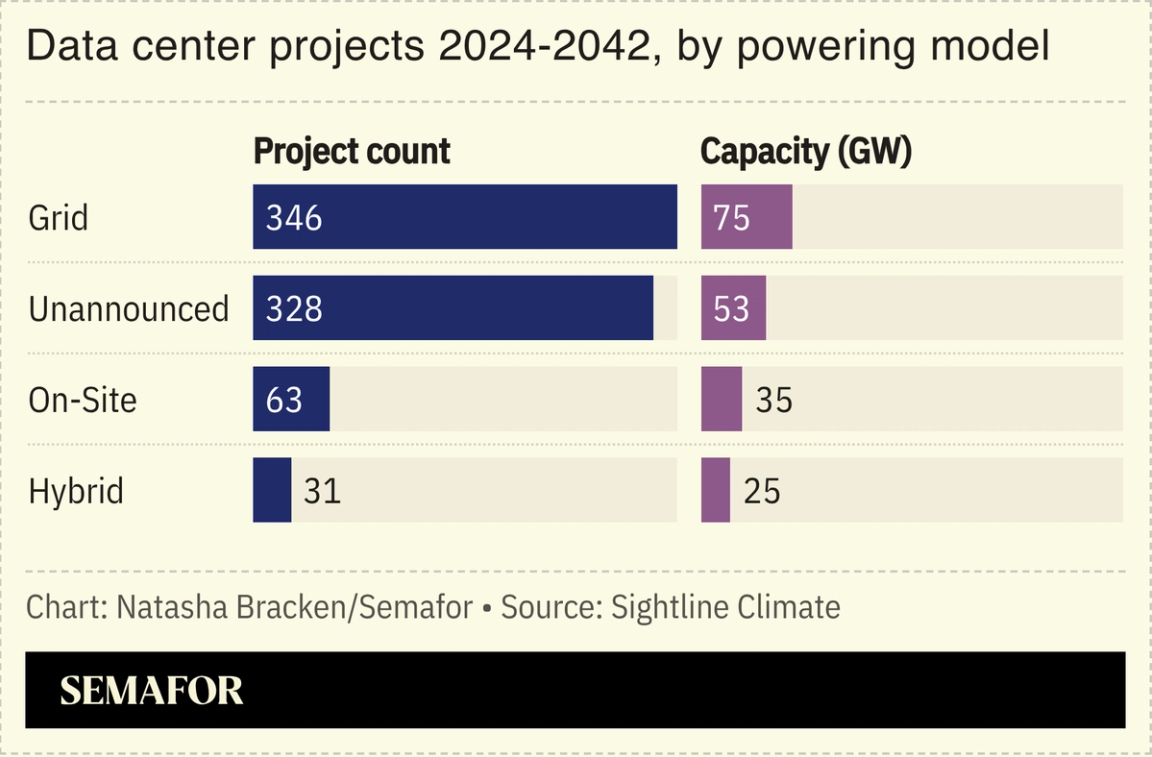 Power constraints and potential grid equipment shortages are set to delay 30% to 50% of data center projects in 2026, pushing some hyperscalers to weigh the benefits of pursuing on-site power generation instead, a Sightline report found. Delays are already a familiar occurrence: Last year, 110 data center projects were planned to come online, but 26% were delayed, and 10% quietly revised their target operation dates. In response, technology companies have been adopting different tactics: Google recently acquired energy group Intersect Power, while Microsoft has cancelled leases and announced smaller data centers. A Kenyan data center backed by Abu Dhabi’s G42 and Microsoft has languished as government officials there struggle to come up with commercial terms to justify the $1 billion price tag, Semafor reported. In the Gulf itself, projects can suffer delays from the extreme climate and geopolitical considerations, including access to advanced chips from the US. |
|
 We are ramping up our global coverage: We’ve just launched Semafor China, an ambitious briefing for leaders on how the world’s second-biggest economy is changing the world around it. Helmed by Andy Browne — a Pulitzer Prize-winning reporter and editor who has covered the country for decades — and featuring a new CEO interview series by Clay Chandler, a decorated Asia-focused journalist who has covered the region for The Wall Street Journal, Washington Post, and Fortune, our weekly briefing will tackle the vast financial, economic, and technological impact China is having across the globe, from Africa to the Americas. Our inaugural edition had scoops on a Chinese industrial giant’s expansion into Europe, AstraZeneca’s strategy in China, and the extent of US allies’ courting of Beijing over the first year of Trump’s second term. Subscribe to Semafor China for your weekly look at the biggest stories and best analysis on the country, and its huge impact on the world. |
|
Bahrain hit by another downgrade |
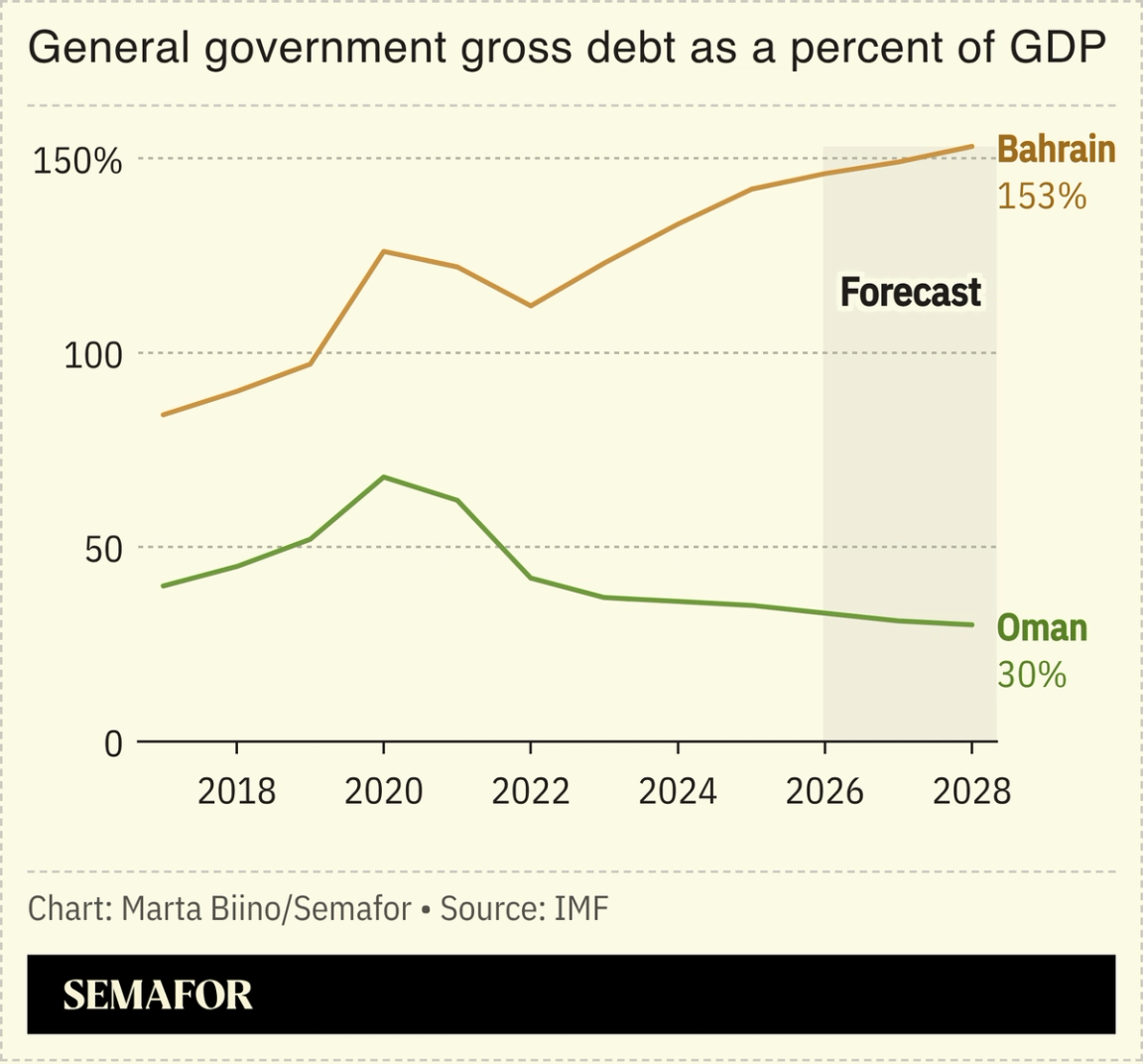 Bahrain’s credit rating was downgraded further into junk status by Fitch, which said that recent measures to raise revenue and trim spending won’t be enough to reverse rising debt levels. By 2027, the country’s deficit is expected to still be 9.2% of GDP, with the debt-to-GDP ratio reaching over 150%, Fitch said. Standard & Poor’s had downgraded it in November. In December the government set out plans to tackle the situation, including higher energy prices, fees for services, and dividends from state-owned firms, along with a corporate income tax from 2027. Bahrain has the weakest finances in the Gulf and in the past has received bailouts from richer neighbors including Saudi Arabia and the UAE. In contrast, the credit rating of Oman — whose economy used to be bracketed with Bahrain’s — has moved into investment grade after it took steps to balance its budget and lower its debts. — Matthew Martin |
|
Kuwait plans new citizenship rules |
 Stephanie McGehee/File Photo/Reuters Stephanie McGehee/File Photo/ReutersKuwait is preparing to enact a new citizenship law, following a period in which authorities stripped at least 50,000 people of their nationality, claiming they obtained it illegitimately. The country’s minister of interior said in a local TV interview that the new law will revise paths to citizenship, such as those granted for distinguished service, which he said have been abused. The reforms were needed to protect the state and prevent abuse of social welfare benefits tied to citizenship status, he said. Kuwait’s emir dissolved parliament in May 2024 and embarked on a regulatory overhaul and citizenship crackdown. The wealthy nation, heavily dependent on oil revenue, has been dogged by deficits over the past decade, with 80% of the state budget spent on subsidies and salaries. Authorities say some of those stripped of citizenship held another nationality — dual citizenship is illegal for Kuwaitis — while others had obtained it through fraud; rights groups say political opponents have also been targeted. — Mohammed Sergie |
|
 Semafor will convene with leaders in Nairobi on Tuesday, March 24 to advance financial inclusion at the intersection of long-term capital, policy, and financial infrastructure. Bringing together investors, policymakers, and financial system leaders, the conversation will move beyond ecosystem-building toward action — mobilizing capital, strengthening infrastructure, and closing persistent access and affordability gaps. Join us as we dive into how coordinated public-private efforts can accelerate inclusive growth across East Africa and other emerging markets. March 24 | Nairobi | Request Invitation |
|
 Deals- State-owned Kuwait Petroleum Corporation has held early-stage talks with potential investors in a leasing deal for its oil pipeline network which could be worth $7 billion. BlackRock, EIG Partners and KKR are among those that have expressed interest. — Reuters
Human Rights- A few prominent chefs have criticized the decision to host the awards for the World’s Best 50 Restaurants in Abu Dhabi later this year, citing the UAE’s policies on human rights. — The New York Times
Military- Kuwait has updated its national service rules, under which military service is mandatory for all Kuwaiti men once they turn 18. The changes close some loopholes and set out stricter penalties for those failing to report for duty. There are a few exemptions, including for only sons. Neighboring UAE and Qatar also impose military service, in part as an exercise in national unity for countries where locals are vastly outnumbered by expats.
Sanctions- A network of companies connected to an Azeri businessman, many of them based in the UAE, have reportedly moved at least $90 billion of Russian oil. The smuggling ring, which is crucial to funding Moscow’s war on Ukraine, was discovered because the companies shared a private email server. — Financial Times
|
|
 Domingo Zapata at home in his home studio in The Bowery Hotel in 2012. Rahav Iggy Segev/Photopass via Reuters. Domingo Zapata at home in his home studio in The Bowery Hotel in 2012. Rahav Iggy Segev/Photopass via Reuters.Diriyah is getting a mural the size of nine football fields. Spanish artist Domingo Zapata has been tapped to paint a 540,000-square-foot work as part of the $63 billion redevelopment of the ancestral home of the Al Saud family. It will take roughly 100 artists, architects, and engineers about six years to complete. The mural, designed like a giant hieroglyph, will trace Saudi history along a new boulevard leading into the cultural district, in what the artist has called “the Middle East’s Sistine Chapel.” Once long forgotten, the UNESCO world heritage site of Diriyah is now a cultural hub, with Michelin-starred restaurants, luxury hotels, and, in a few years, the world’s largest frieze. |
|
|


