| | In this edition: Zimbabwe bans exports, Nigeria’s surprising rate cut, and lessons Sudan could offer͏ ͏ ͏ ͏ ͏ ͏ |
| |  Harare Harare | Kampala |  Addis Ababa Addis Ababa |
 | Africa |  |
| |
|
 - Zimbabwe’s mineral ban
- Nigeria’s rate cut
- Senegal-IMF talks stall
- Spiro’s expansion plans
- Call for Nigeria action
- Sudan’s lessons for Ethiopia
 Why Ghana is changing the name of its airport. |
|
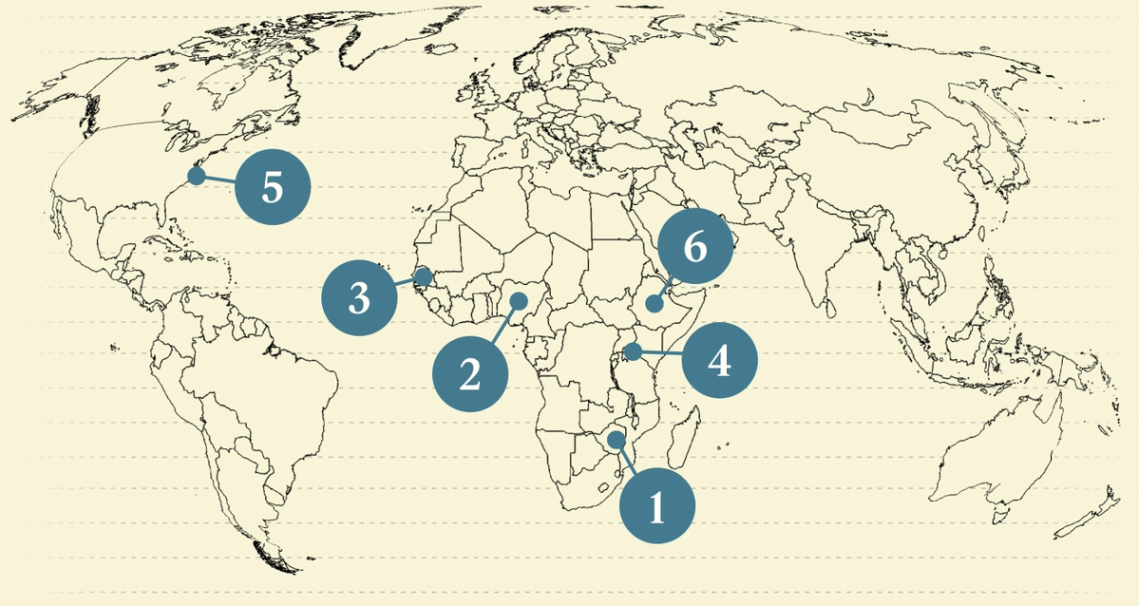
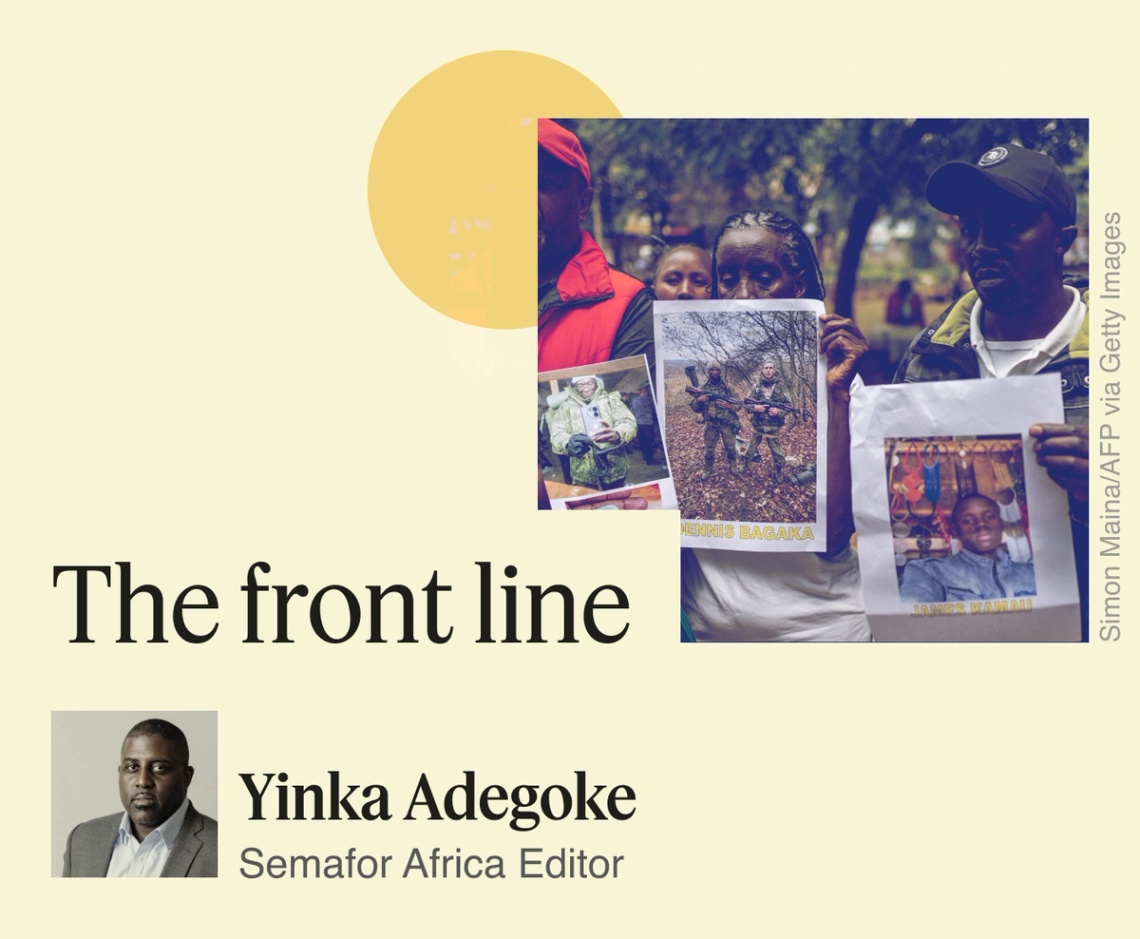 Four years after Russia’s full-scale invasion of Ukraine, a war many African officials once viewed as distant and European is now uncomfortably close to home. What began as a geopolitical rupture in Eastern Europe is now a domestic political headache in Kenya, Nigeria, and South Africa. Ukraine has said roughly 1,400 Africans from nearly 40 countries are fighting on the Russian side, though experts believe the numbers are higher. Many of them were recruited online, lured by promises of steady pay, legal residency, or educational opportunities — offers that often disappear upon arrival at the front. Research from the Atlantic Council shows Russian-linked recruiters ramping up digital campaigns across African social media as battlefield losses — there are reportedly more than 1 million Russian casualties — mount. The pitch mixes selective truths with outright deception, targeting young men facing joblessness, inflation, and creeping poverty, as well as young women lured by promises of factory jobs, including in drone production tied to the war effort. Social media has since carried horror stories of recruits subjected to abuse and sent to the front line with minimal training. The uncomfortable truth for African governments is that this phenomenon mirrors another crisis many on the continent have struggled to contain: The steady flow of migrants risking their lives by crossing the Mediterranean to Europe. In both cases, desperation meets disinformation. The same economic frustrations that drive perilous journeys north are now being weaponized to fill foreign trenches east. A year into the conflict, African leaders sought to chart a different course. A delegation of seven countries led by South Africa’s President Cyril Ramaphosa attempted to position the continent as a neutral peace broker. They were politely received and largely ignored by Russian President Vladimir Putin and Western leaders. Now, as families in Nairobi, Johannesburg, and beyond demand the return of sons recruited into a distant war, the political and human costs are landing squarely at home. The war was never Africa’s to fight. But four years on, its consequences are unmistakably African. |
|
Zimbabwe bans mineral exports |
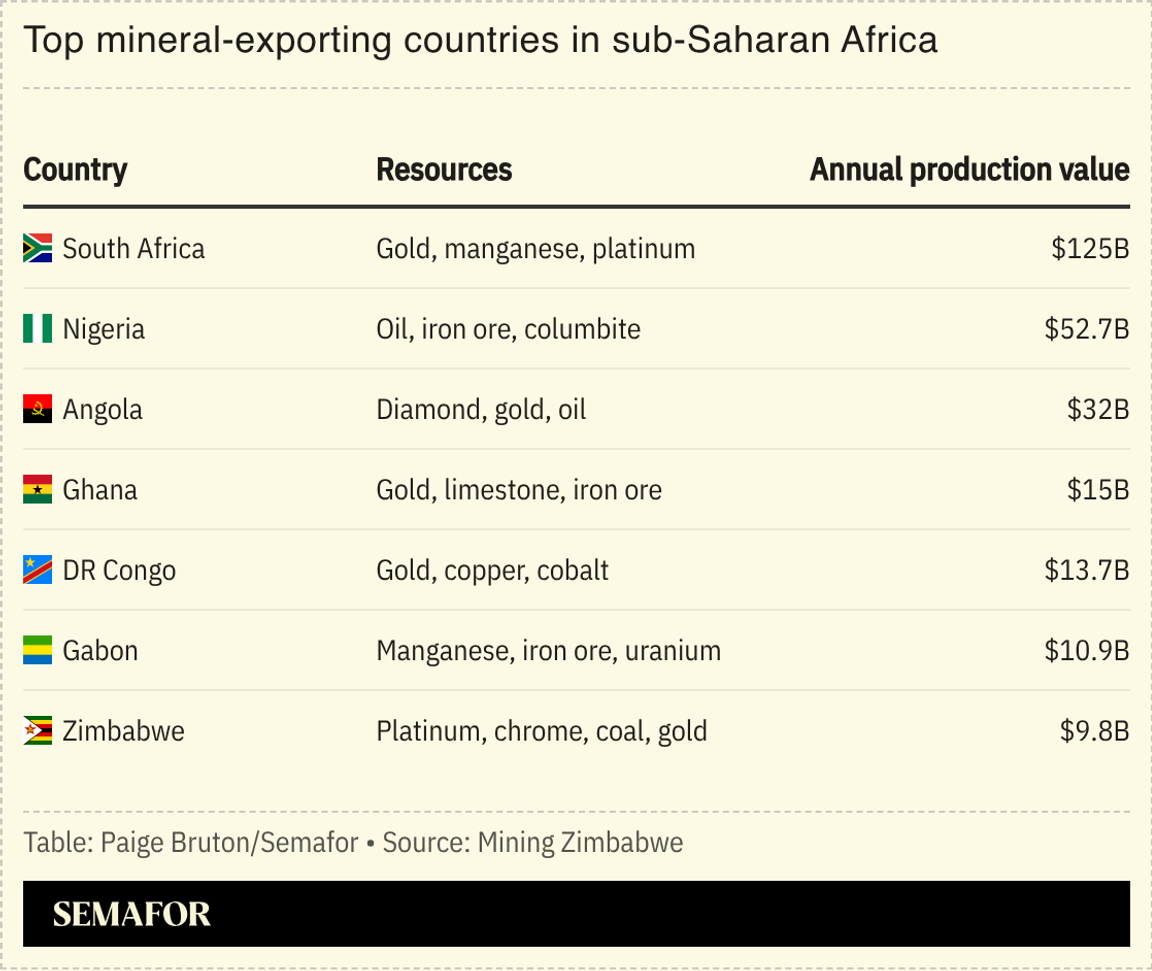 Zimbabwe suspended exports of all raw minerals from the country in a sudden move that could impact global supply chains that depend on its output of lithium to produce EV batteries. Harare said the step was in the “national interest” to promote local processing of minerals to add more value within the country. Africa’s largest lithium producer — whose stores make up 4.4% of global reserves — is a major supplier to China, which leads the world in refining the battery metal. But like other African countries, Zimbabwe is increasingly keen to maximize the value of its minerals by processing them at home before exporting. Despite its mineral wealth — the country also has vast deposits of platinum, gold, and diamonds — Zimbabwe has failed to improve the lives of its citizens: The national poverty rate exceeds 60%, according to the World Bank. DR Congo imposed a ban on cobalt exports last year but reviewed its position months later in favor of a quota system. About a third of the continent’s $29 trillion mineral wealth remains undeveloped, with energy availability a major bottleneck. — Alexander Onukwue |
|
Nigeria’s surprising rate cut |
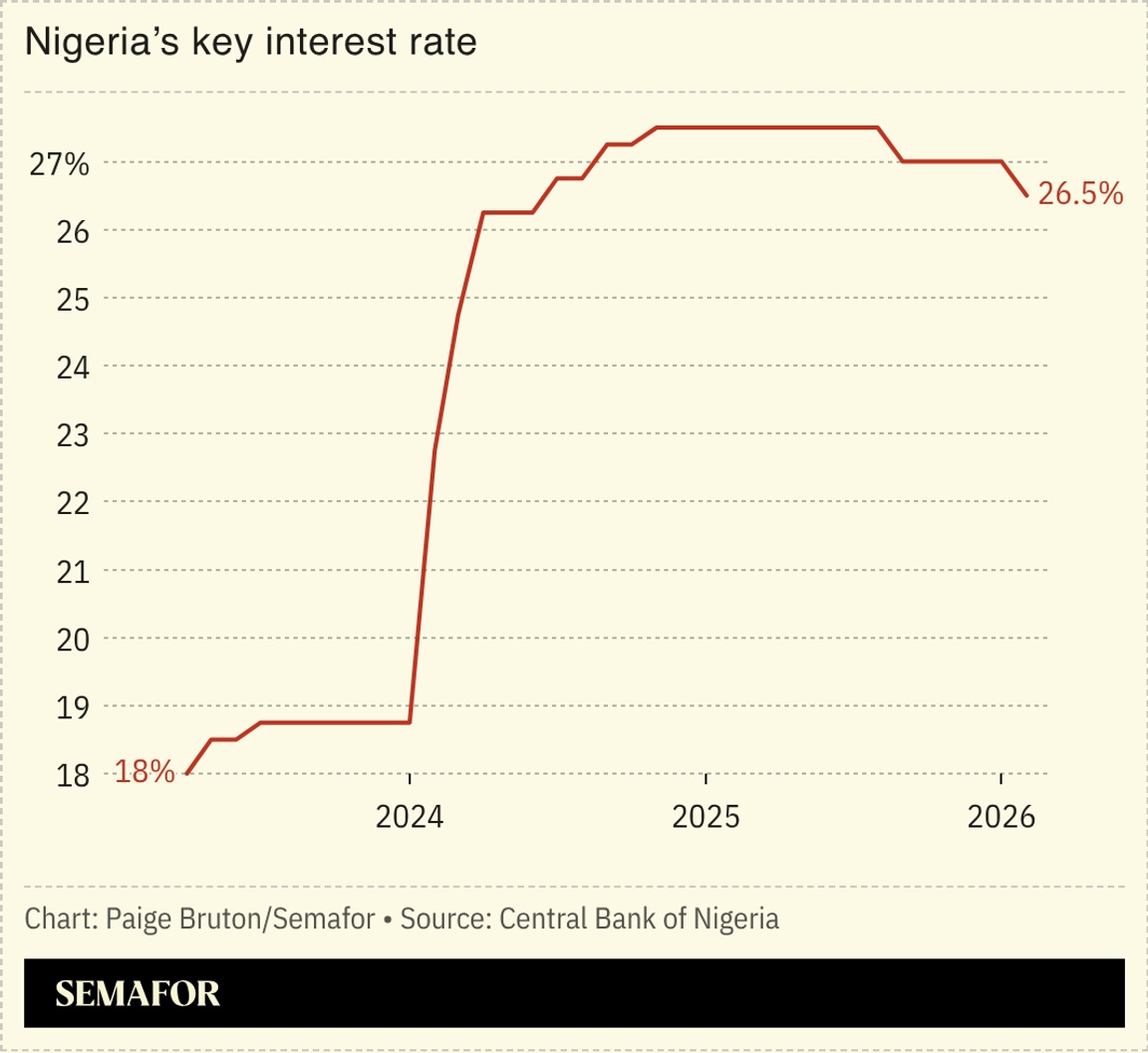 Nigeria’s central bank cut its interest rate by far less than most economists expected in a move to quell inflation ahead of elections next year. Slowing price rises and higher foreign exchange reserves had prompted predictions of a larger rate cut to shore up growth in one of Africa’s biggest economies. The decision to cut the benchmark rate by just 50 basis points took it to 26.5%. Razia Khan, Standard Chartered’s head of Africa research, said the “cautious” move reflected “concern over potential global risks and their impact on oil prices,” as well as an “unwillingness to be too complacent on inflation.” Nigerian President Bola Tinubu’s moves to shore up public finances — such as scrapping costly fuel subsidies — have been praised by the World Bank and attracted foreign investors but sparked a cost of living crisis. Inflation has since slowed — the rate fell to 15.1% year-on-year in January, marking the tenth consecutive monthly decline. But the central bank governor has warned increased fiscal spending ahead of the elections could threaten price stability. — Alexis Akwagyiram |
|
 Semafor will convene with leaders in Nairobi on Tuesday, March 24 to advance financial inclusion at the intersection of long-term capital, policy, and financial infrastructure. Bringing together investors, policymakers, and financial system leaders, the conversation will move beyond ecosystem-building toward action — mobilizing capital, strengthening infrastructure, and closing persistent access and affordability gaps. Join us as we dive into how coordinated public–private efforts can accelerate inclusive growth across East Africa and other emerging markets. March 24 | Nairobi | Request Invitation |
|
Senegal, IMF fail to strike deal |
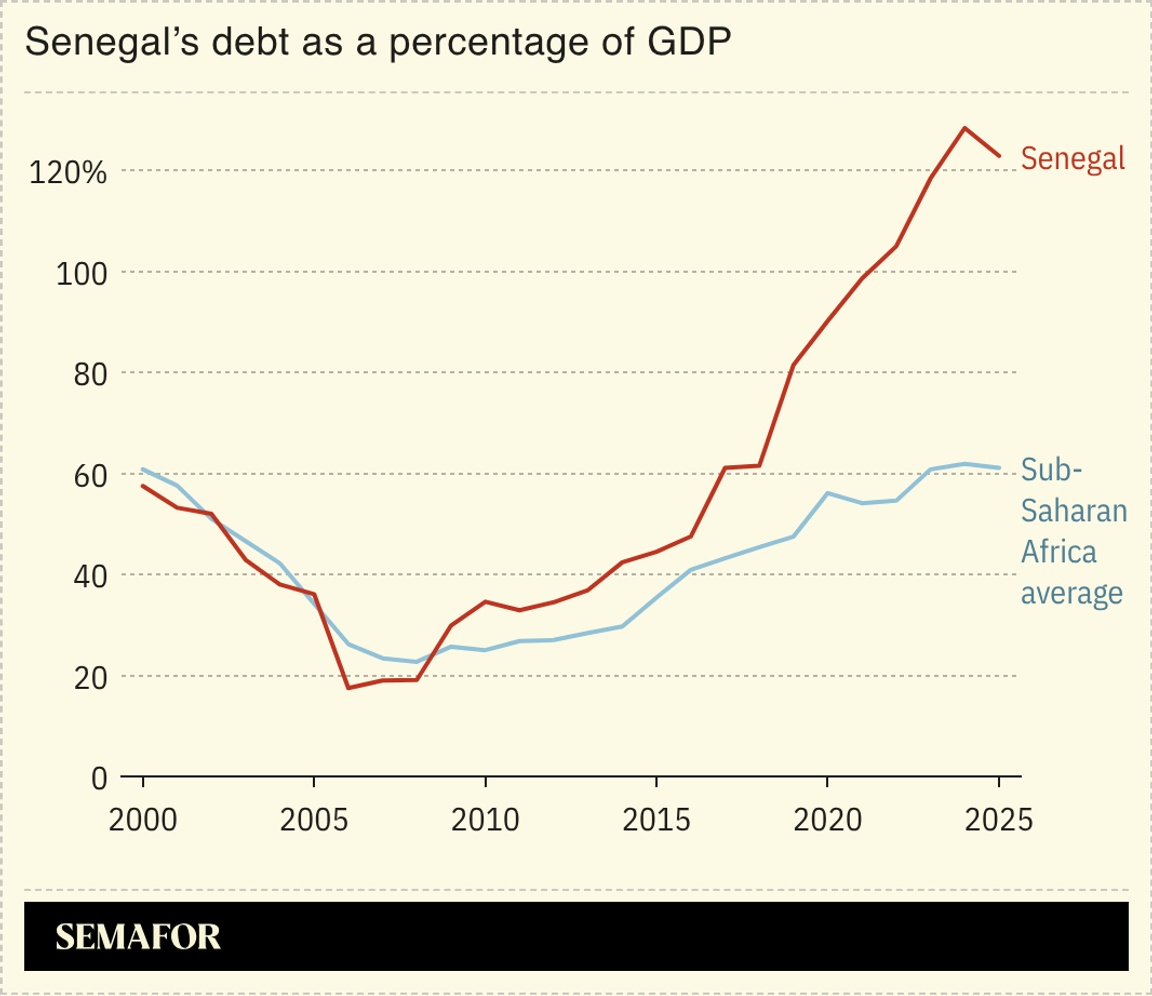 Senegal and the International Monetary Fund failed to agree on a lending deal after the latest round of talks in the debt-strapped West African nation. “Fundamental differences” remain between the two sides, the country’s finance minister told lawmakers on Tuesday, while an IMF spokesperson told Reuters that the group remains engaged with Senegalese authorities and talks will continue. Senegal’s debt burden has now crossed 130% of GDP, after the administration that came to power in 2024 uncovered billions of dollars of unreported borrowing under the previous government. Dakar has ruled out debt restructuring and looked toward West Africa’s regional debt market to bridge its budget gap. But some experts are questioning its position: Debt restructuring is Senegal’s best bet, argued two economists in a commentary for Project Syndicate. “Senegal does not have any pain-free options for escaping its current morass,” they wrote. “But absent large volumes of cheap liquidity, attempting to repay its debts at all costs would be more dangerous — and, ultimately, more costly — than default.” |
|
Spiro raises $50M to drive expansion |
| |  | Alexander Onukwue |
| |
 AFP via Getty Images AFP via Getty ImagesElectric mobility company Spiro plans to expand its motorcycle fleet in Africa and ramp up battery production after raising $50 million from the African Export-Import Bank. The move comes amid growing electric vehicle adoption in African cities, with the rise of competitors pushing to take market share from dominant Chinese manufacturers. The Dubai-headquartered company, which has now raised more than $230 million since launching in 2022, plans to add to the 80,000 motorbikes and 2,500 battery swapping stations it operates across Benin, Kenya, Nigeria, Rwanda, Togo, and Uganda, CEO Kaushik Burman told Semafor. Two- and three-wheeler vehicles are an essential part of the public transportation mix across Africa, where, on average, less than a fifth of roads are paved in each country. The push by many companies to capitalize on this comes as the global EV market faces strong headwinds after US President Donald Trump signed an executive order repealing Biden-era incentives and tax credits created to encourage consumers to buy EVs. |
|
 We are ramping up our global coverage: We’ve just launched Semafor China, an ambitious briefing for leaders on how the world’s second-biggest economy is changing the world around it. Helmed by Andy Browne — a Pulitzer Prize-winning reporter and editor who has covered the country for decades — and featuring a new CEO interview series by Clay Chandler, a decorated Asia-focused journalist who has covered the region for The Wall Street Journal, Washington Post, and Fortune, our weekly briefing will tackle the vast financial, economic, and technological impact China is having across the globe, from Africa to the Americas. Our inaugural edition had scoops on a Chinese industrial giant’s expansion into Europe, AstraZeneca’s strategy in China, and the extent of US allies’ courting of Beijing over the first year of Donald Trump’s second term. Subscribe to Semafor China for your weekly look at the biggest stories and best analysis on the country, and its huge impact on the world. |
|
US Republicans urge Nigeria action |
 Members of the Nigerian Armed Forces and residents following an attack in Woro, Kwara state. Light Oriye Tamunotonye/AFP via Getty Images. Members of the Nigerian Armed Forces and residents following an attack in Woro, Kwara state. Light Oriye Tamunotonye/AFP via Getty Images.US Republican lawmakers submitted a report to the White House this week calling for sweeping actions to end what they describe as the systematic persecution of Christians in Nigeria. The report, by Republicans on the House Appropriations and Foreign Affairs committees, recommends a bilateral security agreement, targeted sanctions, visa restrictions, more international partnerships, and demands for the repeal of sharia and anti-blasphemy laws in up to a dozen northern Nigerian states. These proposals reflect hardening congressional sentiment toward Abuja at a moment when jihadist and bandit violence has impacted millions across the region. There have also been questions about the report’s conclusions, with ONE Campaign’s Doug Anderson telling Semafor that the report’s recommendations — like adequate staffing at US diplomatic posts in Nigeria — would rely on the same foreign policy mechanisms that have been cut by the Trump administration. “This report underscores the value of those traditional tools.” Oge Onubogu, director of the Africa Program at the Center for Strategic and International Studies think tank, told Semafor that “there should be more of a push for [the US and Nigeria] to work together to address these root causes of insecurity.” — Adrian Elimian |
|
View: What Sudan could teach Ethiopia |
  Sudan’s colonial-era Republican Palace in ruins due to conflict. Cameron Hudson. Sudan’s colonial-era Republican Palace in ruins due to conflict. Cameron Hudson.Sudan’s ongoing civil war offers lessons for Ethiopia as the threat of a new conflict with Eritrea looms, an independent analyst argues in a Semafor column, saying the African Union could play an important role. Last week’s AU summit offered an opportunity for leaders to “draw a line” between Sudan and its neighbour Ethiopia “and use [the AU’s] voice to help one find peace and the other avoid war,” wrote Cameron Hudson, a former White House official focused on African security. “Instead, the elephant in the room at last week’s summit went unremarked, increasing the odds that the sub-r |
|
|


