| | In this edition, the real breaking point between Anthropic and the Pentagon, and the Commerce Depart͏ ͏ ͏ ͏ ͏ ͏ |
| |  | Technology |  |
| |
|
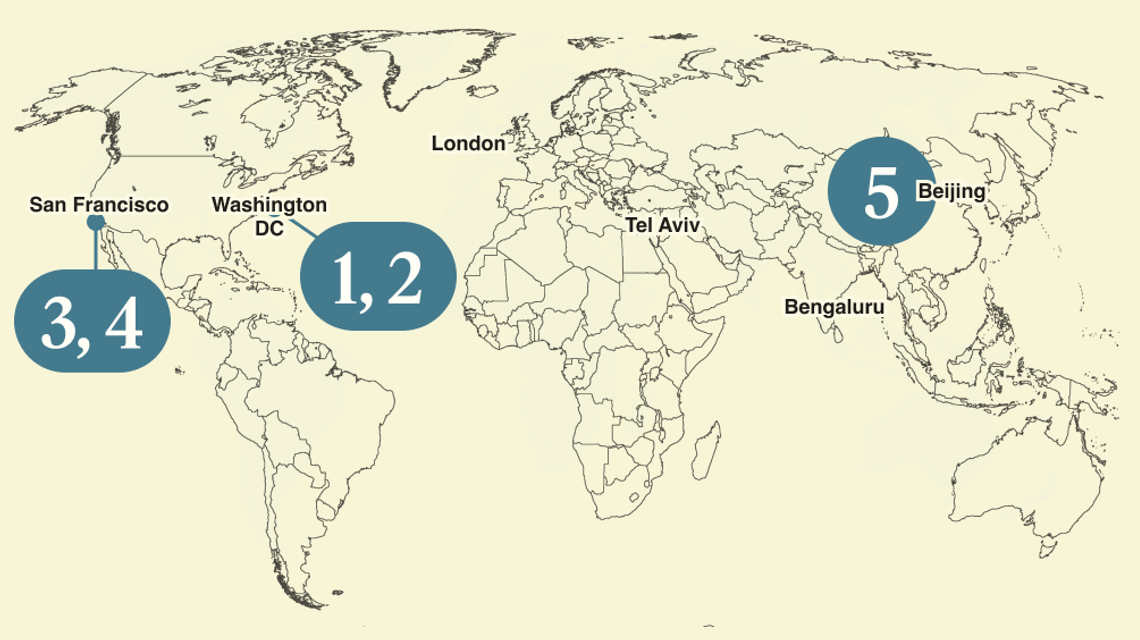 - Commerce talks robotics
- Tech absent at SOTU
- A ‘Computer’ to kill them all
- Meta taps AMD chips
- How Chinese EVs can save the US
 Anthropic’s relationship with the Pentagon has long been deteriorating, and a new AI tool helps fighter jets better identify targets. |
|
 Last night, I wrote about how the relationship between Anthropic and the Pentagon was starting to devolve in early December, long before the raid on former Venezuelan President Nicolás Maduro sent it into the red. The breaking point occurred at a meeting at the Pentagon, when Emil Michael, a former tech executive who is now the Pentagon’s chief technology officer, brought up a hypothetical question to Anthropic CEO Dario Amodei: What if the US faced a barrage of hypersonic missiles and the Department of Defense was using Anthropic’s chatbot to help stop them? By the Pentagon’s account, the AI company gave the US government the corporate brush-off: Check in with us first. Anthropic’s side disputes the account, claiming an exception to the model’s ban on autonomous weapons that would allow the Pentagon to use Claude to stop missiles. Which side is telling the truth is less relevant than what the argument represents and just how many consequential and important decisions are being made based on hypothetical scenarios. The Pentagon is not about to put its missile defense system in the hands of a chatbot and Anthropic knows that. AI has a long way to go before it can make those kinds of decisions reliably and even if it could, the Pentagon wouldn’t put missile defense on autopilot. But the fallout from the hypothetical scenario led to real consequences for Anthropic: The DoD has threatened to prohibit it from doing work for the government and its contractors. The same pattern is playing out in corporate boardrooms and government policy settings, prompting job losses, software disruption and other massive changes. Just look at the whipsaws in the AI-obsessed stock market, hit by investors who go from believing AI is a passing fad to thinking it will wipe out almost every human job overnight. Like an immune system overreacting to an unrecognized molecule, we are allowing the AI debate to cause more turmoil than AI itself. Change is coming, for sure. But nobody can predict exactly what will happen and when. The best way to deal with it is to stop obsessing over the hypotheticals and using AI as a scapegoat for bigger systemic issues. Job displacement from AI hurts more when social safety nets are broken, for instance. The concern that AI could be used for illegal surveillance of American citizens is really a concern about lack of oversight and accountability in government. You can’t stop change, but you can fix what’s broken before change makes it worse. |
|
US government to meet with robot-makers |
 Steve Marcus/Reuters Steve Marcus/ReutersThe US Department of Commerce is convening American robot manufacturers for a roundtable next month as it looks to bolster the domestic industry and thwart Chinese competition, Semafor’s J.D. Capelouto scooped. According to an invitation from Commerce’s National Telecommunications and Information Administration reviewed by Semafor, the March 10 gathering aims to identify “key supply chain and policy challenges affecting American robotics manufacturing and deployment.” US makers of both manufacturing robots and humanoids were invited. A Commerce spokesperson told Semafor it’s gathering robot-makers to solicit industry feedback on federal robotics policies. The agency will “likely hear a variety of opinions and perspectives from robotics manufacturers,” but the discussion is not meant to overlap with existing work on tariffs or import/export restrictions. Some American firms have called on the government to do more to bolster the industry as China makes robotics a national priority. They argue it’ll be hard to compete with Chinese manufacturers that have benefited from heavy state subsidies. They’re asking Washington to help level the playing field. |
|
State of the Union largely skips AI |
 Jessica Koscielniak/Pool/Reuters Jessica Koscielniak/Pool/ReutersFor all the AI investments President Donald Trump has been taking credit for this year, he said surprisingly little about the technology at Tuesday’s 108-minute long State of the Union. He did talk about energy concerns of data centers, calling on tech companies to pay for their own energy needs instead of asking nearby residents to shoulder some of the costs. But he didn’t hit on many of the topics I was expecting: where the US stands on the tech race with China (the first president to leave China out of the SOTU since Bush), how AI is making the federal government more efficient, and concerns among the American people about how to address AI-related job losses. While I may have been wrong about my predictions, AI was pretty spot on. The AI company we wrote about last week that predicted what Trump would talk about got nearly every major talking point right, as well as the general flow of those points. The AI transcript guessed correctly about referencing the phrase “golden age of America,” criticizing Democrats for staying seated, and claiming their “affordability” push is all talk. But in a nod to just how far the machines still have to go to think like unpredictable humans, the bots also got stumped on Trump’s China and AI references. — Rachyl Jones |
|
 We are ramping up our global coverage: We’ve just launched Semafor China, an ambitious briefing for leaders on how the world’s second-biggest economy is changing the world around it. Helmed by Andy Browne — a Pulitzer Prize-winning reporter and editor who has covered the country for decades — and featuring a new CEO interview series by Clay Chandler, a decorated Asia-focused journalist who has covered the region for The Wall Street Journal, Washington Post, and Fortune, our weekly briefing will tackle the vast financial, economic, and technological impact China is having across the globe, from Africa to the Americas. Our inaugural edition had scoops on a Chinese industrial giant’s expansion into Europe, AstraZeneca’s strategy in China, and the extent of US allies’ courting of Beijing over the first year of Trump’s second term. Subscribe to Semafor China for your weekly look at the biggest stories and best analysis on the country, and its huge impact on the world. |
|
Perplexity launches ‘Computer’ super agent |
 Courtesy of Perplexity Courtesy of PerplexityEach time an AI company launches a category-killer product, it poses dangers to another swath of stocks and sectors. This is no different, though the buzziest news of late has been less about how good the actual product is and more about the propensity to fuel people’s fears — and stoke their hopes — about what is still coming. (We’re back to the land of hypotheticals again.) Perplexity launched a new product on Wednesday with an old name — “Computer” — that acts as a super agent that can create a website, write a report, or generate a dataset. It’s like the next level of vibe coding — all the user has to do is describe the end-product they want and Computer breaks down the assignment for task-specific sub-agents to do the work from start to finish. It even chooses the best model for the specific job, outsourcing to Nano Banana for images, Veo 3.1 for video, Gemini for deep research, and Grok for quick searches. It runs autonomously for hours, or even months, according to the company. The idea to package and refine existing technologies in a way users will pay for is a smart one — Computer is the kind of product that the tech industry has been talking about for the last year but hasn’t yet been developed in a way that lives up to the hype. Most everyday users don’t really care which software they’re using, they just want to do cool things quickly. The big risk for Perplexity, however, is if the models themselves become commodities, which would render useless a service that allows users to jump between the AIs for tasks. — Rachyl Jones |
|
View: Detroit’s EV ‘salvation’ lies in China |
 Rafael Martins/File Photo/Reuters Rafael Martins/File Photo/ReutersUS restrictions on Chinese EVs are misguided and, in fact, the vehicles’ entry into the American market could offer a salvation for Detroit’s automakers, Semafor’s China columnist Andy Browne argues. Wary of the security risks Chinese internet-connected cars might pose, and of howling in Detroit, Trump has maintained sky-high tariffs on EV imports. Solar panels, drones, and surveillance cameras have all met a similar fate. The problem, Andy writes, is that Chinese EVs are cheaper and often better, and the secret is already out. To compete with cars like the Xiaomi SU7 Max, Detroit will have to learn from Chinese carmakers. Keeping out Chinese players risks American firms languishing, failing to innovate against the products that are setting the standard worldwide, and closer to home in Canada, where Chinese EVs are now starting to be sold. Without a world-class EV industry, the US will also fall behind on other, related technologies critical to national security. Take, for example, the batteries that are essential for modern industry and warfare. In Ukraine, battery-operated drones keep Russian invaders at bay. Modern combat troops use batteries to power walkie-talkies, night-vision goggles, and satellite communications. There is some prospect of a shift on the horizon. Ahead of a meeting with Chinese leader Xi Jinping in Beijing in late March, Trump said he’d “love” to see Chinese carmakers opening factories and creating jobs in the US. |
|
Chips race intensifies with Meta, AMD deal |
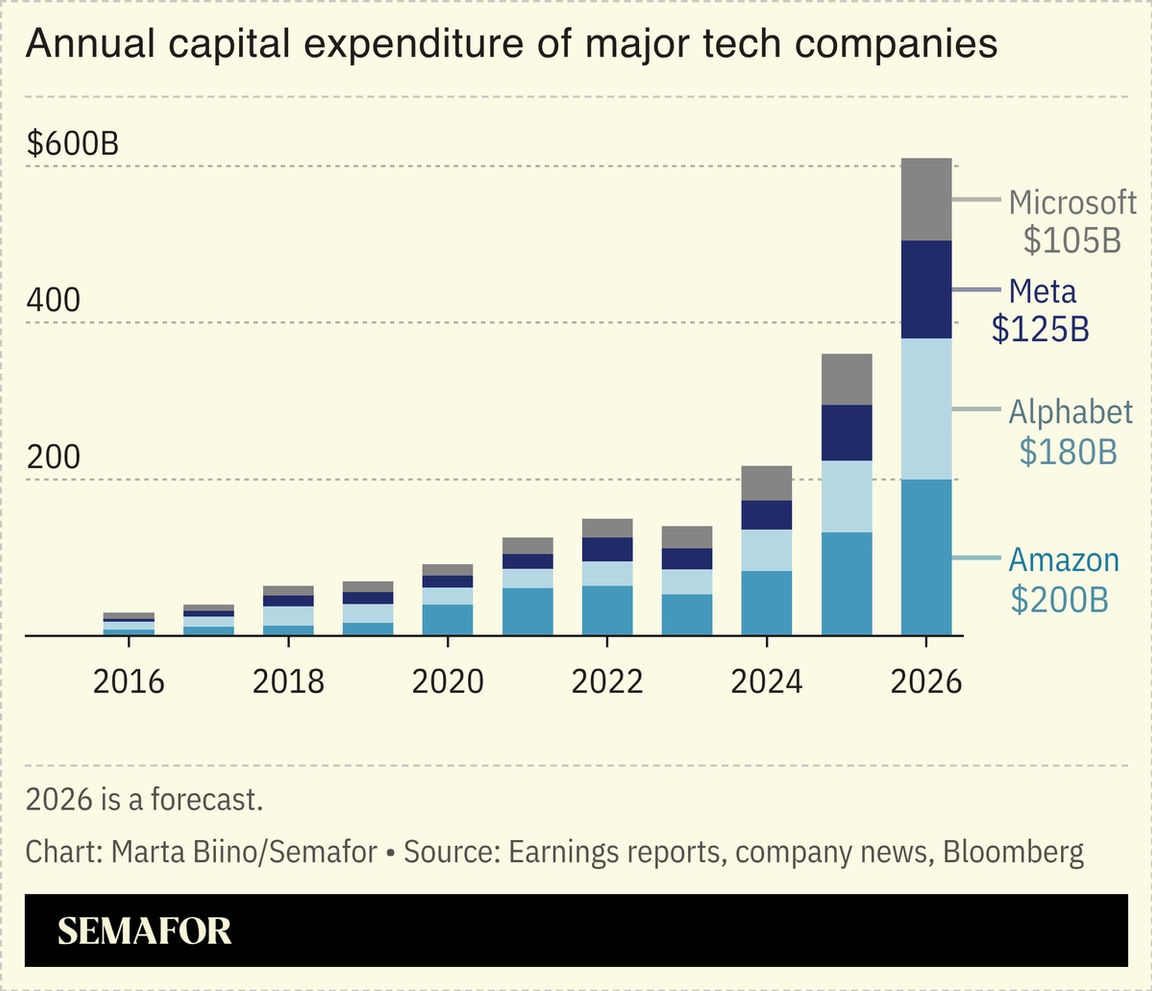 Meta investors gave the tech giant the green light to spend like crazy on AI, and CEO Mark Zuckerberg is taking advantage. A week after striking a deal to buy tens of billions of dollars’ worth of Nvidia chips, Meta announced a fresh partnership with AMD that would give Meta a stake in the chipmaker in exchange for a pile of chips big enough, in energy-consumption terms, to power 4.5 million homes. The deal is nearly identical to one AMD struck last year with OpenAI, and shows AMD using the potential appreciation of its stock as bait to land big chip customers. Meta can buy up to 10% of AMD — for a penny a share — as AMD fulfills its chip orders. It’s the latest bit of circular financial engineering that tethers the contestants in the AI race to each other. — Rohan Goswami |
|
 F-35 fighter jets. Ricardo Arduengo/Reuters. F-35 fighter jets. Ricardo Arduengo/Reuters.A fighter jet used AI to better identify targets for the first time. Modern air combat usually happens beyond visual range, meaning pilots have to rely on sensors rather than eyesight to tell friend from foe. Sophisticated software can present sensor information comprehensibly, allowing pilots to make combat decisions rather than puzzle over readings. Lockheed Martin said the test version on its F-35 “can enable faster and superior operational decisions,” although one 2025 report warned that military AI, just like civilian versions, can hallucinate, and the lack of good training data — because unfriendly nations hide their aircrafts’ capabilities — can make it unreliable. For now, a human would remain “in the loop,” although AI’s faster reactions may one day make that untenable. |
|
|


