| | Gulf stock markets fall, oil is set to spike, and regional economic efforts have been thrown into ch͏ ͏ ͏ ͏ ͏ ͏ |
| |  | Gulf |  |
| |
|
 - Stocks down, crude up
- Gulf carriers grounded
- China is a Gulf bystander
- Why oil won’t go to $100
|
|
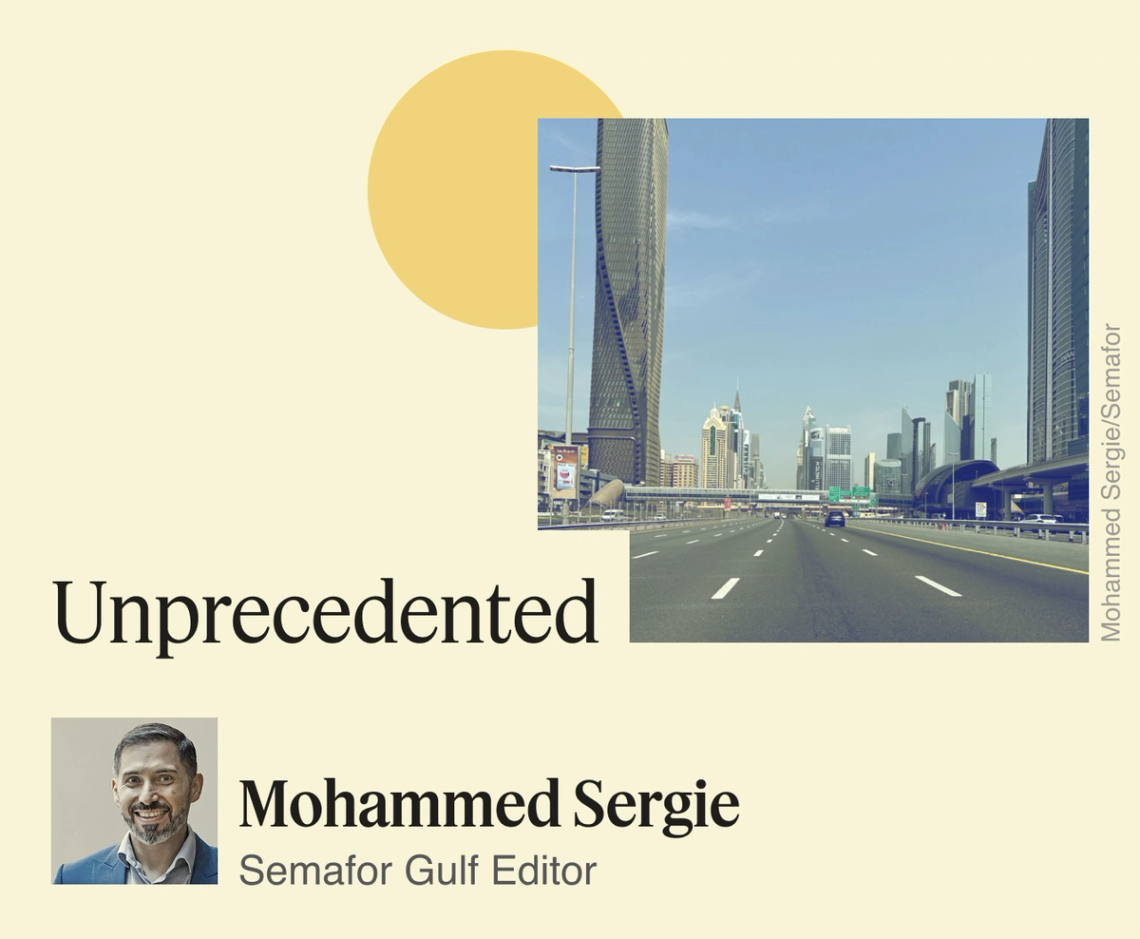 The ending of the June war between Iran and the US, with Tehran’s retaliatory strikes on a US base in Qatar, felt choreographed. As we enter Day Two of the Israel-US-Iran war — following confirmation of the killing of Iran’s Supreme Leader Ali Khamenei and other top regime figures — the scenarios are anything but predictable. The cities here feel like ghost towns. Iran has lobbed nearly as many missiles at the UAE as it has at Israel. Defense systems intercepted most, but debris and drones still caused damage, including at major airports in Abu Dhabi, Dubai, and Kuwait. At least three people died in the UAE. On Sunday, parts of Dubai were eerily quiet, reminiscent of early COVID-19 lockdowns. Schools and companies are going remote. Some residents spent the night in parking garages and hallways after receiving late-night messages urging them to seek shelter — though there are few in a region that has not faced widespread air strikes since Iraq’s 1990 invasion of Kuwait. Expats are looking for exits, driving to Oman or Saudi Arabia, where airports remain open. Governments have been unusually transparent, identifying impacted areas and dispatching senior officials for interviews. Part of the aim is to curb disinformation, even as authorities crack down on speech: Bahrain arrested people accused of expressing support for Iran’s attacks. While ties between the Gulf and Iran were never warm, the scale of Tehran’s strikes is likely to sever what little trust had been built. Anwar Gargash, diplomatic adviser to UAE President Sheikh Mohamed bin Zayed, said Iran’s assault “isolates Tehran” and reinforces the view that its missile program remains a persistent threat to the region. Former Qatari Foreign Minister Hamad bin Jassim Al Thani warned the attacks will push Gulf states to lean more on outside powers for security. There is no downplaying what’s happening here. But across the water, something potentially larger is unfolding. Israeli and US strikes targeting senior commanders and security institutions can’t produce regime change on their own, but they have shaken the Islamic Republic. What follows could be a generational transition that reshapes the region for the better. Or it can be the start of an unpredictable conflict that defines it for years. |
|
Gulf markets slump, oil set to spike |
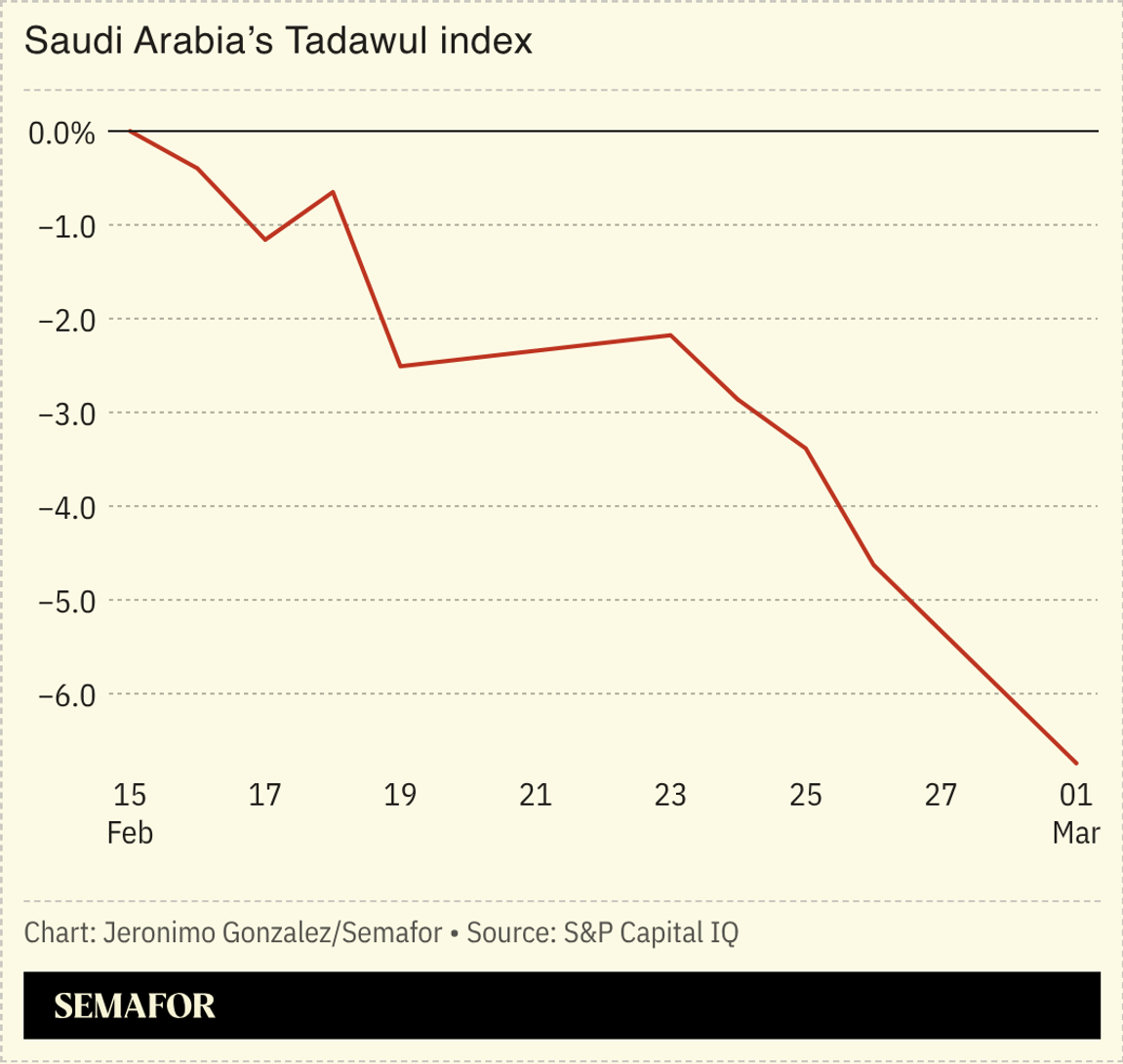 Stock markets in the Gulf slumped and oil prices are set to spike as investors digest the impacts of a barrage of Iranian strikes that have upended years of regional security and shaken markets that had seemed able to brush off geopolitical risk. OPEC+ agreed to a larger-than-expected increase in output to mitigate the anticipated price jump, but that may still face the practical challenge of actually getting Gulf oil into global markets. A spike in oil prices is only useful if Gulf producers can safely export crude to customers, but Iran has threatened ships traversing the Strait of Hormuz chokepoint: Around 20% of global oil supply passes through the narrow waterway, not to mention the goods that also move through. Ship traffic through the Strait has plummeted. Markets in the region that were open on Sunday dropped. The Saudi Tadawul fell by nearly 5% before paring losses, while the Oman and Bahrain bourses also slipped. Iran’s strikes on Gulf cities are a blow to the region’s goal of promoting itself as a financial center that can be a haven of stability. Gulf governments have leaned on stock markets as a way to bring in foreign investors and raise money to fuel economic diversification plans. This had been having some success, until now. — Matthew Martin |
|
Air traffic chaos hits the Gulf |
 Flightradar24 Flightradar24Iran is pounding the Gulf’s aviation industry. Drones hit airports in Bahrain, Dubai, and Kuwait, and airspace is closed everywhere except Oman and Saudi Arabia. Hundreds of jets operated by Emirates, Etihad Airways, and Qatar Airways are grounded, and hundreds of thousands of travelers are stranded across hubs that typically handle some of the most international traffic in the world. Aviation, logistics, and tourism are crucial industries in the Gulf and are driving their diversification from oil. Abu Dhabi, Doha, and Dubai have marketed themselves as global hubs and for decades have been siloed from Middle East turmoil. The past two days shattered that assumption. Most residents in the Gulf are staying put. Some of the richest expats who enjoy living in the “safe and tax free haven” are not. Ameerh Naran, CEO of Dubai-based Vimana Private Jets, told Semafor he received 12 requests last night from clients seeking to leave Dubai. He initially intended to have them drive to Oman, but the strikes there have made Saudi the only outlet after charters refused to fly to the sultanate. — Manal Albarakati |
|
China’s limited Gulf options |
 Iran’s Presidential website/WANA (West Asia News Agency)/Handout via REUTERS Iran’s Presidential website/WANA (West Asia News Agency)/Handout via REUTERSChina urged restraint and called for an immediate ceasefire over the US and Israeli assault on Iran — but analysts noted Beijing’s limited options to exert control over a region in which it has huge, strategic interests. The statement from China’s foreign ministry came after the country’s state news agency called the strikes against Iran a “brazen aggession” as well as “power politics and hegemony.” Yet while Beijing made waves by finalizing a diplomatic rapprochement between regional heavyweights Iran and Saudi Arabia in 2023, it does ot have military assets in the Middle East, nor does it retain other levers to exert hard power in a manner similar to the US. The relative quiet from China mirrors its lack of options when the US unseated Venezuela’s leader in January; at the time, “the prevailing mood [among Chinese experts] was one of resignation.” Indeed, since the Oct. 7, 2023 Hamas attacks on Israel, “China has largely taken a backseat in the region,” a Chatham House expert wrote. — Prashant Rao |
|
View: Why $100 oil isn’t on the horizon |
| |  | Wael Mahdi |
| |
 Dado Ruvic/Reuters Dado Ruvic/ReutersUS and Israeli strikes on Iran have raised geopolitical tensions, but won’t necessarily drive oil prices up to $100 a barrel — unless the Strait of Hormuz is threatened, the oil expert Wael Mahdi wrote in a Semafor column. “The war is real and the risks aren’t trivial,” Mahdi — a longtime Saudi watcher and co-author of OPEC in a Shale Oil World: Where to Next? — wrote. “But the oil market is not as fragile as the headlines suggest, and OPEC+ is not standing by while the world burns. To forecast where oil prices go, watch the Strait, not the strike tallies. |
|
| |