|



Get first access to the Second Edition of Designing Data-Intensive Applications [O’REILLY] (Sponsored)
Start reading the latest version of the book everyone is talking about.
 |
The second edition of Designing Data-Intensive Applications was just published – with significant revisions for AI and cloud-native!
Martin Kleppmann and Chris Riccomini help you navigate the options and tradeoffs for processing and storing data for data-intensive applications. Whether you’re exploring how to design data-intensive applications from the ground up or looking to optimize an existing real-time system, this guide will help you make the right choices for your application.
Peer under the hood of the systems you already use, and learn how to use and operate them more effectively
Make informed decisions by identifying the strengths and weaknesses of different approaches and technologies
Understand the distributed systems research upon which modern databases are built
Go behind the scenes of major online services and learn from their architectures
We’re offering 3 complete chapters. Start reading it today.
Agoda generates and processes millions of financial data points (sales, costs, revenue, and margins) every day.
These metrics are fundamental to daily operations, reconciliation, general ledger activities, financial planning, and strategic evaluation. They not only enable Agoda to predict and assess financial outcomes but also provide a comprehensive view of the company’s overall financial health.
Given the sheer volume of data and the diverse requirements of different teams, the Data Engineering, Business Intelligence, and Data Analysis teams each developed their own data pipelines to meet their specific demands. The appeal of separate data pipeline architectures lies in their simplicity, clear ownership boundaries, and ease of development.
However, Agoda soon discovered that maintaining separate financial data pipelines, each with its own logic and definitions, could introduce discrepancies and inconsistencies that could impact the company’s financial statements. In other words, there is no single source of truth, which is not a good situation for financial data.
In this article, we will look at how the Agoda engineering team built a single source of truth for its financial data and the challenges encountered.
Disclaimer: This post is based on publicly shared details from the Agoda Engineering Team. Please comment if you notice any inaccuracies.
The Problems of Multiple Financial Data Pipelines
A data pipeline is an automated system that extracts data from source systems, transforms it according to business rules, and loads it into databases where analysts can use it.
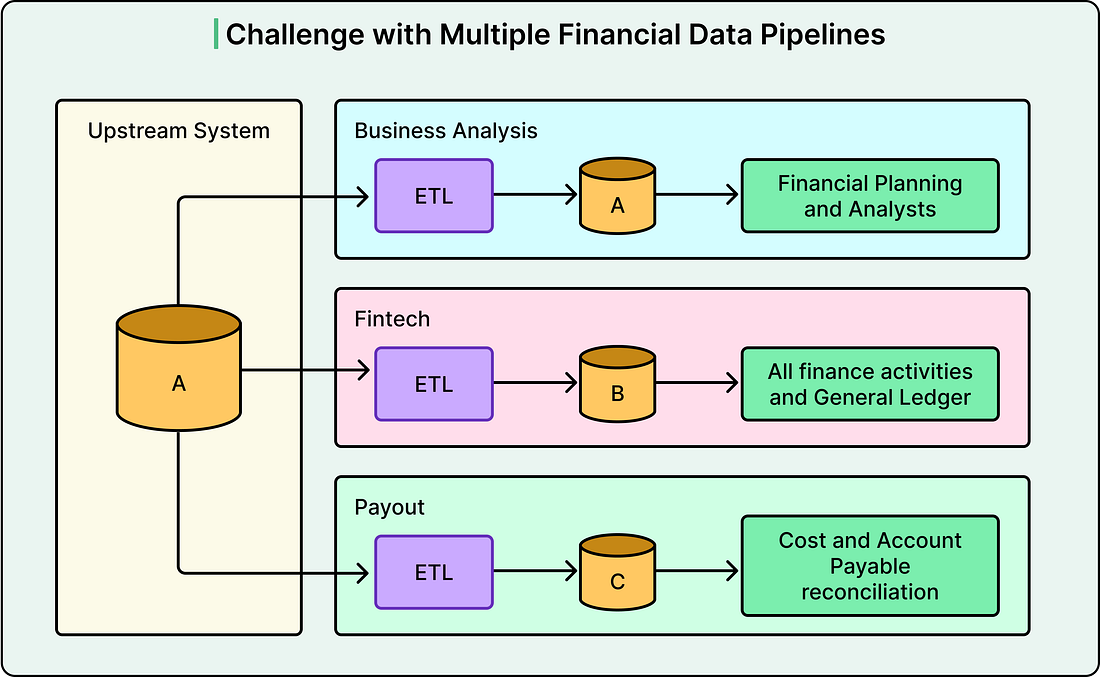
The high-level architecture of multiple data pipelines, each owned by different teams, introduced several fundamental problems that affected both data quality and operational efficiency.
First, duplicate sources became a significant issue. Many pipelines pulled data from the same upstream systems independently. This led to redundant processing, synchronization issues, data mismatches, and increased maintenance overhead. When three different teams all read from the same booking database but at slightly different times or with different queries, this wastes computational resources and can lead to scenarios where teams are looking at slightly different versions of the same underlying data.
Second, inconsistent definitions and transformations created confusion across the organization. Each team applied its own logic and assumptions to the same data sources. As a result, financial metrics could differ depending on which pipeline produced them. For instance, the Finance team might calculate revenue differently from the Analytics team, leading to conflicting reports when executives ask fundamental questions about business performance. This undermined data reliability and created a lack of trust in the numbers.
Third, the lack of centralized monitoring and quality control resulted in inconsistent practices across teams. The absence of a unified system for tracking pipeline health and enforcing data standards meant that each team implemented its own quality checks. This resulted in duplicated effort, inconsistent practices, and delays in identifying and resolving issues. When problems did occur, it was difficult to determine which pipeline was the source of the issue.
See the diagram below:
 |
During a recent review, Agoda observed that differences in data handling and transformation across these pipelines led to inconsistencies in reporting, as well as operational delays.
Unblocked: Context that saves you time and tokens (Sponsored)
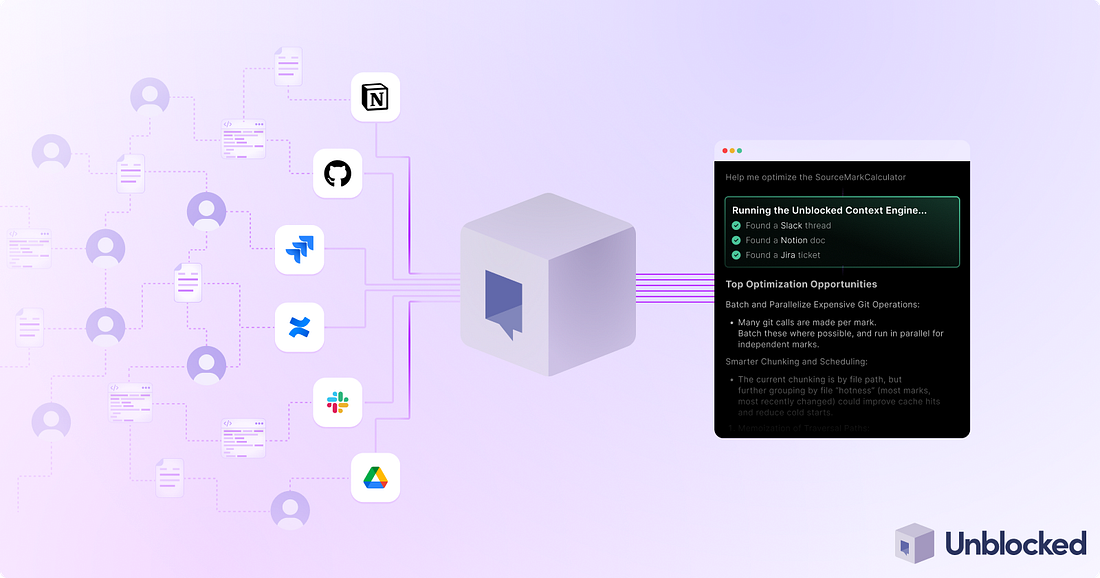 |
AI coding tools are fast, capable, and completely context-blind. Even with rules, skills, and MCP connections, they generate code that misses your conventions, ignores past decisions, and breaks patterns. You end up paying for that gap in rework and tokens.
Unblocked changes the economics.