|
 |
Hi, y’all. Welcome back to The Opposition. Today I’m gonna tell you something you might not want to hear: Some Democrats are worried about James Talarico. Not that he’s not a good candidate or that he’d make a bad senator. They’re worried that he’s going to give grassroots donors and activists so much hope that all the money flows to Texas and not to more winnable races that could more easily give the Democrats the majority . . . again. Because, well, it’s happened before.
Is this just Democrats being angsty Democrats—perpetually discovering something to fret about even in moments when things appear to be going well? Maybe. But, that’s what they’re saying. And part of our mission here at The Bulwark is to explain to you what the real conversations are behind the public utterances. If you appreciate these insights—the reporting and the candor—please consider becoming a Bulwark+ member. And if you don’t, let me know in the comments . . . which you can participate in after you become a Bulwark+ member :)
–Lauren



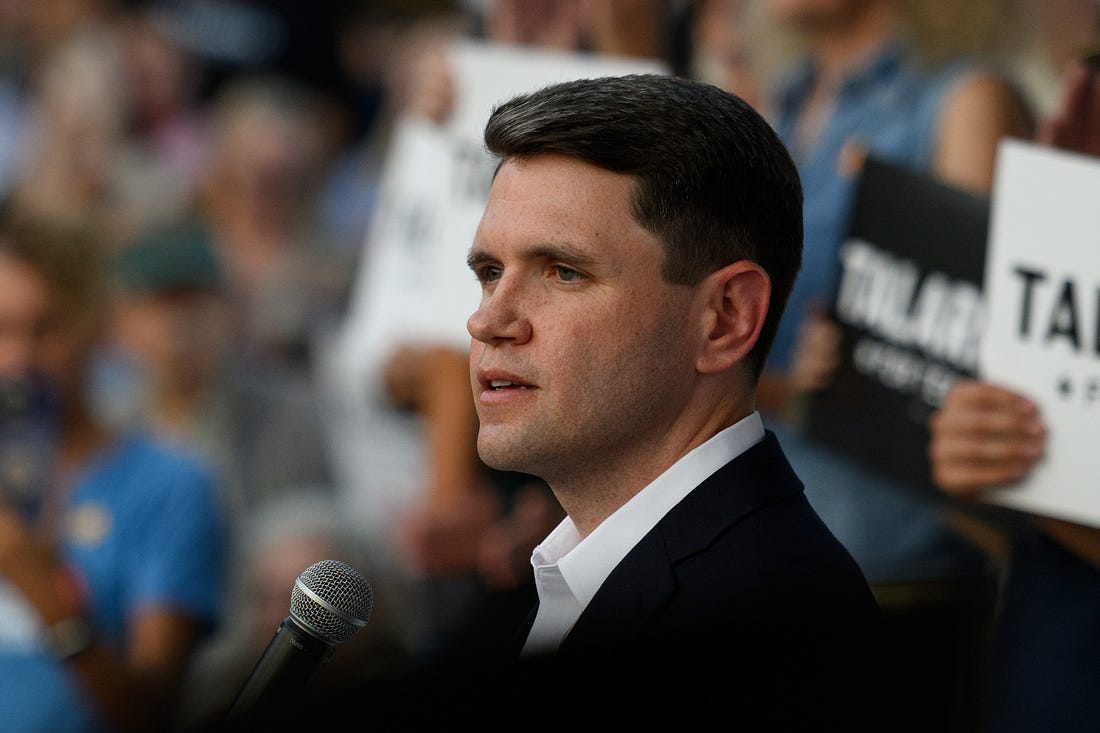 |
DEMOCRATIC OFFICIALS WOKE UP Wednesday morning with a giant sense of relief. Their party’s messy, drama-filled Texas Senate primary was finally over. And while the major Democratic campaign committees and top super PACs stayed neutral in the race, it was a poorly kept secret that they viewed state Rep. James Talarico as the stronger general-election candidate over U.S. Rep. Jasmine Crockett. When he beat her by a comfortable 6-point margin, they collectively exhaled.
But underneath the quiet elation was an equally quiet fear. Texas is still Texas: No Democrat has won there statewide since 1994 and the last time Texas elected a Democrat to the U.S. Senate was in 1988.¹ Yet it’s still the perpetual object of Democratic longing. Precisely because Talarico won, and because he has clear gifts as a campaigner, Democrats could end up, once more, overinvesting in a contest that remains out of their reach, harming other Senate candidates in states that would be easier to win—and more likely to give them a Senate majority.
“As exciting as Talarico is, we also have to make sure we’re in a strong position in Iowa, Ohio, Alaska—and even look at states like Kansas and Mississippi and Florida,” said Adam Jentleson, the former chief of staff to Sen. John Fetterman and the founder of Searchlight Institute, a Democratic think tank. “We shouldn’t just be thinking about taking back the majority in 2026, we should be thinking about building toward a substantial majority in 2028. And in order to get there in 2028, you have to run up the score in 2026.”
For well over a decade, Democrats have been investing talent and resources into trying to turn Texas blue, just to end up disappointed. Tuesday’s results make it all the more likely that they will once again invest heavily in the state. The party’s voters turned out in impressive numbers. There were also promising signs that Talarico can appeal to Latino voters, a key demographic group that has shifted to the GOP in recent cycles. Talarico also seemed to unite various ideological factions within the party. Everyone from the Progressive Change Campaign Committee to centrist Democratic think tank Third Way cheered his win. He will have to work to win over the state’s black voters, who largely supported Crockett. But he has a ten-week head start to do so while the two Republicans in the primary runoff—Sen. John Cornyn and Texas Attorney General Ken Paxton—drag each other through the mud and exhaust GOP donors.²
All of those factors have made even the most skeptical Democratic operatives hopeful about Talarico’s prospects.
Part of the Democrats’ quandary about how much to invest in Texas is about short-term and long-term goals. With Texas on track to gain more representatives in Congress and more Electoral College votes following the 2030 census, Democrats will need to be more competitive in the state long-term. But some operatives are cautioning the party not to get too sucked into the allure of flipping the reliably Republican stronghold this year. After all, they’ve been down that road before (See O’Rourke, Beto).
“It’s a tricky dynamic, and it’s a bit incumbent on rank-and-file Democrats to be strategic in their thinking here and say, ‘I want to use what resources I have to not just give to the candidate who I like the most on [MS NOW], but to make sure Democrats have as many pieces on the board to beat Republicans as possible,” said Jentleson.
Grassroots donors became enamored with Talarico—encouraged by fawning media coverage—leaving other Democratic candidates feeling spurned (not to mention wanting for cash). Jentleson noted that often what makes candidates best suited to win in states like Ohio or Iowa is a stay-above-the-fray approach, which also makes them less likely to go viral online or inspire massive excitement with small-dollar donors. Operatives in those states recognize the challenge too.
“I spent some time with the national donor class and you have to have something to sell. It’s a transactional thing,” said Sue Dvorsky, former chair of the Iowa Democratic Party. “We have not been a good investment property. And it isn’t the donors’ responsibility to throw money at us. It’s our responsibility to get out there and prove that we can bring this back. This is a local job.”
Some of the top Democrats in the country are skeptical about Texas flipping blue in 2026, though they don’t always say it out loud. Senate Minority Leader Chuck Schumer has said that the clearest path to the Senate runs through Alaska, Ohio, North Carolina, and Maine—the Lone Star state left notably off the list.