| | In today’s edition: Trump’s war poses a test for Democrats, and Daines’ surprise withdrawal.͏ ͏ ͏ ͏ ͏ ͏ |
| |  | Washington, DC |  |
| |
|
 - Dem war powers test
- WH reassures on Iran
- Trump’s call in Texas
- GOP shakeup in Montana
- Bessent’s housing objection
- DHS funding vote
- Anthropic’s lonely war
- Countering nukes a priority
PDB: House Oversight moves to subpoena Bondi  Trump hosts Inter Miami … Hegseth visits CENTCOM headquarters in Florida … China’s National People’s Congress holds annual meeting |
|
Iran war poses a test for Democrats |
 Kylie Cooper/Reuters Kylie Cooper/ReutersAlmost every Democrat in elected office opposes President Donald Trump’s Iran war. Their explanations could quickly become an electoral litmus test, Semafor’s Nicholas Wu reports. A subtle split emerged almost immediately after the first strikes on Iran, with Democrats voicing their opposition in several different ways. But as the House prepares to vote on war powers today, they’re trying to unite around a doomed push to rein in Trump that threatens to expose deeper divisions on Middle East policy. “It is a really, really dangerous precedent if any Democrat votes against the war powers resolution, because it is not a matter of conscience,” said progressive Rep. Pramila Jayapal, D-Wash. “Whether you think the goals of the war are right, it is a matter of constitutional obligation, and that is about Congress having the power to determine when and where we go to war.” |
|
White House stresses speed on Iran |
 Nathan Howard/Reuters Nathan Howard/ReutersThe White House is trying to reassure the public that it’s making rapid progress in Iran, as the conflict weighs on markets and energy prices. White House press secretary Karoline Leavitt told reporters Wednesday that the US would have complete control over Iranian airspace within “hours,” and administration officials have said that the military is operating ahead of schedule. While the Pentagon hasn’t detailed specific plans, operations are ramping up with the arrival of more forces. But the White House is cognizant of the political ramifications if the war lasts too long. “This can’t go on past Memorial Day,” one person close to the White House told Semafor. Defense Secretary Pete Hegseth, meanwhile, acknowledged it could last for eight weeks. Meanwhile, the conflict is straining US alliances: the White House and Spain disagreed over whether Madrid had agreed to cooperate with US operations. — Shelby Talcott |
|
Republicans pray Trump backs Cornyn |
 Jose Angel Juarez/Reuters Jose Angel Juarez/ReutersTrump says he’s decided to endorse in the brutal Senate race between Sen. John Cornyn and state Attorney General Ken Paxton in Texas — and tell the other candidate to drop out. Top GOP leaders are hoping Trump backs Cornyn, Semafor’s Burgess Everett reports. Cornyn himself said on Wednesday evening that he’s in the dark: “I don’t have any more information than what you’ve read.” He did seem to be in a pretty good mood, and many Republicans think Trump will pragmatically back Cornyn. The party may need someone battle-tested to beat state Democratic Rep. James Talarico in November, and with Paxton it “becomes more expensive, and it’s at-risk,” said Sen. Steve Daines, R-Mont., a former chairman of the party’s campaign arm. Senate Majority Leader John Thune, Whip John Barrasso and Sen. Lindsey Graham, R-S.C., all said Trump should back Cornyn. Sen. Ted Cruz, R-Texas, remains neutral. |
|
Daines’ surprise exit rocks Montana |
 Elizabeth Frantz/Reuters Elizabeth Frantz/ReutersSen. Steve Daines knows how to clear a primary field — including when it comes to his own retirement. The Montana Republican unexpectedly dropped his reelection bid on Wednesday night — a surprise, though Daines didn’t love all the travel and likes to spend time with his family. He and Sen. Tim Sheehy, R-Mont., along with Trump, immediately endorsed US Attorney Kurt Alme to succeed him, a coalescence similar to the one Daines helped execute around Sheehy in 2024. Independent candidate Seth Bodnar entered the race on Wednesday; Democrats will have to decide whether to back him. Democratic candidate Reilly Neill doesn’t exactly sound like she’s going anywhere, but it’s hard to see Alme losing ground in a fractured field. Daines isn’t the only Republican to call it quits: Fellow Montanan Rep. Ryan Zinke also announced his retirement this week, and Utah Rep. Burgess Owens said he’s not running again. — Burgess Everett |
|
Bessent breaks with White House on housing |
 Kevin Lamarque/Reuters Kevin Lamarque/ReutersTreasury Secretary Scott Bessent’s skepticism of bipartisan housing policy put him briefly at odds with the White House on one of Trump’s top priorities. Bessent told House Republicans in a closed-door meeting Wednesday that Republicans should “take the lead” to “pass our own housing affordability” legislation so they “don’t let the Democrats like Senator [Elizabeth] Warren get ahold of this issue,” people familiar with the exchange told Semafor. He had relayed concerns outside of the meeting over the Senate’s bipartisan approach to boxing out institutional investors, including its requirement investors sell any rental housing they build to individuals within seven years, other people familiar with those talks said. The White House had endorsed that approach Monday. Shortly after Semafor broke the news, Bessent called for the Senate to pass its bill and “for the House to swiftly send it” to Trump’s desk. |
|
House tees up DHS funding vote |
 Kylie Cooper/Reuters Kylie Cooper/ReutersThe House is set to vote again today on funding the Department of Homeland Security, which has been partially shut down since mid-February. House GOP leaders are aiming to pressure Democrats on the vote by linking it to the escalating conflict in Iran; Speaker Mike Johnson called it “shameful” to oppose the homeland security funding bill. But Democratic leaders expect their caucus to hold firm against the legislation, with California Rep. Pete Aguilar, the No. 3 House Democrat, telling reporters Wednesday: “We’ll continue to oppose this terrible homeland bill because they’re trying to use ICE and CBP money against US citizens.” Democrats are still pushing for policy changes at DHS that many Republicans insist are nonstarters. And even if the legislation passes the House, it lacks a filibuster-proof majority in the Senate. — Nicholas Wu |
|
Anthropic allies silent in standoff |
 Anthropic CEO Dario Amodei is fighting a lonely war with the Pentagon. Anthropic’s investors, which include Silicon Valley giants like Amazon, have remained silent in public on the young AI behemoth’s feud with the Trump administration over its Claude model. When the conflict came up in a private meeting with Defense Secretary Pete Hegseth, Amazon CEO Andy Jassy demurred, Semafor’s Reed Albergotti scoops. Other tech executives said they fear inflaming a tense situation they hope de-escalates, according to Reed, who broke the news of brewing tensions between Anthropic and the Pentagon in January. |
|
Americans’ fears over nuclear weapons |
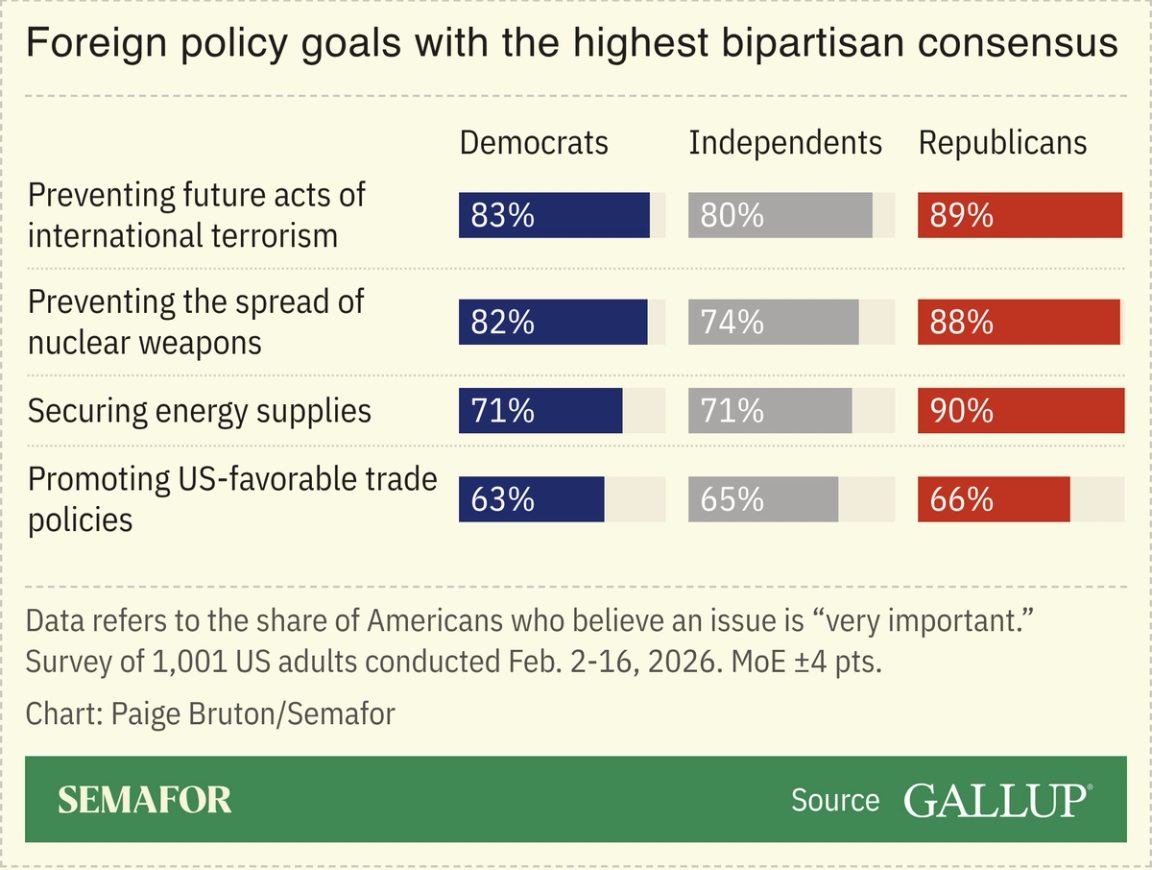 Eight in 10 Americans say that preventing the spread of nuclear weapons is a “very important” US foreign policy objective, a potential boon for Trump as he looks to message the US-Israeli war against Iran. Just one issue — preventing international terrorism — is viewed as “very important” by a larger percentage of US adults, according to new Gallup polling. Lower on the priority list are goals like promoting economic development in other countries and democracy-building. The figures would suggest some support among the US public for going after Iran’s nuclear program, though other polling suggests most Americans disapprove of the strikes and think the administration should have given diplomacy more of a shot. The Gallup survey, which was conducted before the Iran strikes, also showed the number of Americans who want a greater commitment to NATO is rising as the Trump administration pulls back. |
|
 The Trump administration’s argument for its war in Iran is an unusually tortured one, but it had to be that way, Semafor’s David Weigel writes. That’s because the voters who joined Trump’s coalition in 2024, after staying far away from it in 2016 and 2020, were told that Trump wouldn’t do something like this — but that it would definitely happen if he lost. The undercurrent of today’s situation is that it has become much harder to sell a war of choice since Bill Clinton mobilized troops for NATO’s mission to bomb Yugoslavia and George W. Bush announced Operation Iraqi Freedom. Today, the downside risk of supporting a war, even one that goes better than anybody expected, is higher than the risk of opposing it. |
|
 The Gulf has transformed from a bustling economic hub to the front line of a major war. Iran’s retaliatory strikes have hit bases and airports across the region. The Gulf’s cities have gone quiet, their airports grounded and streets empty as residents take shelter. The US-Israel assault that killed Iran’s supreme leader has unleashed a new and unpredictable phase of conflict. For the Gulf, the illusion of distance from regional turmoil has been put on hold. Energy markets are bracing for volatility, diplomacy is strained, and the region’s stability is under pressure. Semafor Gulf is here to help you make sense of it. Four times a week, editor Mohammed Sergie and our team across Abu Dhabi, Dubai, and Riyadh will connect you with what’s happening on the ground, and how it affects business, energy, and diplomacy — bringing clarity to the most consequential story in the world. Subscribe to Semafor Gulf with one click here. |
|
|


