| | In today’s edition: Qatar’s LNG shutdown hits its industrial sector and Gulf ties with Africa are pu͏ ͏ ͏ ͏ ͏ ͏ |
| |  Tehran Tehran |  Doha Doha | Strait of Hormuz |
 | Gulf |  |
| |
|
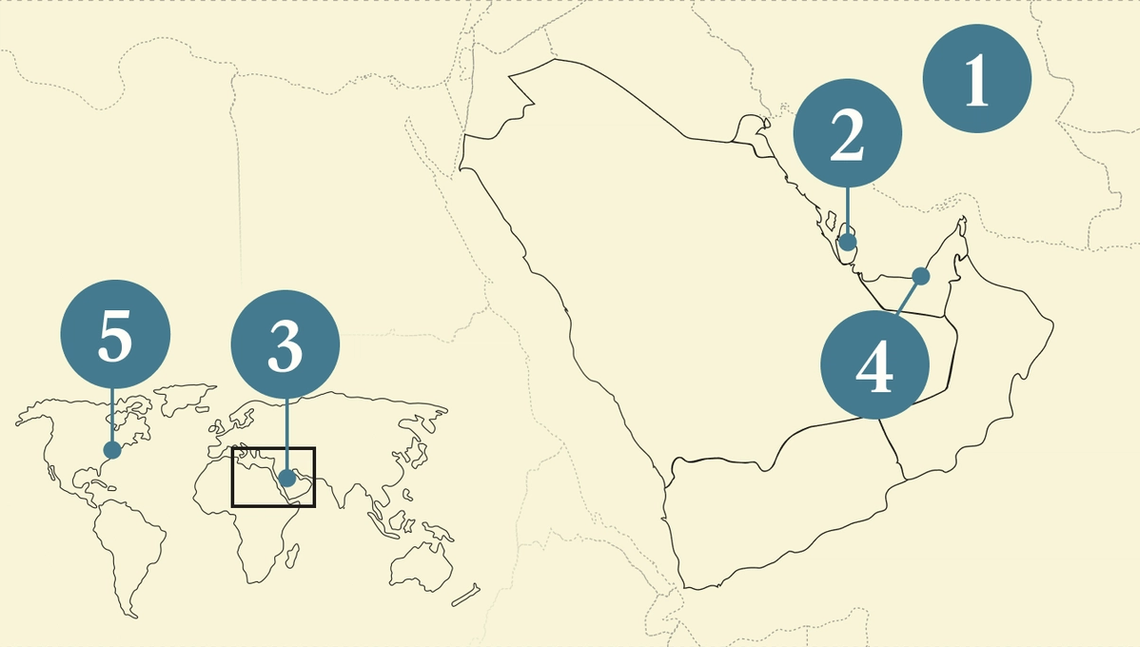 - Doha rejects Iran overture
- Qatari industries spiral
- Renewables to the rescue?
- War threatens Africa-Gulf ties
- Last chance to break Iran
 Uber CEO’s (pre-war) comments on Iran. |
|
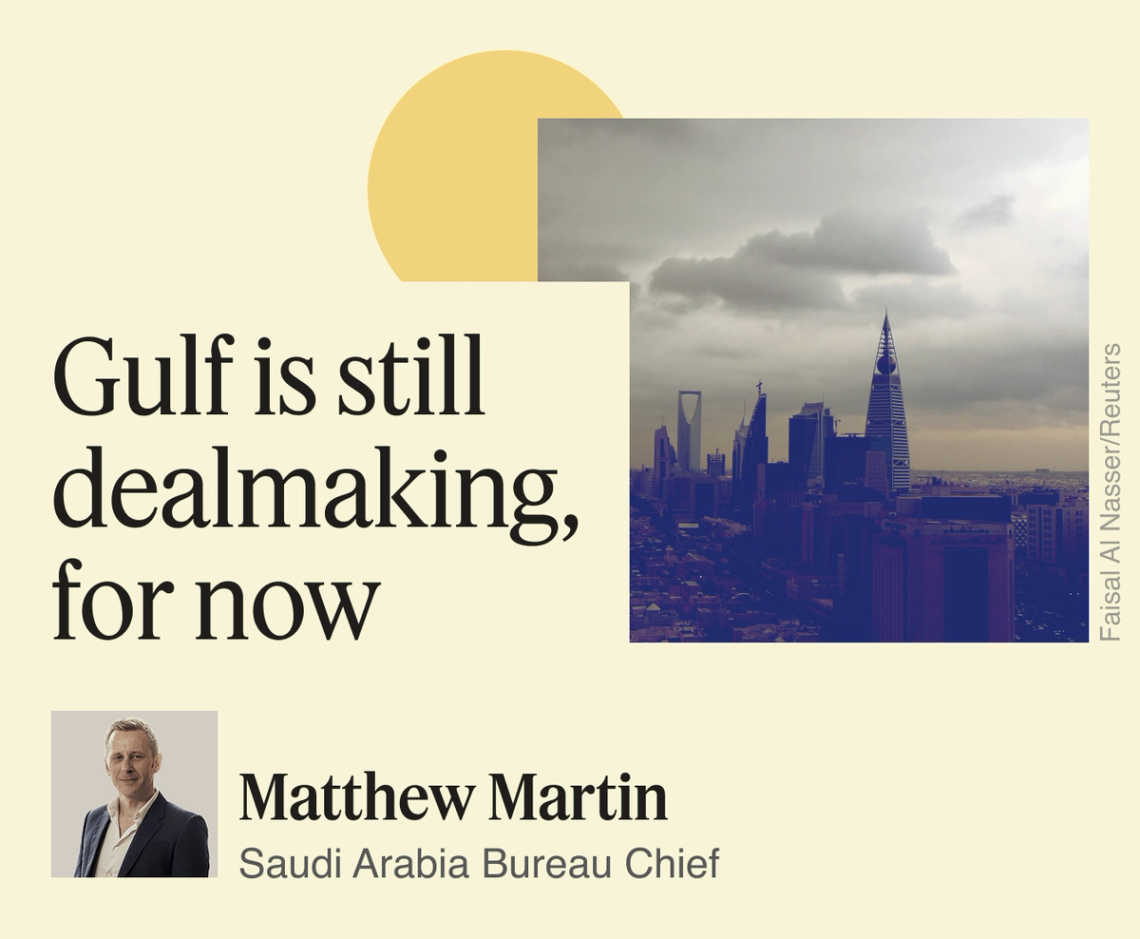 As conflict hits the Gulf, investors into and out of the region are adapting to a new reality of dealmaking. Right now, the appetite to show that life carries on as usual by continuing to do outbound deals is high. On Tuesday, even as Qatar was stopping gas production after Iranian strikes, Qatar Investment Authority backed a $10.7 billion buyout of AES Corp, and Aluminium Bahrain, controlled by the kingdom’s sovereign fund, agreed to acquire the EU’s biggest aluminum smelter even as a missile hit the Mina Salman port. Saudi Arabia’s Future Investment Initiative has reiterated its commitment to holding an event in Miami this month. Wall Street will take comfort from the fact that Gulf sovereign funds, which together control around $5 trillion, are still interested in writing checks. It will be more difficult to press the case that it’s business as usual for attracting money into the region. Chinese banks are already limiting their exposure to Middle East debt. Asian investors have been playing an increasingly prominent role in buying Gulf bonds. If they start to get nervous about the region, it could significantly affect borrowing costs at a time when the Gulf will already be facing a serious economic hit. Investment bankers are starting to talk about putting deals on hold, or slowing down work. The UAE’s decision to close the stock markets for several days, and then limit declines to 5% when they reopened, also irked many international investors. And while the Saudi market has quickly recovered from earlier losses, a hoped-for pick up in IPO activity is probably some way off. Takeovers within the region are also likely to slow as growth projections are scrambled by the war: Who wants to buy an asset that could be hit by a drone next week? Much will depend on how long the conflict drags on, but for now, there’s likely to be more outbound deals from the region than inbound. |
|
Qatar’s first aerial combat kill |
 Sukhoi Su-24 bombers fly in formation in Moscow. RIA Novosti via Reuters. Sukhoi Su-24 bombers fly in formation in Moscow. RIA Novosti via Reuters.Qatar has long been accused by Israel of being cosy with Iran, an allegation Saudi Arabia and the UAE also used as a pretext to embargo it almost a decade ago. Doha has always rejected that charge, insisting it prioritizes diplomacy and cordial ties with all its neighbors. That stance hasn’t spared it from Iran’s wrath in Tehran’s spiraling war with the US and Israel — and Qatar is proving it can defend itself. On Monday, in the first manned aerial combat of the conflict, Qatari fighter jets shot down two Iranian Su-24 bombers headed toward Al-Udeid Air Base — the US’ largest in the Middle East — and the Ras Laffan liquefied natural gas complex. The attacking aircraft were flying low to evade radar, CNN reported, and were minutes from their targets before Qatari F-15s destroyed them. Doha’s tone toward Tehran is now notably sharper. Qatar accepted taking the final volleys of the June 2025 war between Israel and Iran, but in a call with Iran’s foreign minister on Wednesday, Qatar’s prime minister said the attacks this week showed Tehran had “no desire” to de-escalate and was instead trying to drag its neighbors into the war. The unusually blunt readout underscores what could be a long enmity between the region and Tehran, with Arab Gulf states concluding that Iran’s drones, missiles, and proxies — essentially the regime itself — pose a regional threat. — Mohammed Sergie |
|
Qatar’s industrial base hit by LNG halt |
 Stringer/File Photo/Reuters Stringer/File Photo/ReutersQatar’s decision to suspend LNG production in the face of Iranian attacks on its energy infrastructure is having a domino effect on the country’s industrial sector. As well as gas, QatarEnergy has also halted output of downstream products such as methanol, polymers, and urea, prompting local industrial groups to suspend their own operations. Industries Qatar — which makes fertilizer, petrochemicals, and steel — and Mesaieed Petrochemical Holding Company have reduced or halted the production of some products. Gulf International Services, a conglomerate part-owned by QatarEnergy, has also paused some energy sector activities. Qatar Aluminum Co. is enacting a “controlled shutdown” of its operations over the course of this month. Even if the conflict ends soon, the consequences of some of these decisions will linger: It could take as long as a year to restart the Qatari smelter. — Dominic Dudley |
|
Renewables to the rescue? |
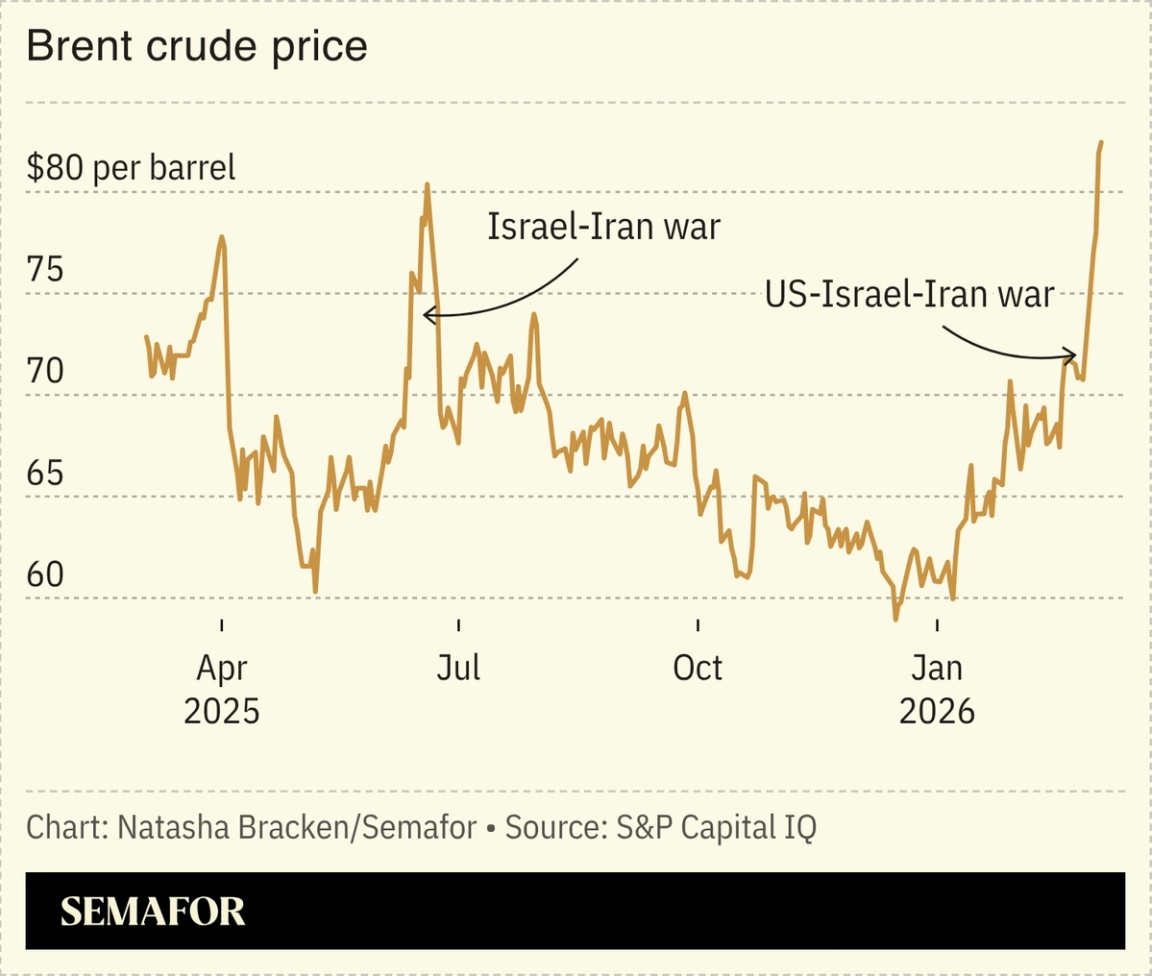 The war in Iran could be a breakthrough moment for the clean energy sector, but for now the industry faces more risks than rewards. Surging prices for oil and gas underscore a point that climate activists have hammered for years: The supposed energy security benefits of fossil fuels are actually very fragile. Yet share prices for some of the big clean energy companies also plunged this week, in part because the Strait of Hormuz is a vital thoroughfare for the gases and chemicals used by the renewables industry, just as it is for oil. And if the war causes interest rates to spike, that would choke off capital for new renewables projects. Gulf countries have invested heavily in clean energy, in part to free up crude and gas to sell abroad. But the closure of export routes means local storage facilities are quickly filling up; Kuwait could soon follow Iraq in curbing production for want of storage options. In the meantime, security experts said Gulf countries should look to Ukraine for guidance on how to defend against drone and missile attacks. No other country has as much experience in managing an onslaught against its power plants, or finding creative ways to strike its adversary’s energy infrastructure. — Tim McDonnell |
|
War puts Gulf’s ties with Africa on hold |
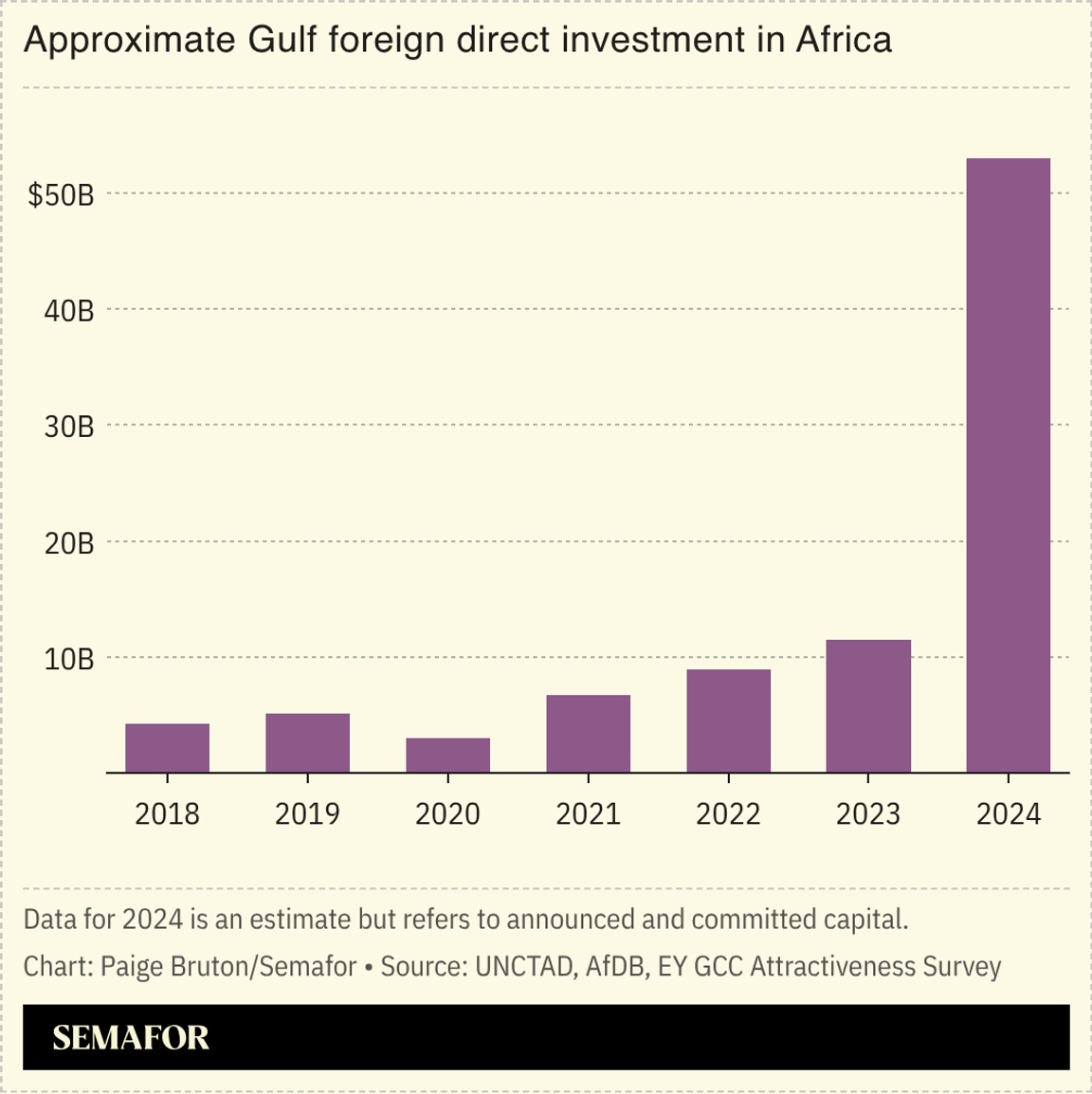 In recent years, Africa’s political and business leaders have come to see Gulf nations as the perfect counterweight to Washington and Beijing and a welcome new source of capital. More than $100 billion of Gulf investment has poured into the continent’s energy, ports, logistics, and tech sectors, dwarfing transfers from the US and rivaling those of Europe. Abu Dhabi, Doha, and Dubai have become regular backdrops for African presidents, ministers, and CEOs. That momentum has now been severed: The US-Israel war on Iran — and Tehran’s reprisal attacks on its neighbors — threaten to pull the Gulf region’s attention, capital, and political bandwidth back home. Diversification from the West and China was meant to reduce vulnerability. Instead, the continent may discover that, in an interconnected world, there is no true hedge. — Yinka Adegoke
|
|
View: A chance to break Tehran’s grip |
  Majid Asgaripour/WANA via Reuters Majid Asgaripour/WANA via ReutersThe ambitions of the Gulf states to diversify and transform their economies requires security. If they work with the US and Israel, they can isolate the Iranian regime diplomatically, dismantle its proxy infrastructure, degrade its military reach, and strip it of the intimidation it has used to dominate the region, Jason D. Greenblatt, US President Donald Trump’s former Middle East envoy, writes in a Semafor column. “Containment is not enough. Deterrence must be unmistakably reestablished, and Iran’s ability to threaten, coerce, and destabilize its neighbors must be broken,” he says. |
|
 - AGBI: Most shops are still open, but Gulf retailers are bracing for a downturn as the conflict hits supply chains and derails tourism spending in what is usually peak season.
- Amena Bakr: Saudi Arabia is moving record amounts of crude through its east-west pipeline so it can be exported via Yanbu on the Red Sea, avoiding the Strait of Hormuz.
- Bloomberg: The Pentagon’s use of Anthropic’s Claude AI model in the war on Iran is part of a wider adoption of a technology that is prone to hallucinations: a shortcoming which can be deadly on the battlefield.
- New Lines: Gulf governments could lose no matter who claims victory in the current war, whether that is a wounded Iran which has set a precedent with its attacks on their cities, or an ascendant Israel happy to use assassinations and airstrikes to resolve disputes.
- The National: NATO forces shot down an Iranian ballistic missile in Turkish airspace. It is thought to have veered off course from its intended target in Cyprus.
- WSJ: Dubai has been a magnet for UK influencers looking for a sunny, tax-free haven, but their current situation has elicited more schadenfreude than sympathy back home.
|
|
 CEOs have spent the past few years retreating from speaking out on issues not directly tied to their business. That followed a period of solemn condemnations of societal ills and bland displays of allyship. In an unexpected moment on Semafor’s new business podcast, Compound Interest, Uber CEO Dara Khosrowshahi provided a middle path. “I hope there’s regime change because that regime has been absolutely terrible for the people of Iran,” said Khosrowshahi, whose family fled just before the 1979 Islamic Revolution. “It’s a regime that has not earned its keep.” Speaking after Tehran’s brutal crackdown on protests at the turn of the year, but before the US-Israel strikes, he added that change should come “from the inside … Regime change driven by countries — driven by Western countries, especially — doesn’t have a good track record.” He said he had talked “very quickly” to US President Donald Trump about it: “The fact that he cares matters.” CEOs might take note and stay quiet where they don’t have authority or a chance to make a difference — but remember it’s OK to pick their spots. |
|
|


