| | The war in Iran looks like it should be a breakthrough moment for a clean energy sector that has bee͏ ͏ ͏ ͏ ͏ ͏ |
| |  | Energy |  |
| |
|
 - Oil in dire straits
- Kyiv’s defense lessons
- Hyperscalers’ Trump promise
- Decarbonizing real estate
- China’s new climate strategy
 China has a backup plan for Middle Eastern fossil fuels |
|
 The war in Iran looks like it should be a breakthrough moment for a clean energy sector that has been hammered on multiple fronts in recent years, but for now the industry could face more risks than rewards. Surging prices for oil and gas, on their own, should improve the economic competitiveness of non-fossil energy sources. And in a broader sense, the price volatility currently underway — which could get far more extreme depending on the US ability to control the Strait of Hormuz — underscores a point that climate activists and European politicians have repeatedly hammered since the invasion of Ukraine: The supposed energy security benefits of fossil fuels are actually very fragile. Shale bosses in the US were quick to warn that they can’t fully cover the gap left by a drop in Middle East exports. The US Strategic Petroleum Reserve remains relatively depleted from when the Biden administration tapped it in 2022. And at least one LNG tanker bound for Europe has already been diverted to Asia as competition for scarce supplies grows. So overall, Trump’s options to limit the energy price fallout from the war could be limited. “The priority now should be very much on getting out of commoditized energy technologies as quickly as you can,” Jon Fuller, a former director of the clean tech investor Breakthrough Energy who recently launched a new energy-security-focused advocacy group called Catalyse Europe, told me. “Electrification and clean energy provide you with sovereignty and security of supply.” Yet the share prices of several big clean energy companies plunged this week. Some of that just reflects general nerves across the stock market. But there are more tangible headwinds, said Alex Jacquez, a former official in Biden’s National Economic Council. While the Strait of Hormuz isn’t critical for shipping renewable energy hardware or critical minerals, it is a vital thoroughfare for industrial gases and chemicals used by the industry. And if energy-related inflation causes the Federal Reserve to ramp up interest rates, that would also choke off capital for new renewables projects. Still, the inevitability of fossil fuel price shocks is a compelling reason for both exporters and importers to think hard about what they can do to build a moat around their energy industries, Jacquez said: “Having such a core economic commodity influenced by forces completely outside your domestic control is an economic and national security vulnerability no matter how you slice it.” In the meantime, I’ll be in London next week and would love to link up with some readers if I can; drop me a line if you’ll be in town. |
|
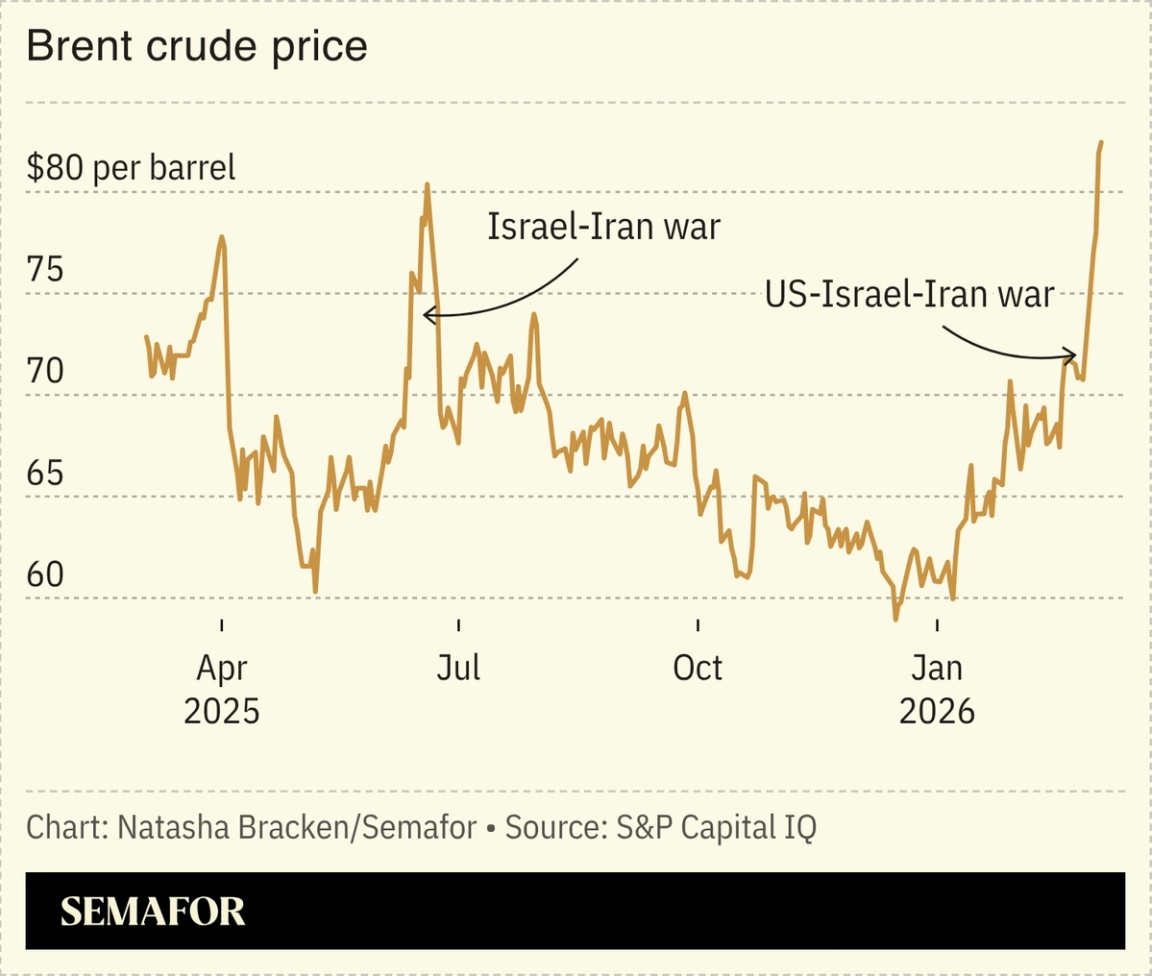 Oil prices extended their gains as the conflict surrounding Iran showed no sign of slowing down. Goldman Sachs raised its near-term price forecast by $10 per barrel, as attacks on tankers persisted — around 10 have been targeted in the Gulf or in waters near Oman since the war started — and Iraq began to shut down production at its biggest fields because of the closure of the Strait of Hormuz and a lack of storage facilities. Kuwait could be next to see production cuts, analysts warned. Saudi Aramco’s Ras Tanura refinery also came under a fresh attack on Wednesday, although there was no damage, and QatarEnergy has declared force majeure on LNG shipments, having said earlier in the week it had halted production amid the Iranian strikes. Aramco is also now reviewing alternatives to shipping oil through the Gulf, including using its east-west pipeline to export crude via the Red Sea, and relying on Egypt’s Sumed pipeline to the Mediterranean, people familiar with the matter told Semafor. Despite the insurance and military assurances offered this week by Trump, “many shipping industry insiders remain cautious,” Stamatis Tsantanis, CEO of the shipping company Seanergy Maritime, said in a statement. “Shipowners and operators will need to see a clear, secure corridor established before confidence fully returns.” In the meantime, the price of insurance for ships wishing to cross the Strait rose further, up about 400% since before the weekend, according to the brokerage Marsh. –Tim McDonnell and Matthew Martin |
|
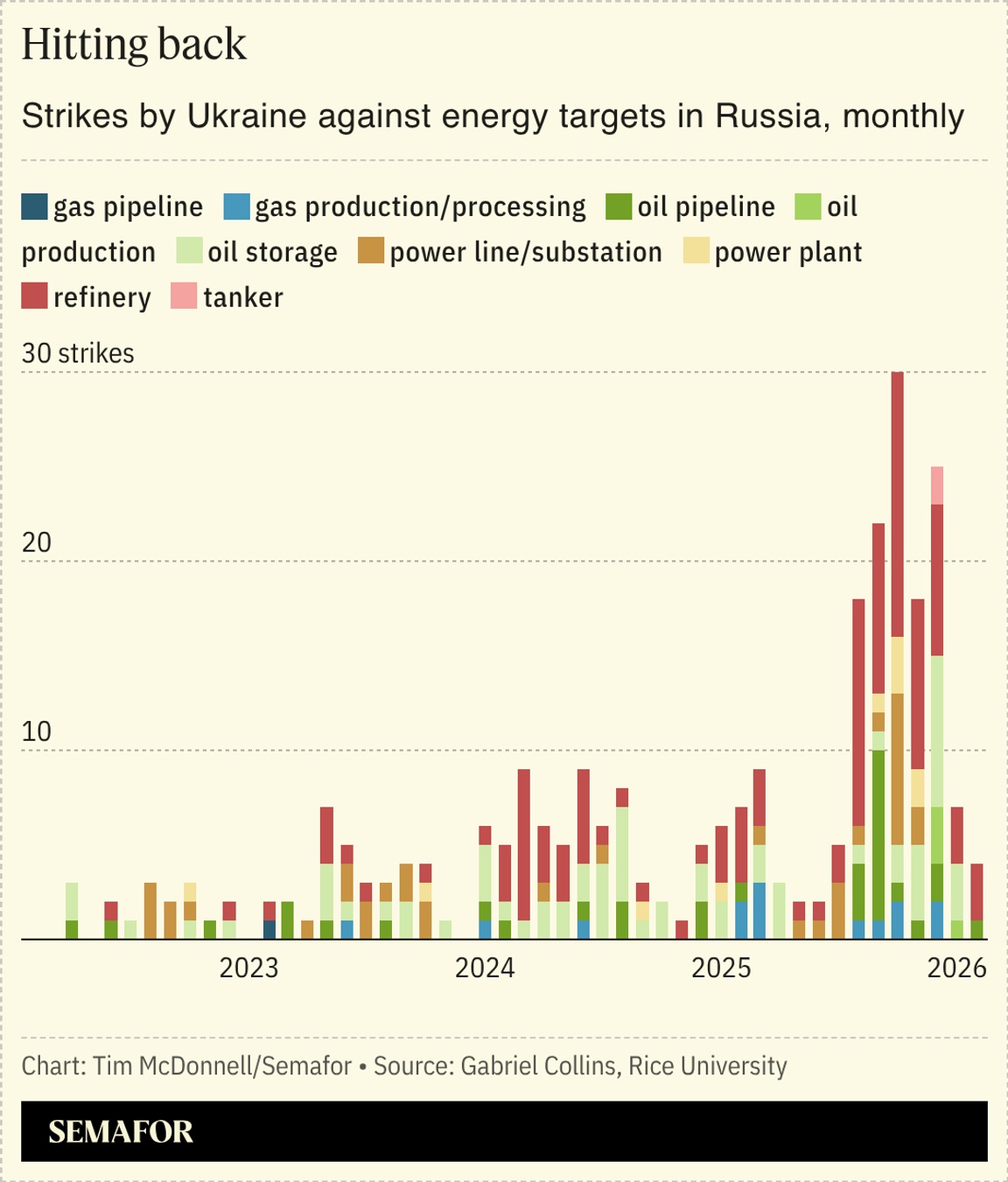 Middle East countries should look to Ukraine for guidance on how to defend their energy infrastructure against drone and missile attacks, security experts said. No country in the world has as much experience as Ukraine in both managing an onslaught against its power plants, and finding creative ways to strike its adversary’s energy infrastructure. For now, air defense systems around the Gulf have been reasonably effective in blocking many Iranian attacks. But the chief lesson of Ukraine is about modern military economics, said Gabriel Collins, an energy security researcher at Rice University who this week published an in-depth study of Ukraine’s energy counterattacks against Russia: It quickly becomes unsustainable to take down $50,000 drones using multimillion-dollar missiles. By the same token, using a few dozen drones to strike an economically vital oil refinery is a great deal, and energy infrastructure will continue to be a top-tier military target in most future global wars, Collins said. Ukraine’s experience has shown that many energy assets are simply too big to defend completely. But the country’s multi-layered defensive system — from simple concrete barriers around substations, to the widespread use of electronic signal jamming, to teams that rove around on pickup trucks fitted with 50-caliber machine guns to shoot down drones — has significantly tilted the cost balance in Ukraine’s favor, Collins said: “What you want to do is move that exchange ratio against them as much as you can.” |
|
Hyperscalers’ promise to Trump |
 Leading tech executives met at the White House on Wednesday to promise to shoulder more of their data centers’ energy costs, but many of the real solutions are out of the Trump administration’s hands. Executives from Amazon, Google, Meta, Microsoft, xAI, Oracle, and OpenAI signed a “ratepayer protection pledge,” which Trump said will have “a tremendous impact on electricity costs.” The pledge doesn’t include any specific new policies to help tech companies finance or build new energy projects. It will ultimately fall to state and local regulators to continue hammering out the specific rate structures that will induce greater investment in the grid near data centers, and power project developers will still contend with years-long backlogs for gas turbines and other necessary equipment. Still, for tech companies that are keen to avoid conflict with the administration, the pledge will likely produce some tangible results, Jeff Jakubiak, energy regulation partner at the law firm Vinson & Elkins, told Semafor: “I think is going to result in more generation than otherwise would have been built.” |
|
Decarbonizing real estate |
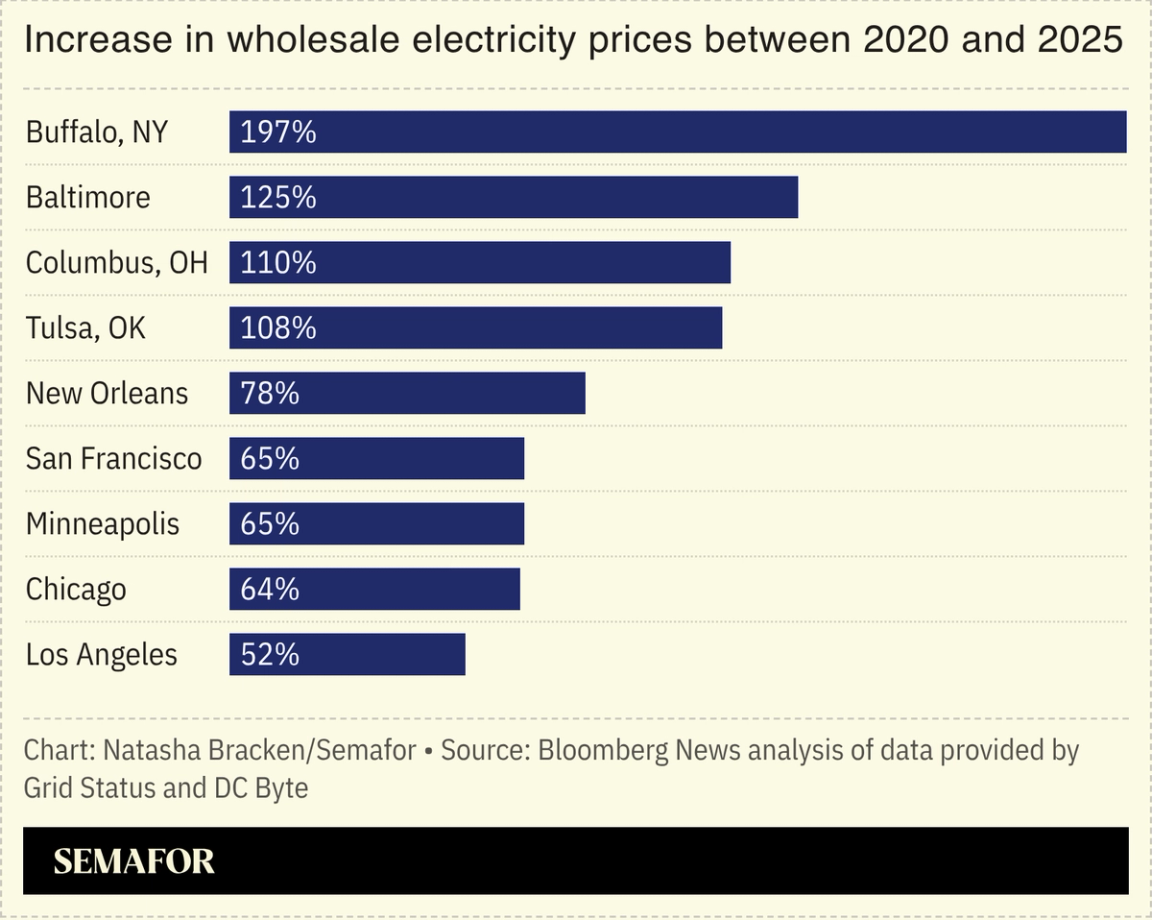
 Value of a new real estate-focused fund that clean tech investment firm Galvanize closed today, part of a strategy to capitalize on rising electricity costs. The fund, details of which were shared first with Semafor, will invest in renewable energy and efficiency projects in commercial buildings in order to lower their electricity bills and carbon footprints. “In an environment where the combined impact of rising electricity prices and market volatility is accelerating, there is a large and ongoing opportunity for the team to leverage decarbonization as a driver of value creation,” said Katie Hall, CEO of Galvanize. |
|
 Business — and the way companies operate — is transforming in ways both subtle and seismic. The forces moving Wall Street and global enterprise are accelerating, powered by AI breakthroughs, shifting capital flows, and evolving ideas about risk. In every sector, technology, regulation, and government are rewriting the balance of power and possibility. To help decode the fast-changing forces reshaping business and markets, Semafor is launching Compound Interest from Semafor Business — a podcast featuring in-depth conversations with the leaders building the next chapter of the global economy. Led by Liz Hoffman and Rohan Goswami, Compound Interest will pull back the curtain, and talk directly to the operators, experts, and innovators behind some of the world’s most consequential companies. On this week’s inaugural episode, Uber CEO Dara Khosrowshahi explains how the company is evolving from ride‑hailing app to an AI‑era operating system for moving people and stuff around cities. |
|
China’s new climate strategy |
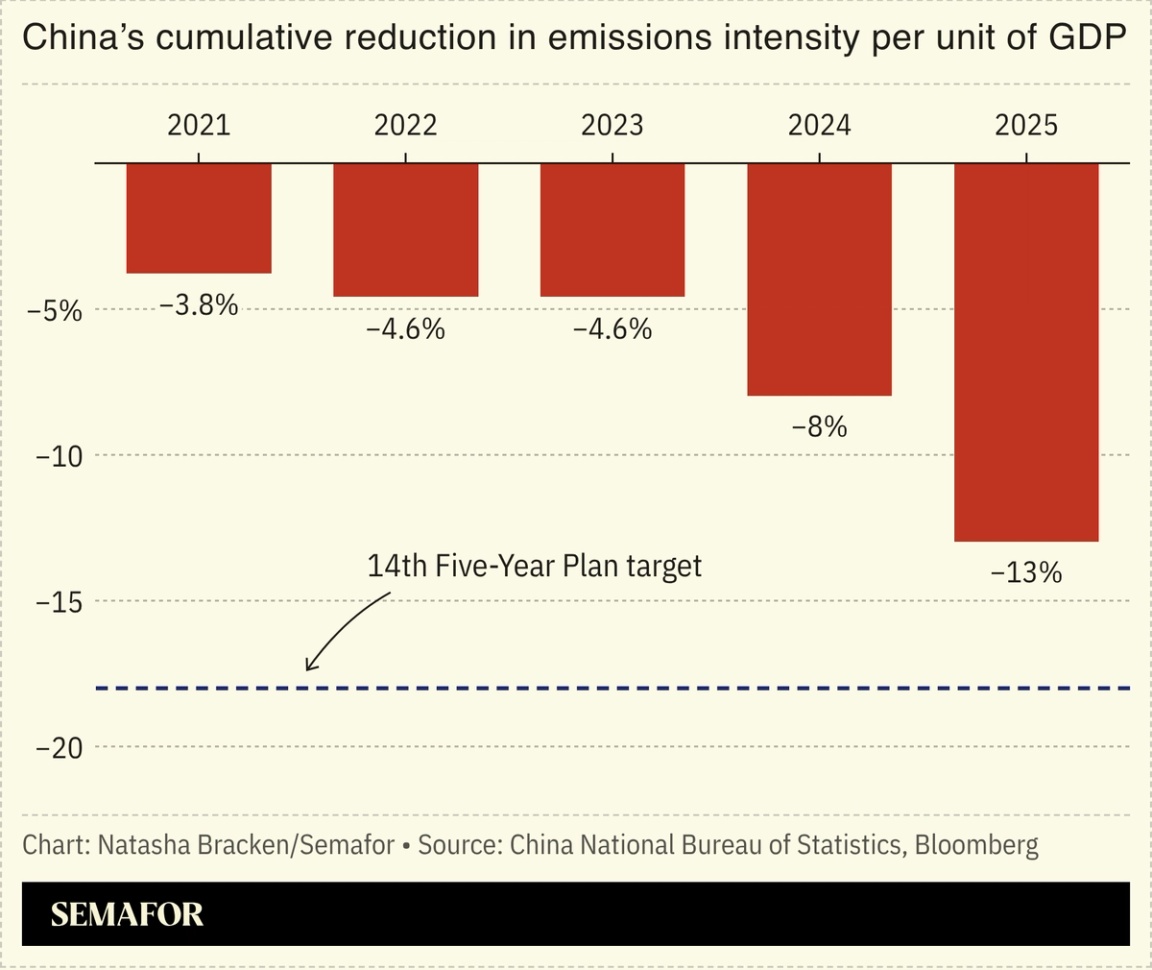 China is targeting a 17% cut in carbon intensity under its 15th five-year plan, it announced Thursday, as the country declares its ambition to “lead global climate governance.” The plan drops long-standing energy intensity targets, reflecting a shift toward measuring climate progress based directly on emissions. Greenpeace said that meant the pace of total emissions reductions will depend mostly on whether renewable energy deployment can keep pace with overall economic growth. Beijing’s renewables rollout, which now accounts for roughly 11% of China’s GDP, is set to continue through the decade: The latest five-year plan calls for replacing 30 million metric tons of coal with renewables annually and aims to bring coal to peak consumption by 2030, but stops short of stricter caps. Beijing wants non-fossil fuels to reach a quarter of total energy use by the end of the decade, up from 21% last year. The plan reaffirmed China’s conviction to “fully implement” the UN’s climate convention and the Paris Agreement, just as US President Donald Trump withdrew from the Paris accord for a second time, and exited a string of UN climate bodies. —Natasha Bracken |
|
 New Energy- BluePath Finance, an owner and operator of distributed energy transition assets, said it has secured a major investment from TWG Global, a diversified holding company that backs businesses with untapped potential.
- China is looking to improve its recycling capacity to reuse end-of-life solar modules as it prepares for a wave of large-scale retirements.
- Solar panel manufacturers are focusing less on producing panels alone and more on ancillary businesses such as energy storage systems and hydrogen.
Fossil Fuels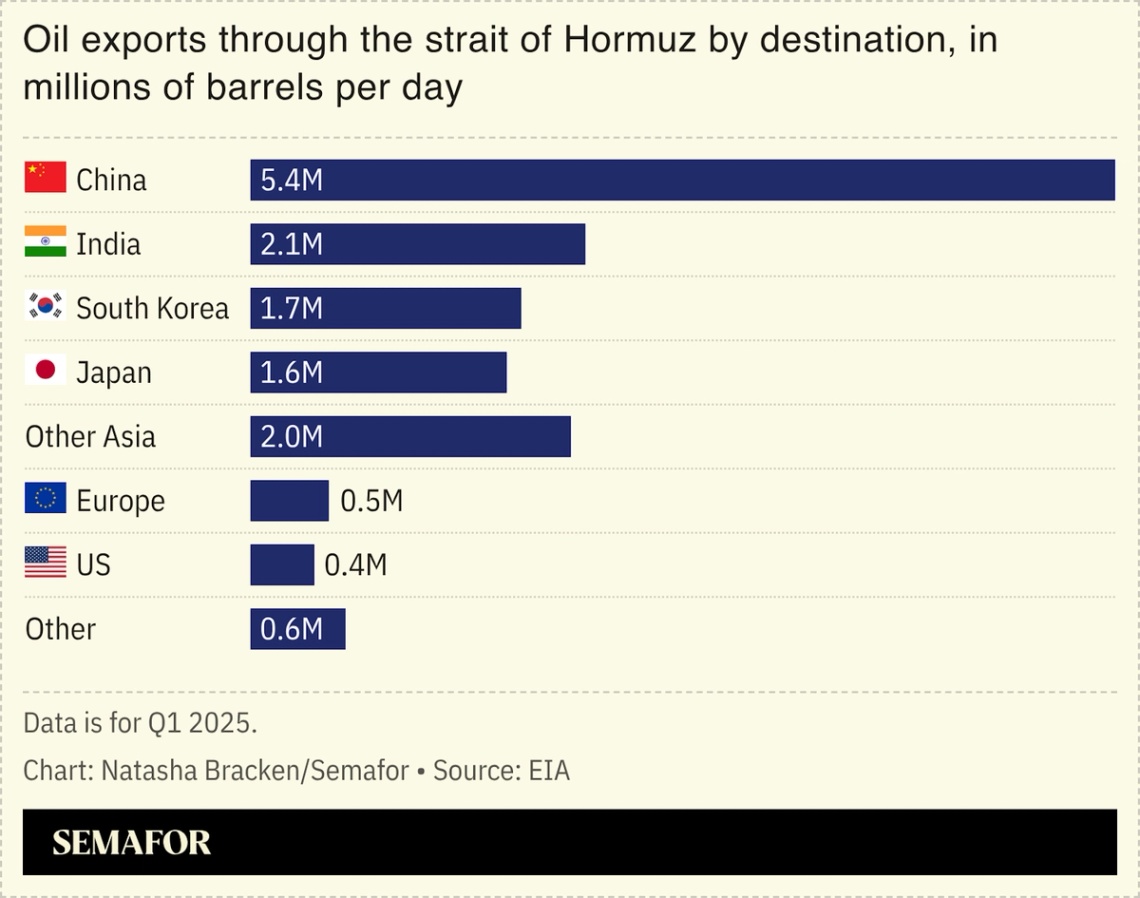 Finance- A group of bankers at Barclays laid out their views on the future of clean energy in a paper published online, arguing that risks for renewables are rising as some companies struggle to connect energy to the grid.
Politics & Policy- In annual reports, companies including ConocoPhillips have expressed concern about Trump’s climate policy overhauls and what they mean for future emissions plans, especially as businesses will need to cut emissions to meet longer-term standards that extend beyond the president’s term.
- China’s oil reserves and access to Iranian and Russian crude in floating storage could cushion a disruption to Middle East imports, though it has less flexibility on LNG, where it would probably opt to curb consumption rather than pay a premium, researchers at the Center on Global Energy Policy said. But a prolonged crisis could also boost the appeal of the proposed Power of Siberia 2 pipeline from Russia, while reinforcing Beijing’s push for energy self-sufficiency.
|
|
|


