Hello and Happy Friday! Enjoy getting a full night’s sleep later before daylight savings strikes our clocks once again early Sunday morning, taking away an hour to save all that daytime… for something or other. Today we’re exploring: |
-
Arch rival: A look at America’s never-ending burger battle.
- HERO journey: Could AI save the GoPro business?
- Single out: More US adults are embracing solo leisure.
|
Burger chain CEOs are competing online — but the sales race isn’t even close |
This week, America’s three biggest burger chains have been competing over something unusual: how their CEOs eat burgers.
A promotional clip of Chris Kempczinski, CEO of McDonald's, cautiously nibbling the chain’s new Big Arch burger suddenly went viral, with social media mocking the tiny bite and his description of the burger as a “product.”
Rivals quickly piled on, with Burger King posting a video of its president enthusiastically devouring a Whopper on Tuesday. The next day, Wendy's US president joined in with a video of him eating a burger and dipping fries into a Frosty, with a caption that read: “Lots of chatter this week about burgers.”
But while the internet and some of fast food’s biggest names have enjoyed roasting McDonald's, in the actual burger business, the competition doesn’t come anywhere close. |
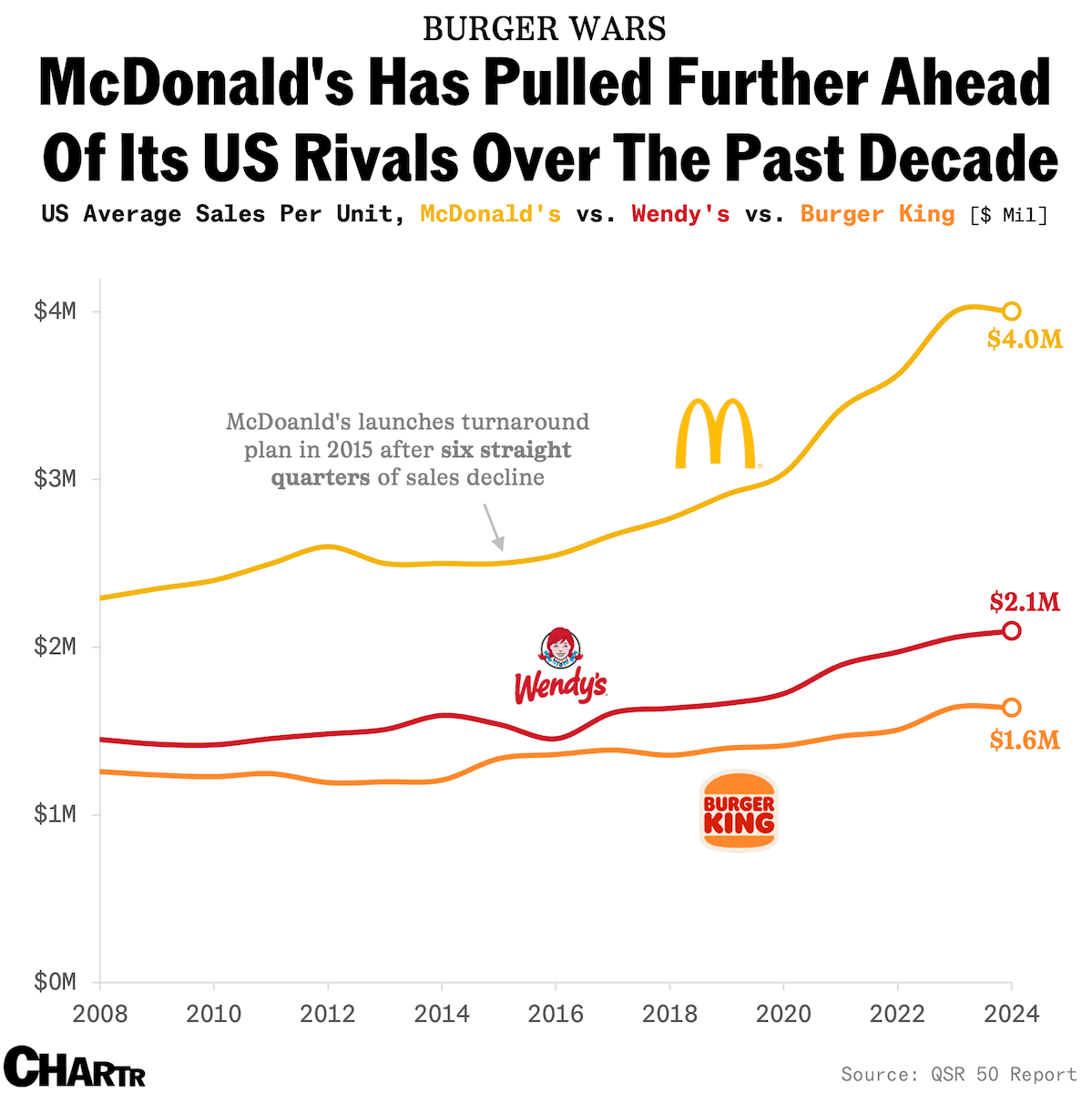
In 2008, the average McDonald’s US restaurant pulled in about $2.3 million in annual sales, roughly 1.8x that of Burger King, according to QSR Magazine. By 2024, that difference had grown to 2.4x, with the typical US McDonald’s store generating more sales than Wendy’s and Burger King’s combined.
Much of that divergence traces back to 2015, when McDonald’s then-CEO Steve Easterbrook launched a turnaround plan following the worst year for sales in decades. The chain simplified its menu and accelerated refranchising, while investing heavily in kiosks, drive-thrus, and a loyalty program that helped build a digital edge over its rivals.
Burger King, meanwhile, spent much of the 2010s struggling with a debt-heavy franchise base, leaving many locations underinvested until its 2022 turnaround plan. Wendy’s faced its own challenges, with its long-standing premium positioning losing price-sensitive customers to McDonald’s.
McDonald’s seems to have scored some smaller wins from the latest burger battle, too. Early Big Arch sales are beating expectations, per the WSJ, and Kempczinski’s social media following has jumped 30% since the video was posted. |
AI models are crying out for new video footage — GoPro has thousands of hours' worth |
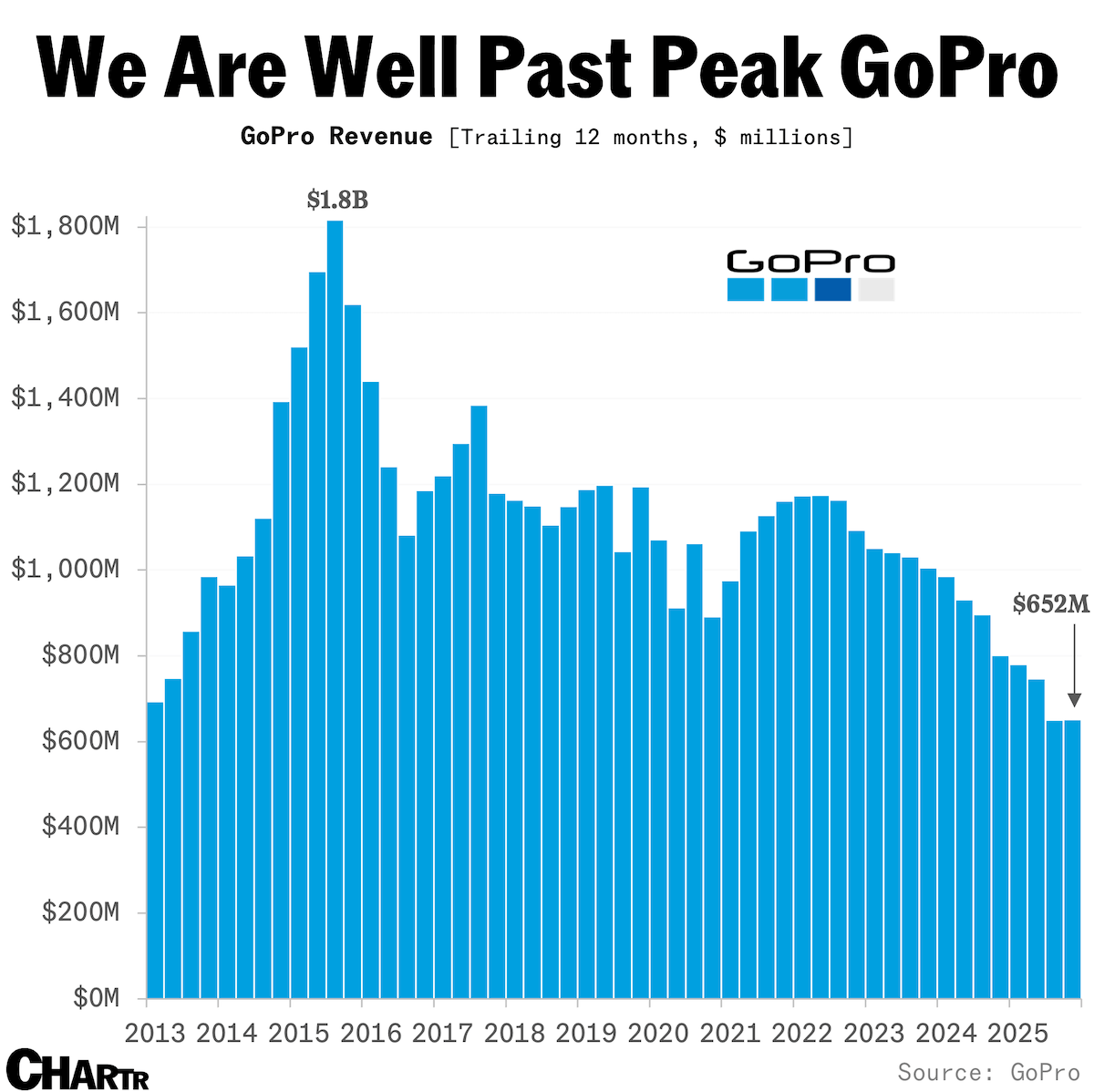
GoPro is dying. The once-iconic company — which provided a way for everyday heroes to film their backflips, waterslides, and sky dives — has seen its share price somersault to a near 99% decline from its 2014 peak.
But could AI turn its fortunes around? The company hopes it might, with executives sharing yesterday that GoPro subscribers had contributed more than 500,000 hours of video content to its AI training program since a test launch in July. GoPro will begin to recognize revenue, which will be split 50:50 with contributing users, from the project in Q1 of this year.
While this might be an attempt to make a business from selling its users’ personal videos to data-hungry AI hyperscalers, desperate to get their hands on unique datasets, any boost to GoPro’s top line can't come soon enough. The flailing action camera brand reported just $652 million in revenue in its latest fiscal year, down another 19% year-over-year. |
In a classic business tragedy where first-mover advantage gets wiped out by fast followers, GoPro lost its grip in the action camera market once cheaper Chinese alternatives from DJI and Insta360 landed, offering eye-grabbing features that were developed using large cash piles from their drone businesses. Waterproof, resilient smartphones didn't help either, and GoPro’s already shaky lead finally toppled after its pricey experiment to expand into drones in 2016 — a market that’s long been dominated by DJI — ended up getting shut down in less than two years due to “margin challenges.”
Still, maybe user videos of ski trips, mountain biking, and family gatherings will be just about enough to spring the camera business back into action. |
|
|
More Americans are doing leisure activities solo |
For some, spending a large part of your free time alone might have previously conjured up the image of a diary-writing singleton, singing “All By Myself” with a bottle of wine and a solitary glass. However, a growing number of people are embracing their independence by doing more things unaccompanied — even activities stereotypically considered to be mainly for couples and groups.
New audience data from the Broadway League found that nearly 20% of Broadway theater tickets in the 2024-25 season were bought by solo attendees, double the rate seen only a few years ago, NPR reported Wednesday. Meanwhile, the party-of-one trend is also being observed across the travel and dining sectors. |
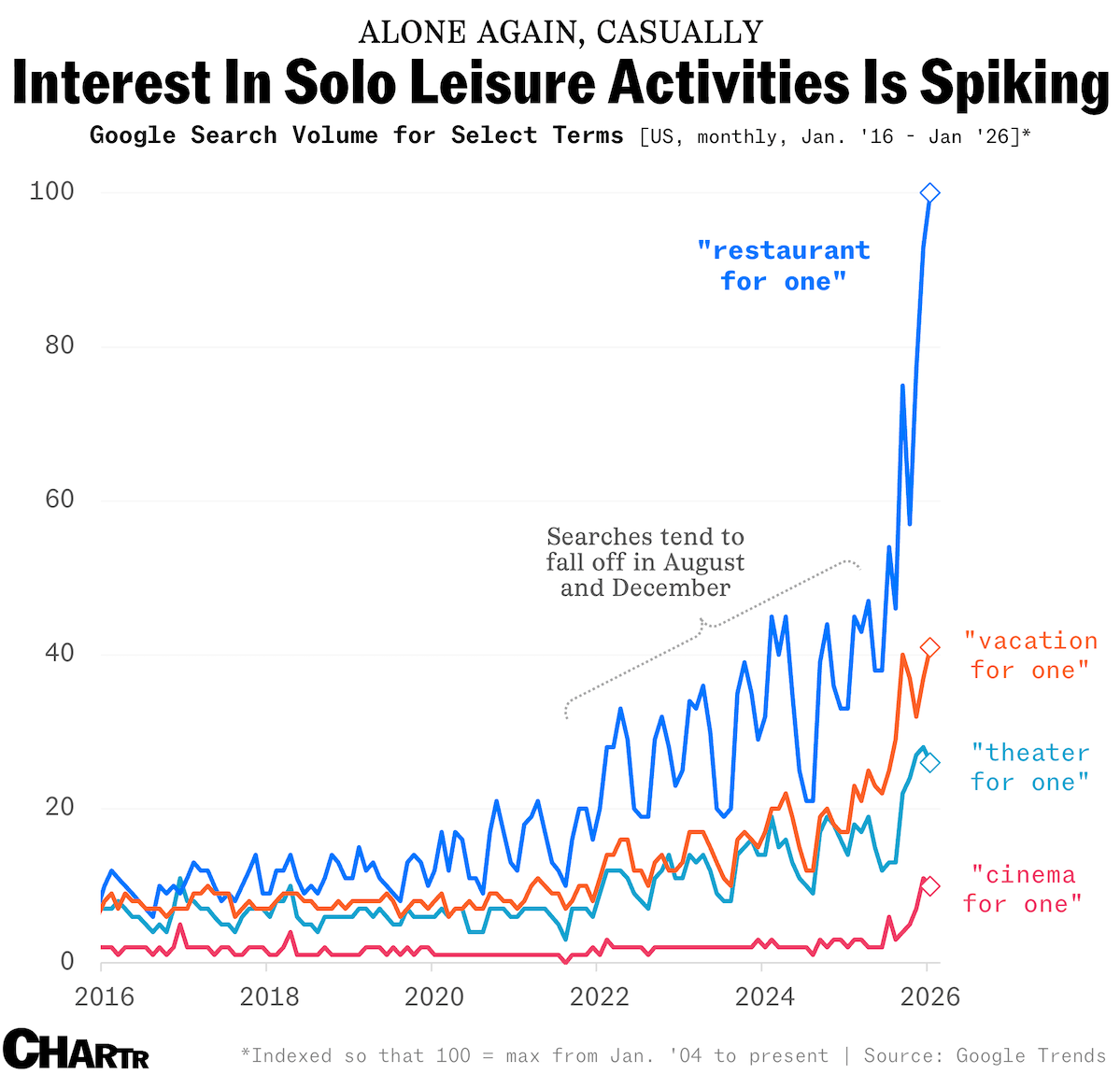
According to Google Trends data, search volumes for “restaurant for one” peaked in the US in January, reaching the highest level seen since 2004. Other search terms related to solo activities also spiked at the beginning of this year, including “vacation for one,” though most queries seem to drop off in the summer months and during the festive period.
Beyond interest online, the shift is already impacting industries. Per Forbes, the US solo travel market was valued at $95 billion in 2024 and is expected to reach over $190 billion by 2030. Along with sit-down meals, eating fast food alone has also surged: a recent report from Yum! Brands, owner of Taco Bell and KFC, found that solo dining orders have risen 52% since 2021, now accounting for nearly half of all quick-service restaurant visits.
With more Americans living alone than ever before, it was perhaps only a matter of time until doing leisure activities solo became more common... particularly since US adults are now spending more than an extra hour per day alone on average than they were in 2010.
|
|
|
-
SoftBank is reportedly seeking a record $40 billion loan to help finance its OpenAI stake… just a few months after a $40 billion investment made it the startup’s biggest backer.
- Net gains: In the week after it officially exited the Warner Bros. bidding battle, Netflix added ~$65 billion in market value.
-
The US labor market unexpectedly lost 92,000 jobs in February — far below the estimated gain of 55,000 jobs, per new BLS data released Friday.
-
New AAA data shows the average price per gallon of gasoline in the US has gone up by 27 cents in the past week due to the ongoing conflict in the Middle East.
-
EBITay: Shares of ticket marketplace StubHub fell ~13% on Thursday after missing earnings expectations, owing to a Taylor Swift-less fourth quarter.
|
|
| - Split screens: Stat Significant explores which movies are the most polarizing based on online ratings.
-
Ahead of International Women’s Day on Sunday, Pew Research Center mapped out the UN member countries that have had a woman leader.
|
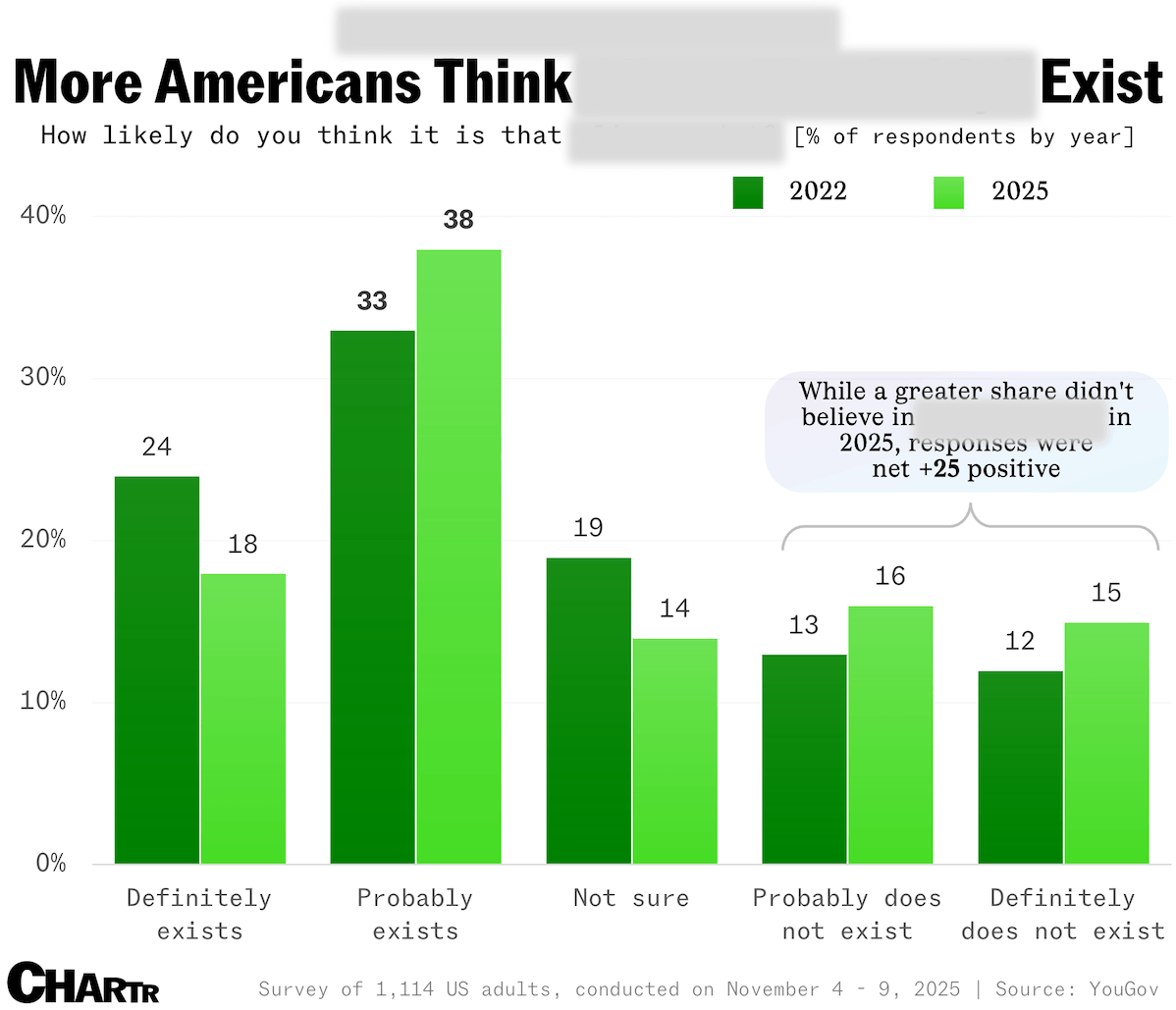
Off the charts: The share of Americans who believe what “probably exists” has risen in recent years? [Answer below]. |
Not a subscriber? Sign up for free below. |
Sherwood Media, LLC produces fresh and unique perspectives on topical financial news and is a fully owned subsidiary of Robinhood Markets, Inc., and any views expressed here do not necessarily reflect the views of any other Robinhood affiliate... See more |
|
|
SHERWOOD MEDIA, LLC, 85 Willow Road, Menlo Park, CA 94025 |
|
|
|